Apple Touts a Staggering $1.4 Trillion App Store Ecosystem
Toggle Dark Mode
Apple has just published another one of its periodic reports highlighting just how much money its App Store ecosystem is responsible for. The numbers are beyond impressive, but there are also some devils dwelling in the details.
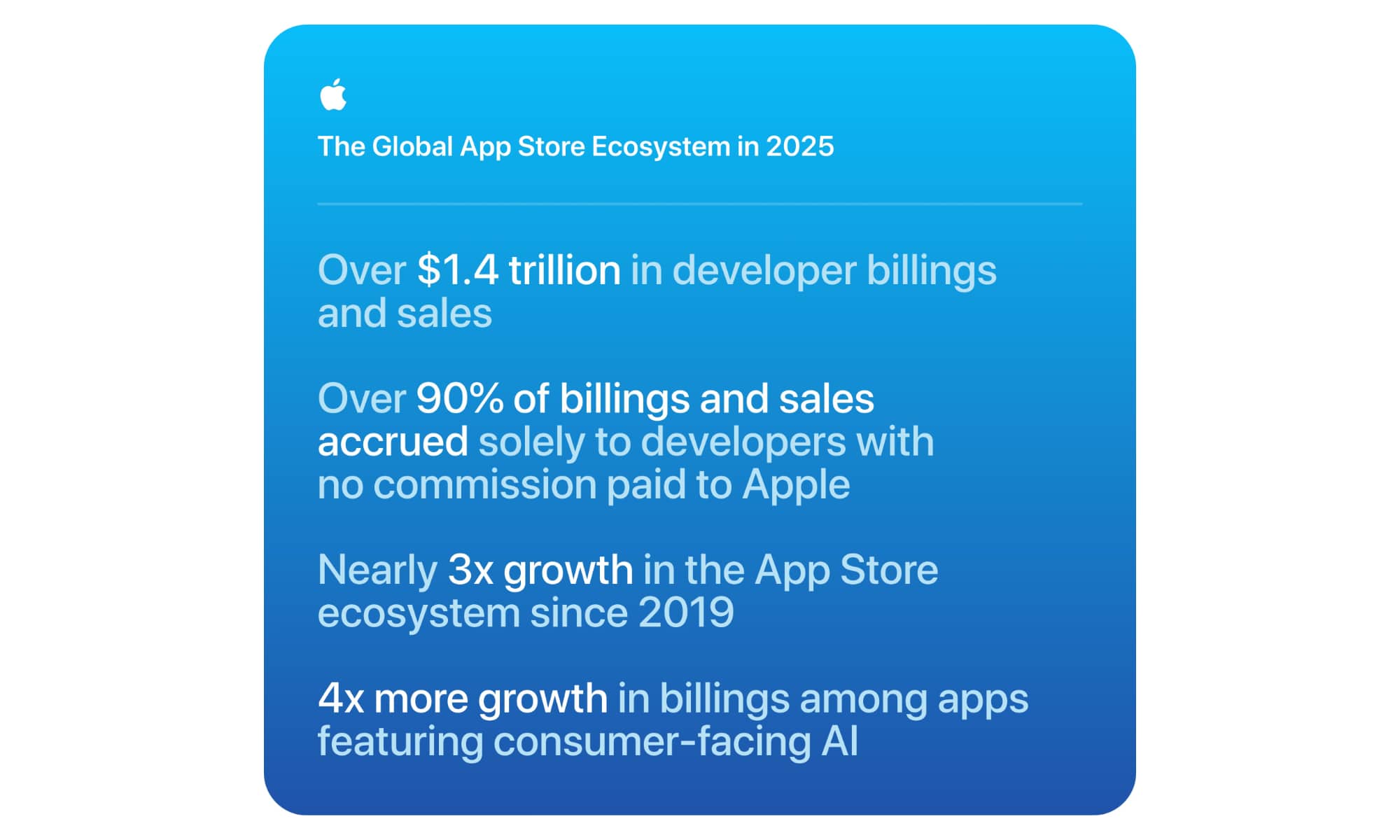
Citing a new study by Analysis Group, Apple announced that the global App Store ecosystem “facilitated over $1.4 trillion in developer billings and sales in 2025.” That’s “trillion” with a “t” — a mind-boggling $1,400 billion.
To be clear, this isn’t what Apple itself made from the App Store. In fact, it’s probably not even close; Apple notes that more than 90 percent of the billings and sales of apps and in-app purchases and subscriptions went straight to developers, with Apple taking no cut at all.
Apple also notes that the App Store ecosystem has nearly tripled since 2019, while adding that consumer-facing AI apps have experienced four times more growth.
In 2025, more than 40 of the top 100 apps on the storefront featured consumer-facing AI capabilities, and those apps saw stronger billing growth than other top 100 apps.
Apple
While Apple is clearly sharing the details of this study — and likely commissioned it in the first place — to show how the App Store remains the best place for developers to sell their apps, it’s still a pretty impressive feat. As with last month’s fraud report, it also shows the kind of scale the App Store operates at — and the numbers don’t lie.
“Developers are the heartbeat of the App Store, and this year’s incredible milestone is a testament to their boundless creativity,” said Tim Cook, Apple’s CEO. “We are deeply committed to providing developers with the tools, technologies, and trusted platforms they need to build for the future. Together, developers are creating apps that enrich the lives of users around the world.”
As with a similar study in 2023, Analysis Group notes that “support for the study was provided by Apple,” but emphasizes that “the conclusions and opinions expressed are exclusively those of the authors” — Jessica Burley, Juliette Caminade, and Markus von Wartburg, all of whom hold Doctorates in Economics. Von Wartburg also served a one-year stint as Chief Economist at Canada’s Competition Bureau — the same agency that could be the next regulator to peer into the App Store’s walled garden.
The App Store’s $1.4 Trillion Illusion
Needless to say, this isn’t a fluff piece. The 20-page report goes into exhaustive detail on the methodologies, and breaks billings and sales into common categories such as general retail, travel, food delivery and pickup, grocery, ride hailing, and even breaks out in-app advertising and the sale of physical goods and services — a category for which Apple has never taken a commission.
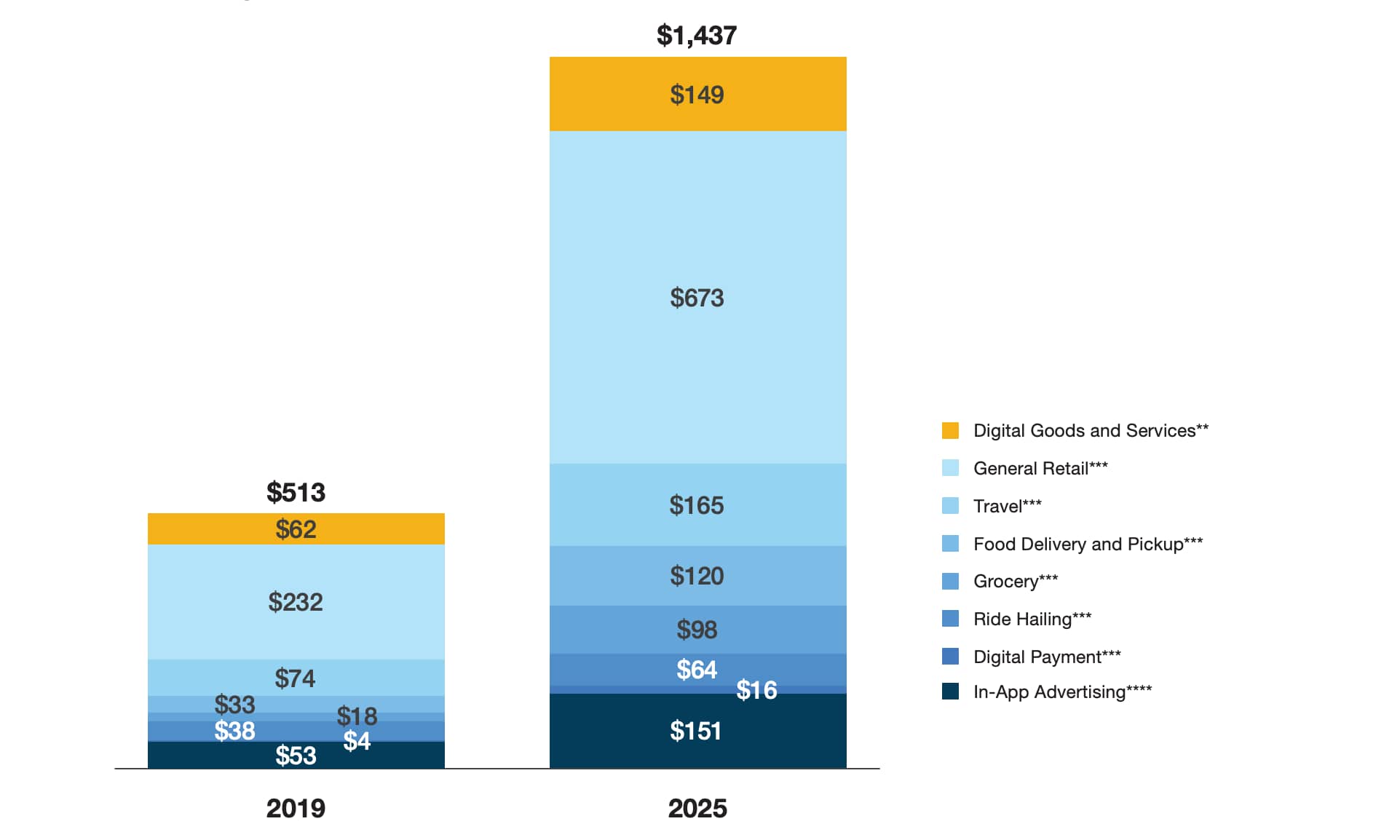
For example, an order placed through the Amazon app, a ride hailed through Uber, or a grocery delivery through Instacart are all completely exempt from Apple’s App Store commission structure. However, this is also where Apple’s boasts become a bit murky.
The trio of economists is merely reporting the facts, but the word “facilitated” is doing a lot of work here.
For example, it’s not wrong to point out that purchases made through the Amazon iPhone app helped drive revenue to Amazon, but it’s more difficult to assess whether those sales would have existed without the app. How many folks would have given up on making a purchase altogether as opposed to simply visiting Amazon’s website on their iPhone or computer?
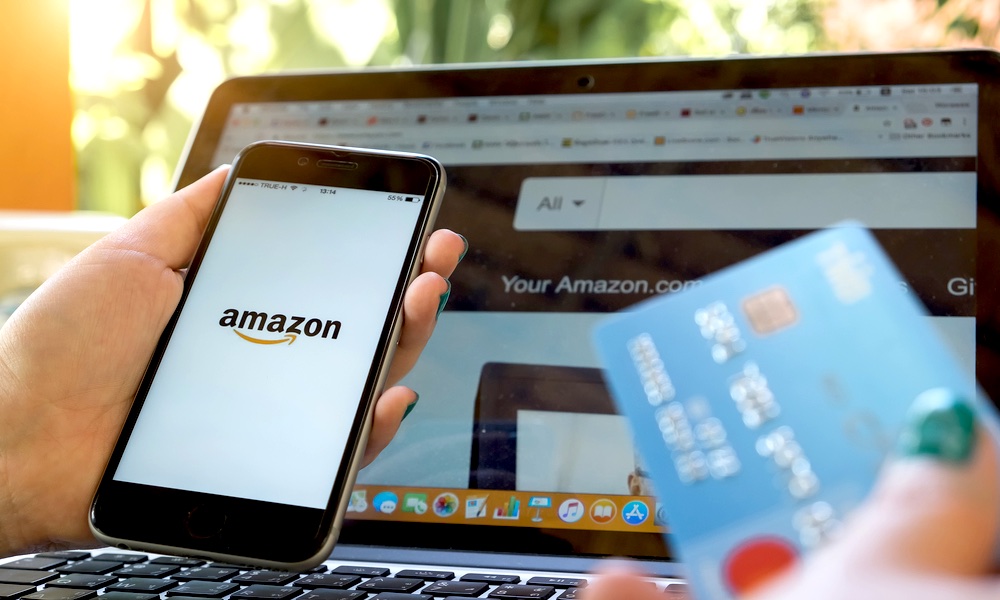
It’s an impossible metric to calculate, and to be clear, nobody is saying outright that the App Store is directly and solely responsible for $1.4 trillion in revenue, although it’s certainly implied by a cursory reading.
Regardless of how much heavy lifting iPhone apps did, the core point still stands that most providers of physical goods are far better off having a mobile app for their customers than not. Providing a pathway for quick and easy purchases — especially impulse buys — definitely benefits retailers, and that’s even more true as consumers spend increasing amounts of time on their mobile devices.
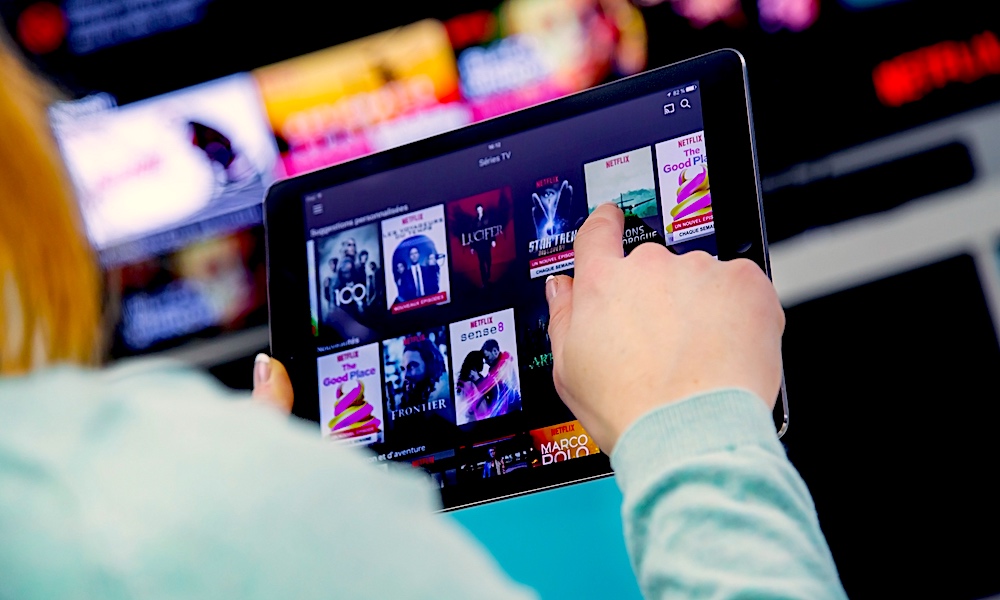
On the flip side, Analysis Group also factors in purchases made outside of the App Store if any portion of them were used through apps available on the App Store. For example, even though it’s impossible to purchase a subscription through the Netflix iPhone or iPad app, it’s fair to say that the App Store ecosystem gets some of the credit for “facilitating” this revenue, on the assumption that Apple device owners might not even subscribe to Netflix if they can’t watch it on their iPhone, iPad, or Apple TV. The same applies to Spotify or even Kindle Books purchased from Amazon and read in the iPhone or iPad Kindle app.
Since Analysis Group can’t actually track how much time people spend in apps, it instead uses a representative statistical analysis to attribute streaming usage to the App Store. For example, it takes the total number of hours users stream Netflix on all smartphone, tablet, and smart TV platforms and divides that by Apple’s iPhone, iPad, and Apple TV market share to determine how much of Netflix’s overall streaming revenue should be attributed to the App Store.
You can read the complete methodology and category breakdowns in the full Analysis Group study, Apple’s Global App Store Ecosystem and Its Growth, 2025.