
Trump Tariff Pressure Pushed Tim Cook into Apple-Intel Chip Deal
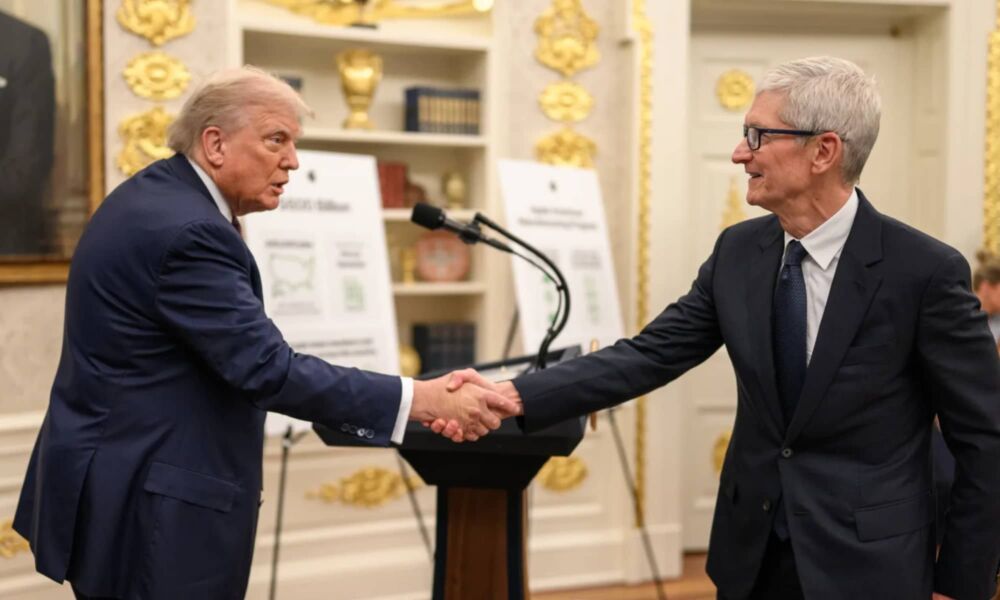 President Donald Trump and Apple CEO Cook meet in the Oval Office in August 2025 [The White House]
Toggle Dark Mode
In August 2025, Tim Cook met with President Donald Trump in Washington to lobby the administration to cancel its proposed 100% tariff on semiconductor imports — a tariff that would have driven costs up across Apple’s entire device lineup had it been enacted.
It was commonly assumed that Apple secured the tariff exemption as a result of its commitment to invest hundreds of billions of dollars into US facilities. The company has pledged $500 billion to US manufacturing earlier in 2025, but added another $100 billion to the pot during the August White House visit.
However, a new report reveals that there may have been even more going on. During the discussions, President Trump and Commerce Secretary Howard Lutnick are said to have pushed Cook to make a deal with US chipmaker Intel to use their fabrication plants to make some of Apple’s chips.
While Intel began courting Apple in 2021, nothing much ever seemed to come of the company’s attempts to offer it chip foundry services for Apple silicon.
That suddenly changed in May 2026, when a deal was reached for the US-based chipmaker to fabricate Apple silicon for future Macs, iPhones, and iPads. The new arrangement reportedly tagged Intel to make some low-end M-Series chips for the Mac lineup, as well as some A-series chips for the iPhone. Oddly enough for such an announcement, at least one industry analyst, Ming-Chi Kuo, even said new chips were already rolling off the line. However, neither Apple nor Intel offered any on-the-record comments.
Although the Trump administration had been showing great interest in Intel, nobody in the press had made an explicit link between the Trump tariff talks and Apple’s deal with Intel. Until now, that is. Last week, The Wall Street Journal reported that Apple faced pressure from the White House to make use of Intel’s chipmaking facilities in the US while the Cupertino company was negotiating relief from the administration’s semiconductor tariffs.
In June 2026, Trump sent Intel shares to record highs when he announced via his Truth Social platform that Apple would begin using Intel-made chips in some of its devices. “We need to design and build our Chips right here in America,” he posted.
According to the WSJ’s source, who is “familiar with the negotiations,” Apple is planning to buy chips to be used on Mac laptops, as well as iPhones. The report does not specify which chips Intel will be fabricating, nor the volume Intel is expected to crank out.
It is believed that the number of chips made by Intel will not be sufficient to ease Apple’s reliance on Taiwan Semiconductor Manufacturing Company (TSMC) for the majority of its chipmaking needs.
Apple once used Intel’s processors in its Mac lineup, but has since gone on to power its entire Mac lineup with M-Series chips, created in-house and fabricated by TSMC, in fabrication plants in both the US and Taiwan. Nothing in this move will see a return to Intel-designed chips; rather the chipmaker will simply be acting as a manufacturing facility for Apple silicon.
The WSJ report points to the deal between Apple and Intel as part of a wider Trump administration effort to improve Intel’s fortunes in the chipmaking industry. The US government has a vested interest in making Intel a going concern once again, thanks to the US government converting $9 billion in federal grants into a 10% equity stake in 2025. That deal made the US government the chipmaker’s largest shareholder.
Intel has made many missteps over the years, while also facing other setbacks. The company’s foundry business posted $10.4 billion in operating losses over its last four fiscal quarters, thanks to outside customers doubting the company’s ability to produce reliable chips at a high volume.
The Trump administration is believed to have put pressure for deals similar to the Apple-Intel pact on other tech firms. Both Nvidia and SpaceX have signed deals since the announcement of the Apple-Intel deal, likely due to a “friendly” nudge from the Trump Presidency.






