
The Prodigal Chipmaker Returns: Apple and Intel Finally Make It Official
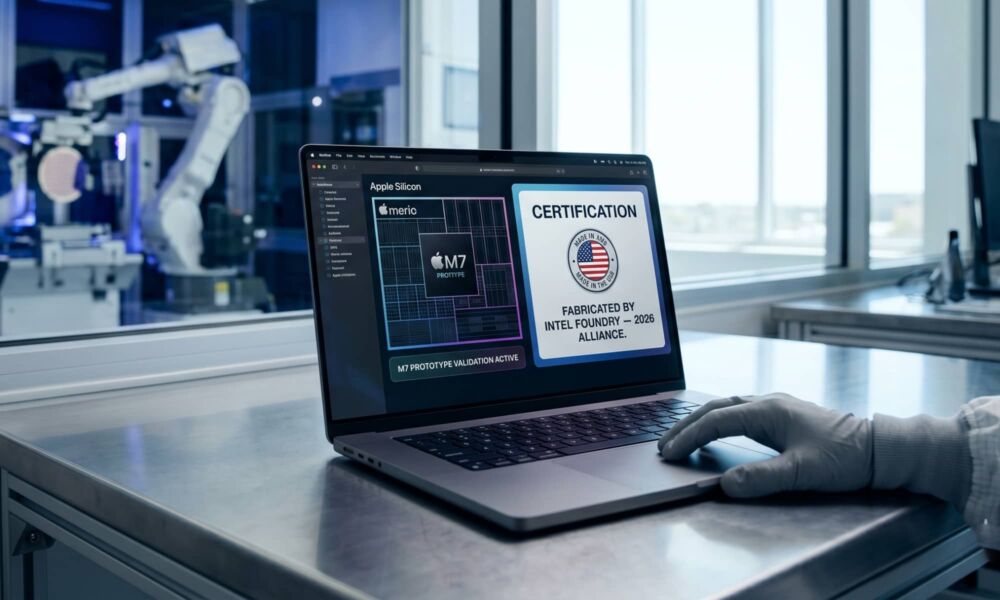 AI-generated concept image [iDrop News / AI]
Toggle Dark Mode
Only days after a report that Apple was in “early-stage talks” with Intel about having the US company fabricate Apple silicon chips, it appears the two companies have already inked a deal.
Last week, Bloomberg reported that Apple was holding discussions with Intel and Samsung about a deal to manufacture A-series and M-series chips. While the Intel deal echoed two reports from late last year when supply chain analyst Ming-Chi Kuo shared that Intel could soon produce low-end M-series chips and Jeff Pu added the possibility of iPhone chips to the mix, the news about Samsung came as more of a surprise.

Perhaps it’s those talks that remain “exploratory,” but it seems the deal with Intel was further along, as The Wall Street Journal (Apple News+) reported on Friday that Apple and Intel have reached a final framework for a deal in the form of a “preliminary chip-making agreement.”
According to the WSJ, the two companies have been in “intensive” talks for more than a year, but it appears that things may have been spurred along by US President Donald Trump, who led the US government to invest $8.9 billion for a 10% stake in Intel last August.
The Trump administration “played a key role in bringing Apple to the table,” the WSJ reports, noting that Commerce Secretary Howard Lutnick has been making the rounds over the past year to encourage several big tech companies to do business with Intel, meeting directly with Apple CEO Tim Cook, Elon Musk on behalf of SpaceX, and Nvidia’s CEO Jensen Huang. President Trump also personally spoke to Cook about making a deal with Intel during their White House meetings, sources told the WSJ.
Investment stakes aside, the goal of the Trump administration is to onshore as much US manufacturing as possible, and even though TSMC has opened several US facilities, it remains a Taiwanese company with its most sophisticated manufacturing still occurring in its home country. There are also concerns about geopolitical stability in play here due to the uneasy relationship between China and Taiwan. Shifting chip production to a US-based firm is a strategic “bank shot” for Apple in that it both satisfies the Trump administration while also diversifying its supply chain for greater stability — and better availability as competitive demand for TSMC’s higher-end nodes increases.
Still, that last one may not be as crucial in the shorter term. The WSJ report doesn’t shed any additional light on specifically what chips Intel will be fabricating for Apple, but it’s TSMC’s highest-end 2nm nodes where Apple has been struggling to get bandwidth from TSMC. Previous reports by Kuo and Pu emphasized that Intel would likely be focusing on the entry-level A-series and M-series chips in the near term, such as the M7 that’s expected to start showing up in the MacBook Pro, MacBook Air, and iPad Pro by late 2027, and the A21 for the 2027 iPhone — assuming it can get started that early.
Most analysts agree that Intel isn’t likely going to be tasked with Apple’s higher-end Pro, Max, and Ultra chips — at least not right away. Apple still has a tight relationship with TSMC, and it’s a proven partner when it comes to manufacturing those more sophisticated chips — even if availability is becoming a problem. Intel might get some of that business eventually, but it’s going to first have to prove its ability to produce satisfactory yields at its US facilities.






