Apple Has a Multi-Million Dollar Plan to Stop Siri from Hallucinating

Toggle Dark Mode
As Apple prepares to pivot to its much more capable Siri AI in iOS 27, it’s reportedly working hard to ensure its voice assistant knows what it’s talking about.
According to The Wall Street Journal (Apple News+), Apple has been pursuing deals with publishers to get legitimate access to their news and information sources so that Siri AI can remain up to date on what’s happening in the world around it.

It’s not pulling any punches here, either. The WSJ notes that Apple has already reached out to several publishers, proposing “multiyear deals” for content access and discussing a possible nine-figure budget.
That’s a stark pivot from the Siri of yesteryear, which generally relied on web searches and common general-knowledge sources like Wikipedia. Even when Apple unveiled Apple Intelligence two years ago in iOS 18, it showed us a Siri that it promised would be very good at knowing the user, thanks to “personal context” capabilities that could read through emails, messages, calendar appointments, and other on-device data, but that needed to rely on external AI extensions like ChatGPT for “world knowledge.”
Of course, nobody expected that would be Apple’s long-term plan, but after Siri’s failure to launch on time in iOS 18 — or even in iOS 26 the following year — many reasonably believed it would remain behind the curve. However, as Apple has already shown us from the very first iOS 27 betas, it hasn’t spared the horses in its efforts to catch up.
That’s not to say that Siri AI won’t have its limitations, but it sounds like many of those are based on guardrails that Apple is intentionally baking in. For instance, executives have already made it clear that Siri won’t be an AI companion. Likely as a result of that, Apple isn’t including the kind of “memory” found in other AI tools like ChatGPT and Gemini, which can carry on threads between conversations.
Siri will be able to learn quite a bit about you from the data on your iPhone, but every conversation will still start fresh. There are pros and cons to that approach, as the lack of memory helps avoid polluting your data with hallucinations when discussing a variety of topics, but it also means you may often have to repeat yourself to establish a baseline. That can be doubly annoying as Siri AI lacks the Custom GPTs or Gems found in ChatGPT and Gemini.
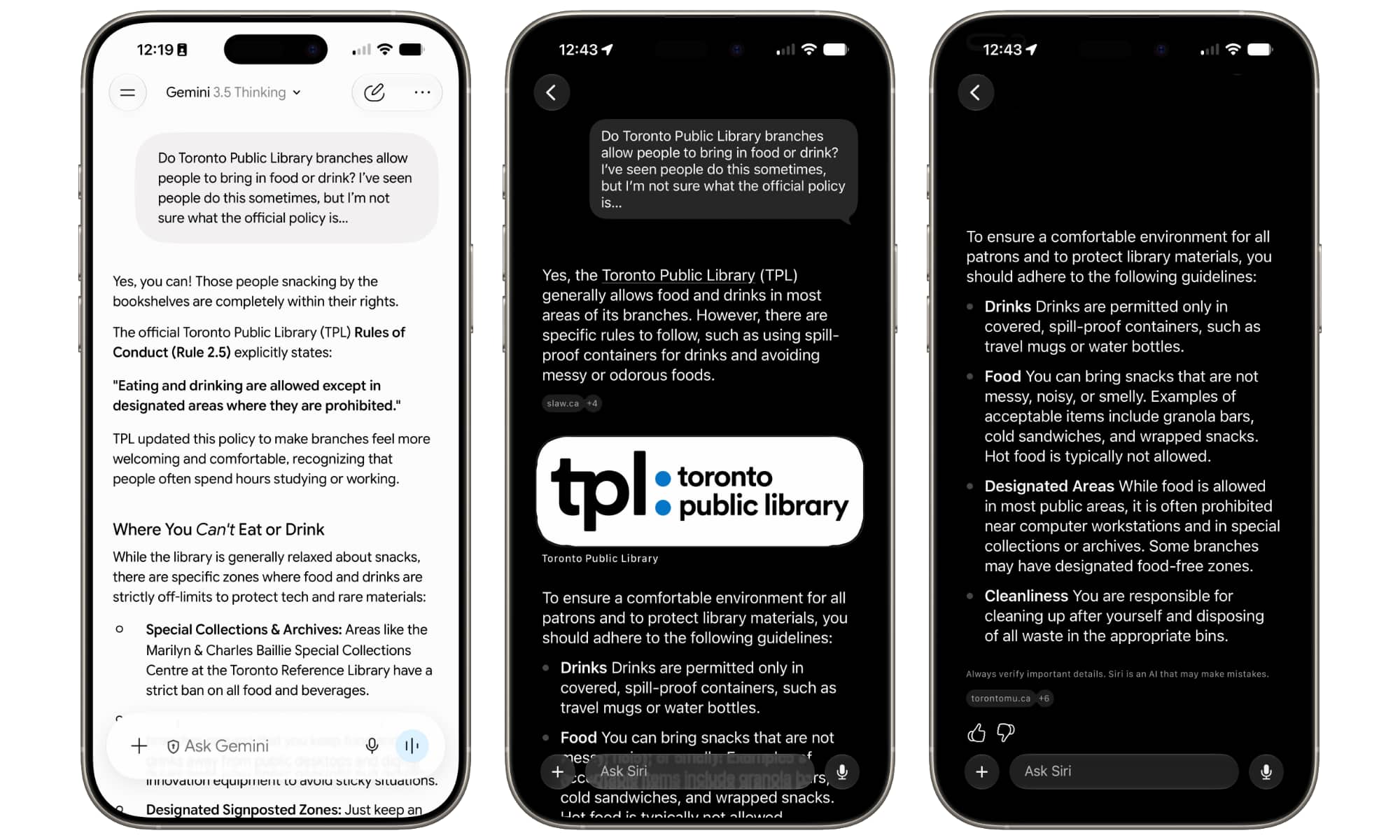
Still, even in beta, Siri AI does a pretty good job of nailing general knowledge questions — even those that cover recent events such as sports and breaking news. However, this data appears to be gleaned from simple web searches, so the responses can be a bit superficial as a result.
Right now, you’re either getting the briefest of summaries or simply blocks of text shared verbatim with a web link — effectively direct citations. That’s the most legitimate way for Siri to operate without running afoul of copyright.
However, Apple isn’t starting from scratch here. The WSJ notes that it has “paid publishers for access to content in earlier deals that included AI training rights,” aligning with a late 2023 report from The New York Times .
Further, while Apple insists that it only uses “licensed data” and “publicly available data collected by [its] web-crawler,” artists and creators have questioned its lack of transparency, and it’s also been accused of training its AI from stolen YouTube videos, alongside other heavyweights like Anthropic, Nvidia, and Salesforce.