The US iPhone 18 Pro Max Is Different from the Rest — Here’s How
Toggle Dark Mode
As expected, Apple’s new trio of fall 2026 iPhone models are now packing its latest 5G modem chip: the C2. At least, most of them are.
It turns out that Apple is still using a Qualcomm 5G modem in one specific model: the US iPhone 18 Pro Max. That distinction was noticed shortly after Apple’s “Surprise and Shine” event earlier this month; when Apple published the spec sheets for the new iPhone 18 Pro models, the “Apple C2 cellular modem” was conspicuously missing from the iPhone 18 Pro Max column on the US product pages.
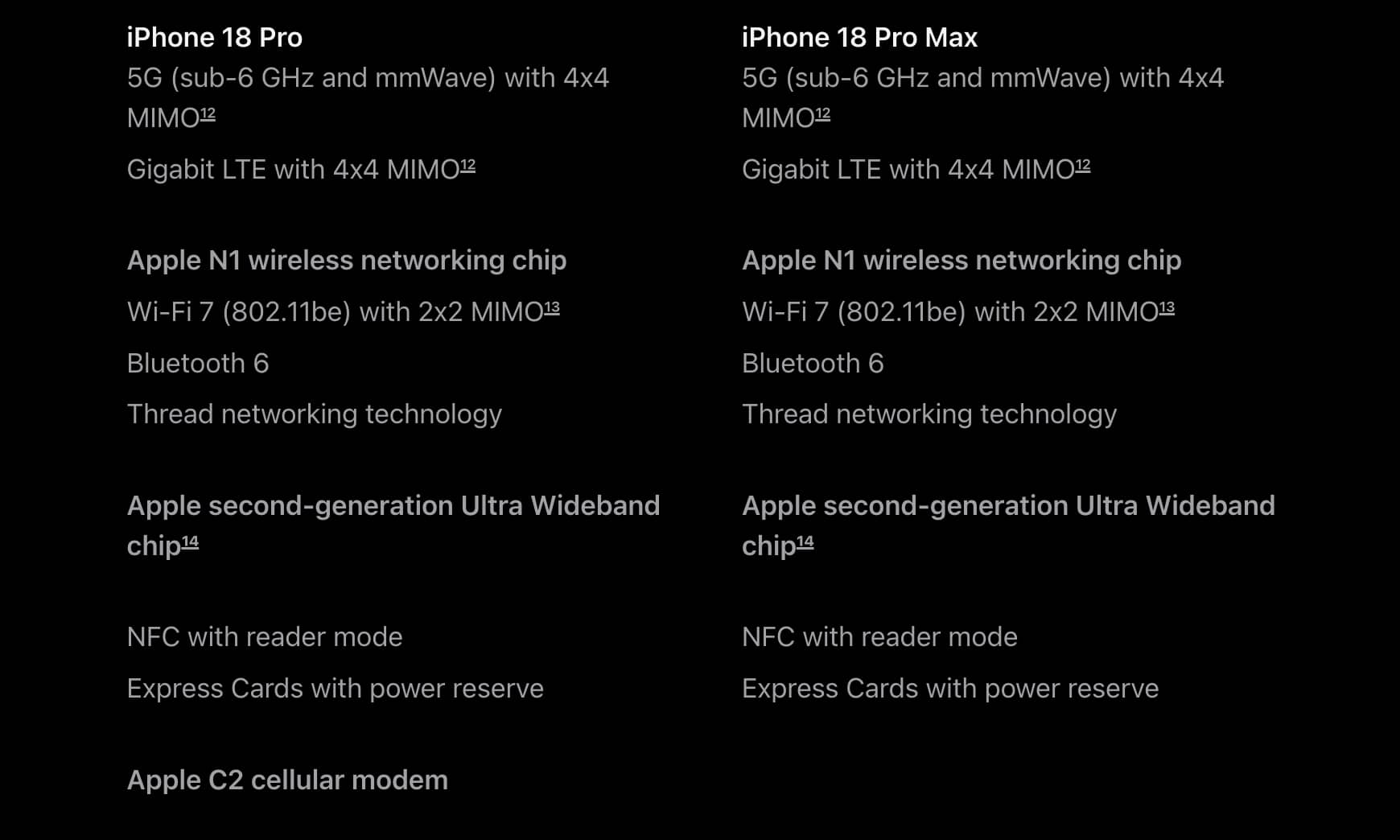
To make matters even stranger, this omission existed exclusively on the US specs pages. Everywhere else the iPhone 18 Pro and iPhone 18 Pro Max are being sold, both models list the C2. That includes places like Canada, Mexico, and Japan, where Apple began selling eSIM-only models with last year’s iPhone 17 lineup.
Apple is continuing that tradition with the iPhone 18 Pro models, but even though these are being sold without a physical SIM slot in Canada, Japan, Mexico, Guam, the US Virgin Islands, and much of the Middle East (Bahrain, Kuwait, Oman, Qatar, Saudi Arabia, and the UAE), Apple still manufactures distinct models for sales in the United States and Puerto Rico. Those are A3472 and A3473 versus A3713 and A3716 for the other eSIM-only countries.
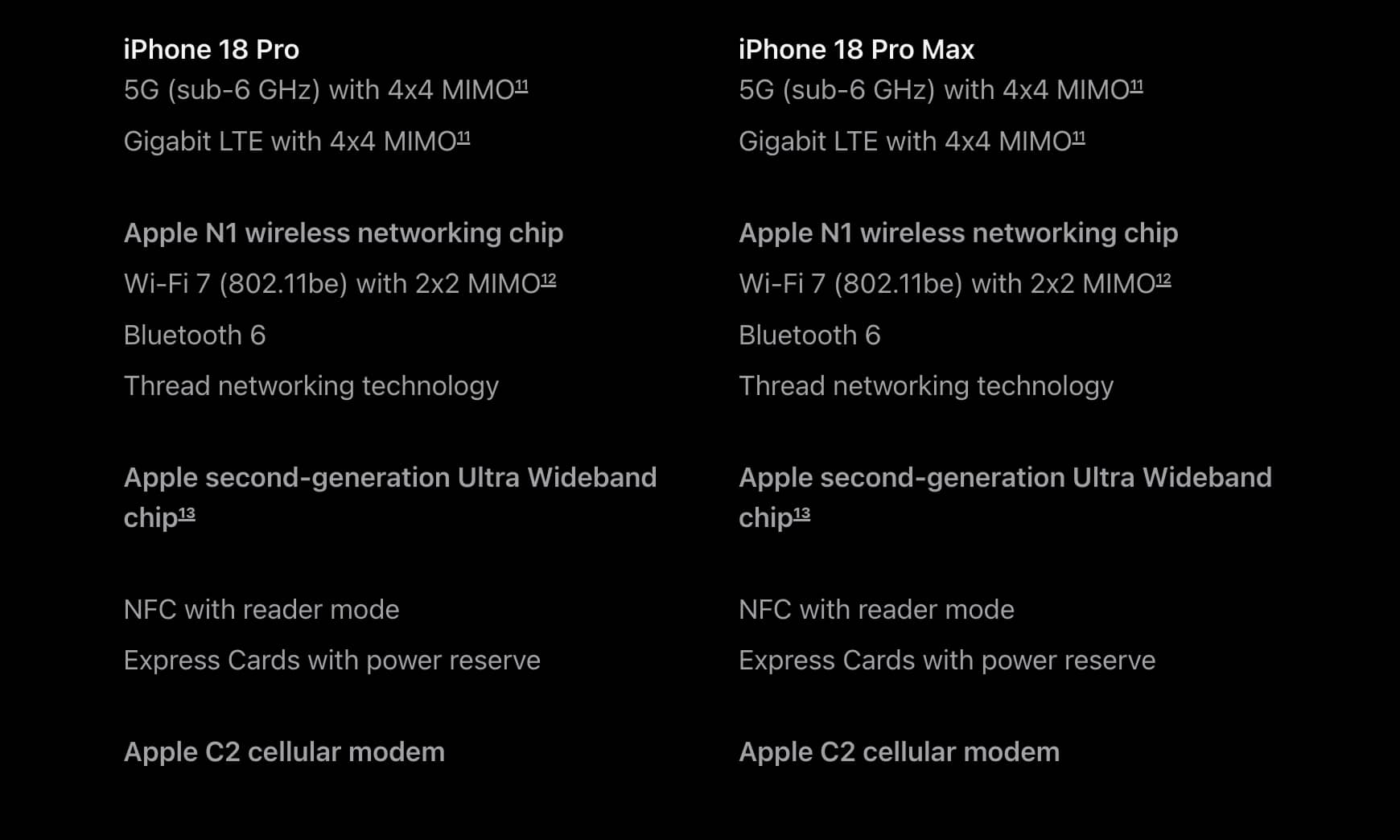
While some initially speculated that this was a typo on the US pages, evidence found in iOS 27 code confirmed that Apple had a different device identifier for the Qualcomm-equipped model — and now a teardown by TechInsights has confirmed precisely which Qualcomm modem we’re looking at: the Snapdragon X80 — the same modem found in last year’s iPhone 17 models.
Under normal circumstances, we’d have expected Apple to go with the Snapdragon X85, which was released in 2025. However, it’s not too surprising that it’s decided to stick with the 2024 model. This is clearly a stopgap at best, and while it’s not entirely clear why Apple left one iPhone model behind, the consensus among analysts and leakers is that the company still had an obligation to purchase at least a few Qualcomm chips as part of the $4.5 billion settlement it made seven years ago, which committed it to using the chipmaker’s 5G modems until at least 2026.
Although Apple may not have been required to put Qualcomm chips into an iPhone — some have theorized that simply purchasing them was all the contract called for — in today’s economy it would have been insane for Apple to waste that kind of money, not to mention the very bad PR optics in the face of its aggressive 2030 carbon-neutral environmental commitments.
The iPhone 18 Pro models are already selling at a base price of $100 more than their predecessors thanks to the rising costs of RAM and flash storage, and that was a much lower price increase than many analysts expected.
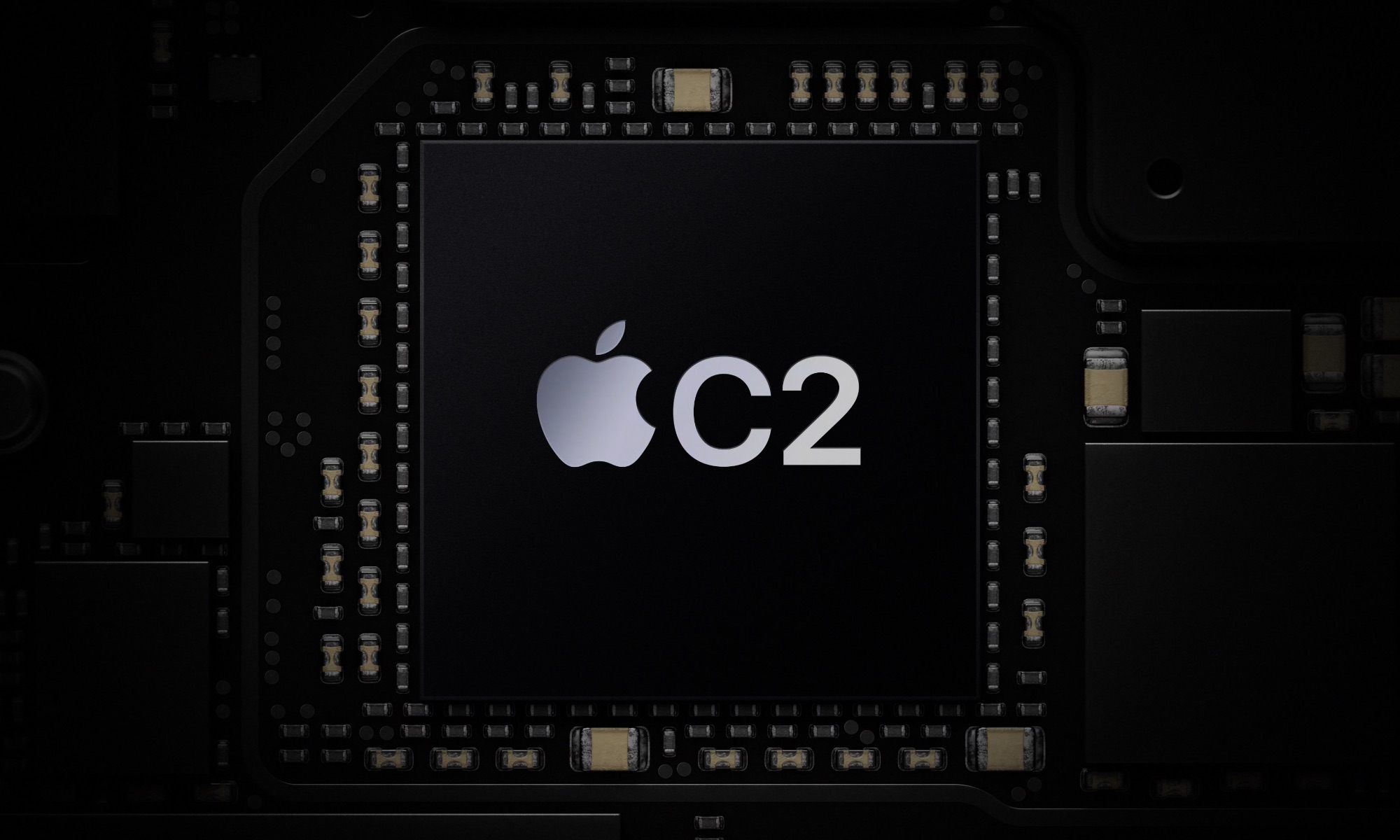
That means Apple has been cutting corners everywhere it can, and if that means using some Qualcomm chips that it has to buy anyway, that’s exactly what it’s going to do. While Apple is promoting its C2 modem as more power-efficient — and it offers a few potential privacy bonuses as well — the X80 is no slouch, and comparisons thus far have shown the iPhone 18 Pro (with the C2) and the iPhone 18 Pro Max (with the X80) offer 5G speeds that are roughly on par.
As John Gruber theorized in his iPhone 18 Pro review at Daring Fireball, Apple likely chose to go with the iPhone 18 Pro Max as the larger battery can offset the higher power requirements of the X80.
As for Apple’s decision to use the X80 in the US iPhone 18 Pro Max versus other countries, I’d imagine that mmWave support may have something to do with that. The US model is still the only one that supports mmWave, which draws more power and can also be notoriously persnickety.
How much time you’ll spend on an mmWave network depends largely on your carrier and the places you hang out; Verizon is still using mmWave in built-up urban cores, as that’s the technology it started with, but you’ll also find mmWave on T-Mobile and AT&T in dense areas like stadiums and airports, as the increased bandwidth can handle connections from thousands of devices at once much better than mid-band or low-band 5G frequencies.
While Apple could have avoided the mmWave power draw factor by pushing the X80 into international models and using its more efficient C2 modem in the US, the other factor is that Qualcomm has been building mmWave chips for nearly a decade while Apple’s C2 is a first-generation mmWave radio.
Market research reports going back to the iPhone 12 Pro Max — the first 5G iPhone generation — have consistently shown that users of Apple’s largest and priciest flagship care more about network performance, so it makes sense to keep the battle-tested Qualcomm silicon in Apple’s most demanding iPhone 18 Pro Max model while letting the smaller iPhone 18 Pro serve as a proving ground for the new cellular radios.