Siri Isn’t Gemini: Inside Apple’s New Third-Gen AI Models

Toggle Dark Mode
Ever since Apple announced its landmark AI partnership with Google in January, there’s been some confusion that the iPhone would simply be getting a port of Google’s Gemini AI assistant in lieu of Apple’s failed attempts to improve Siri.
Those concerns have ramped up over the past few days following Apple’s unveiling of Siri AI at last week’s Worldwide Developers Conference (WWDC), likely because Siri is once again in the spotlight — and it’s working surprisingly well.

It’s hard to believe after years of disappointment with Apple’s lackluster voice assistant, but the company really has pulled it off. The new Siri AI isn’t perfect yet, but it’s at a surprisingly advanced stage for its debut in developer beta 1, and even though Apple needed some help from Google to get there, what we’re seeing is pure Apple, without any of Gemini’s code or AI agents in the mix.
As I explained in January, Google is merely providing the frameworks and the foundation: the science behind the AI, if you will. The result is something called Apple Foundation Models (AFM), a set of AI models that were built entirely independently of Gemini or any other models.
While Google helped build these models, they were designed from scratch entirely to Apple’s specifications. That arguably makes them cousins of Gemini — they share some of the same DNA — but they’re not even close to a direct port.
Apple explains this in a paper on its Machine Learning Research site:
At the heart of this architecture is our third generation of Apple Foundation Models (AFM), a family of five foundation models custom-built in collaboration with Google. These span from on-device models to server-based models running on Private Cloud Compute.
The “third-generation” reference emphasizes that the new models follow in the footsteps of two prior generations: the AFM v1 models that appeared as part of Apple Intelligence in iOS 18, and a more advanced multilingual second-generation set that was baked into Apple Intelligence in iOS 26, but also hit a wall.
Apple Controls All the Pieces
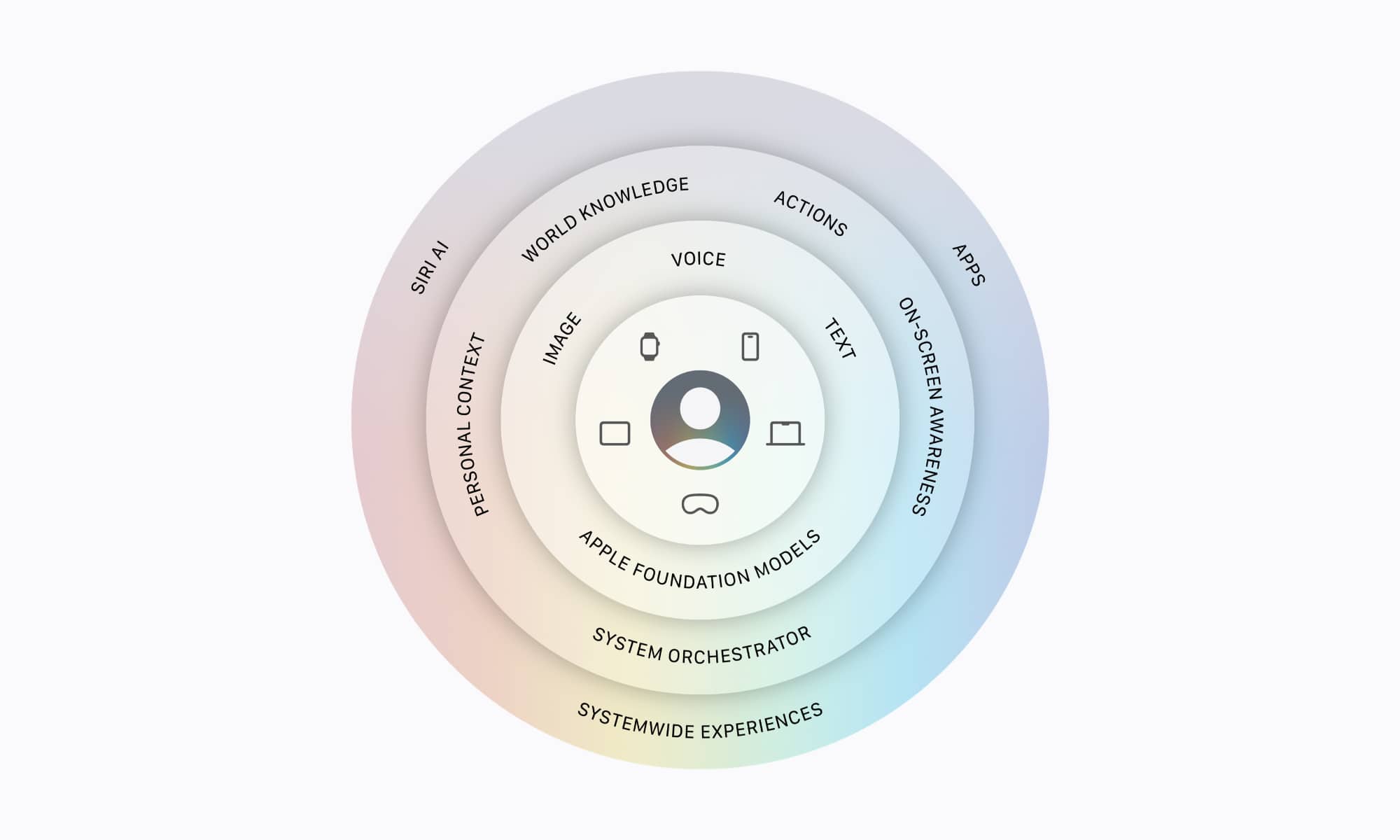
The new set coming as part of iOS 27 and the rest of this year’s OS updates includes two on-device models: AFM 3 Core, a 3-billion-parameter model that will run on Apple Intelligence-capable devices with 8 GB of RAM, and the 20-billion-parameter AFM 3 Core Advanced, which requires 12 GB of RAM and will therefore be limited to the iPhone 17 Pro, iPhone 17 Pro Max, iPhone Air, and M3-powered Macs and M4-powered iPads with 12 GB of memory.
The other three Apple Foundation Models are server-based, and include a standard AFM 3 Cloud for most workflows, ADM 3 Cloud that will power the new photo-editing tool and Image Playground in iOS 27, and AFM 3 Cloud Pro that powers agentic tools and handles more complex reasoning.
Interestingly, Apple’s paper also provides more context around how Apple’s Private Cloud Compute (PCC) infrastructure will be deployed. While several reports over the past few months have pointed to PCC running on Nvidia chips in Google Cloud servers, this will actually only apply to tasks handled by the AFM 3 Cloud Pro model. AFM 3 Cloud and ADM 3 Cloud are still “purpose-built for Apple silicon,” and will presumably continue running on the same server-side infrastructure Apple outlined in 2024, undoubtedly beefed up with the latest high-end Apple silicon.
Apple also released a security research paper last week that outlines how it plans to expand Private Cloud Compute beyond Apple’s data centers while still ensuring it upholds the same privacy standards it committed to two years ago:
Our core PCC requirements remain exactly the same: stateless computation, enforceable guarantees, no privileged runtime access, non-targetability, and verifiable transparency. What’s new with PCC on Google Cloud is the implementation: NVIDIA Confidential Computing with NVIDIA GPUs, Intel CPUs with TDX, and Google’s Titan chip.
Apple’s in-house PCC servers were designed from the ground up to be hardened against outside attacks while using end-to-end encryption, partitioning off memory, and lacking any kind of persistent storage. This would ensure that your AI prompts and related data could only be read by the PCC server it was directed at, while being immediately discarded as soon as the necessary answers were generated.
The PCC nodes themselves also used Secure Boot and Code Signing technologies tied into the same kind of Secure Enclave that powers Apple Pay cards and biometrics on your iPhone to ensure safe storage of encryption keys. Each PCC node has a unique encryption key baked into the Secure Enclave at a hardware level, ensuring that only that node can ever decrypt requests submitted to it.
It turns out that Nvidia has built some similar technologies into its Confidential Computing, but Apple has built even more security on top of these, with full audits of its Google Cloud-based PCC servers to ensure that every component “from firmware through the host and guest OS stacks to application code” is treated as part of the trusted computing base.
As with its own PCC servers, Apple is using a hardened supply chain where it insists that all Google Cloud hardware that’s part of its “PCC fleet” be cryptographically verified to ensure that nothing has been tampered with before it’s put into production.
“Together, these capabilities help ensure that even outside of Apple’s hardware and data centers, user data will continue to be protected by the full force of PCC’s extraordinary security and privacy properties,” Apple notes, adding that Apple retains full control over the PCC software stack, and “Apple devices will only trust PCC software that is cryptographically approved by Apple.”
Apple is still rolling out “PCC on Google Cloud” over the summer, while iOS 27 and the rest of its updates remain in beta. However, this only affects the most sophisticated server-side model, which likely won’t be used all that often at this stage. Meanwhile, the other two Apple Foundation Models are already up and running on Apple silicon PCC servers in Apple’s own data centers.