Apple’s New Upgrade Program Might Come With a Digital Repo Man
Toggle Dark Mode
Following a report yesterday that Apple is poised to introduce a new hardware upgrade program, some code sleuths have now found hints in the latest iOS 27 betas showing how Apple might enforce this new leasing arrangement.
To recap, sources speaking to Bloomberg’s Mark Gurman revealed that Apple is preparing to unveil a new “Apple Upgrade” program on July 28 that will replace the legacy iPhone Upgrade Program, extending hardware leasing options to encompass a wider range of products, including the Mac, iPad, and Apple Watch.

The new program comes after a late 2024 report that Apple had shelved the idea. However, that was widely expected to be an entirely in-house financing arrangement. By contrast, the new “Apple Upgrade” program is expected to be done in partnership with BNPL service Klarna.
As the name suggests, the program will allow Apple fans to upgrade their devices on a more frequent schedule, but it’s not without its downsides. For one, it’s leasing, not financing. That means you’ll either have to be willing to make a balloon payment at the end to cover the residual, or you’ll be pushed into upgrading every year or two.
Of course, that latter scenario is exactly what Apple wants — to get you to buy more stuff. The fact that the company is also reportedly planning to nix all of its standard financing services should be a clear hint that this is about keeping folks on the upgrade treadmill.
Leases would reportedly run 24 months for an iPhone or Apple Watch, or 36 months for a Mac or iPad, at which point you’d have to buy out your device or trade it in for a new lease, much like a car. There will also be an option for early upgrades, since of course Apple would be delighted to have you buy a new device even more frequently, although the specifics of additional fees for that are unclear at this point.
To add an extra wrinkle, the new Apple Upgrade program is expected to differ from the iPhone Upgrade Program in that it won’t include AppleCare+. Customers will have to buy that separately if they want it, but much like comprehensive insurance coverage and lease end protection (LEP) plans for vehicles, it’s something that should be factored into the leasing costs.
The Repo Man Cometh
However, there’s another interesting catch here beyond the mere financial trap: Apple also may be planning to put a digital leash on devices handed out as part of this program.
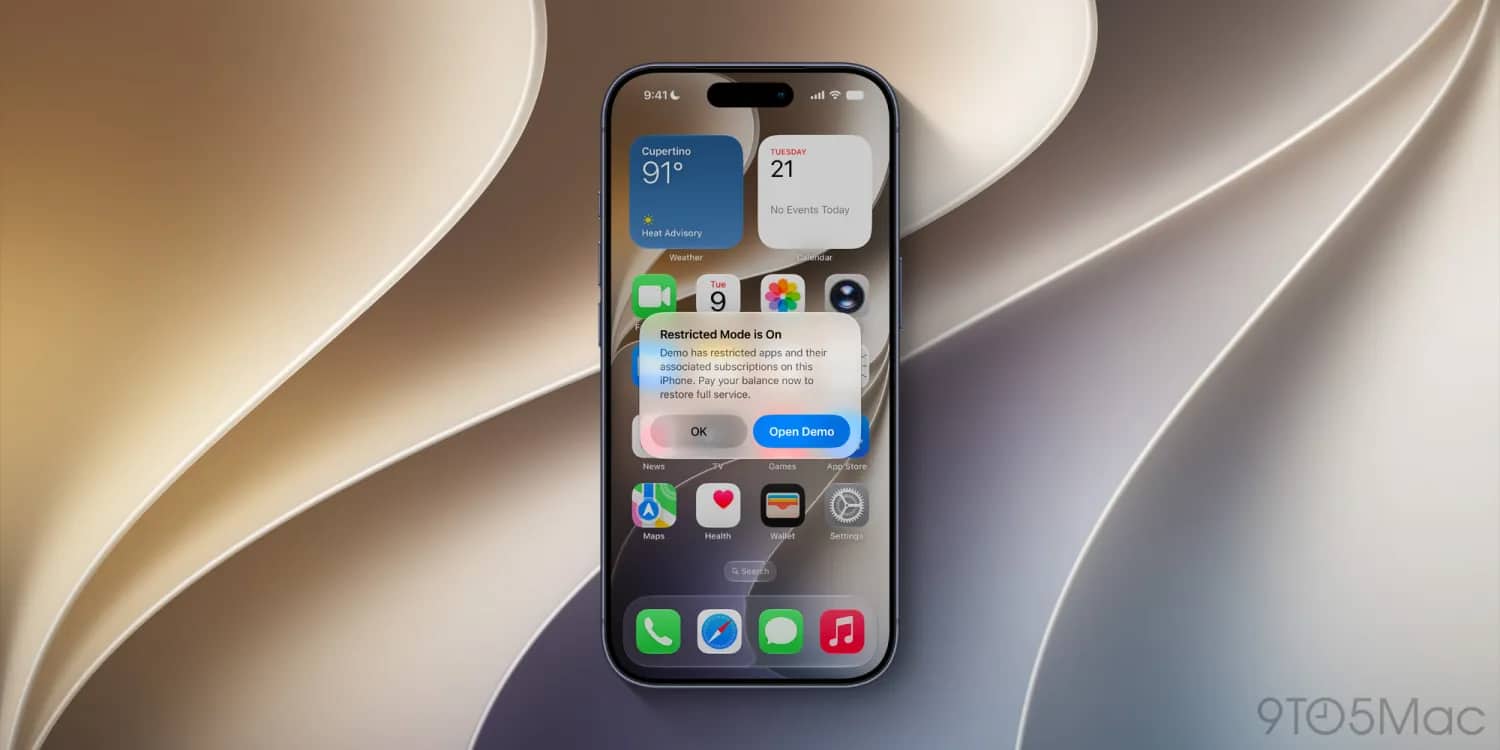
The folks at 9to5Mac have found code in the latest iOS 27 beta that “appears to reveal a broader system for managing a financed iPhone.”
The code describes a system called App Managed Features, which allows an authorized financing or provider app to enroll an iPhone and perform ongoing status checks.
Marcus Mendes, 9to5Mac
The code appears to be very specific to financing, in contrast to the mobile device management (MDM) technologies that have already been around for years, and it’s designed to lock down key parts of an iPhone should the owner start missing payments.
It appears the new “Restricted Mode” would block access to most apps — including nearly all third-party apps — until a contract or payment issue is resolved. A specific list of exceptions would ensure some basic, critical functionality is still available, such as allowing phone calls and access to health data, settings, wallet cards, and passwords.
Specifically, there’s an allowlist that includes Accessibility Reader, App Store, Clock, Health, Magnifier, Passwords, Phone, Settings, and Wallet, leaving the apps accessible even when Restricted Mode is enabled. Apps that can send critical alerts may also remain accessible for safety reasons, such as Messages, Home, and medical and safety apps.
The code doesn’t include any specific rules for when the new “Restricted Mode” would be triggered, such as a specific number of missed payments. It’s more likely it would respond to a command from the mothership to lock down an iPhone, much the same way Apple’s Find My features work today.
In fact, the new frameworks exist within Find My, although Mendes makes it clear that this doesn’t give the financing partner access to the device’s location. It merely uses the same frameworks for features like Activation Lock to create a new “Partner Finance Lock” that ensures a leased device can be turned into a complete brick — and a collection of smaller bricks, since the parts themselves will also be locked.
As invasive as this sounds, it appears to be intended solely for leased devices, and will likely have some checks and balances to ensure it can’t be activated unless an iPhone owner opts in — which they’d undoubtedly be required to do when leasing a new iPhone under the Apple Upgrade program. There’d presumably also be a process to clear the partner financing link if the customer decides to buy the iPhone out and keep it, effectively transferring ownership from the leasing company to the end user.
There’s no word yet on whether this will be limited to the iPhone, but it seems likely Apple is cooking up similar frameworks for iPadOS 27, macOS 27 Golden Gate, and its other software updates. Mendes notes that there’s no sign of similar code in the iOS 26.6 release candidate that came out earlier this week, but Apple could still sneak it into the final release. Alternatively, it’s possible the Apple Upgrade program may be delayed, or that Apple may not launch the partner financing lockdown features until this fall.
[The information provided in this article has NOT been confirmed by Apple and may be speculation. Provided details may not be factual. Take all rumors, tech or otherwise, with a grain of salt.]