
The Foldable iPhone Won’t Have a Stylus (But Apple Tested One)
Toggle Dark Mode
Next week is expected to herald the culmination of a litany of rumors that we’ve been hearing for seven years when Apple finally takes the wraps off its foldable iPhone. While we already have a pretty good idea of what to expect, there’s one smaller niggling question that’s never been fully addressed: Will it have a stylus?
Whatever the foldable iPhone is ultimately called — bets have run the gamut from “iPhone Fold” to “iPhone Ultra,” but we’re expecting Apple to surprise us — the answer to the pencil question appears to be a flat “no.” However, that doesn’t mean Apple didn’t at least consider it.

At least that’s what Bloomberg’s Mark Gurman has heard from his oft-reliable insider sources. In this week’s Power On newsletter, Gurman sets the stage by telling us not to expect a stylus, both based on what he’s heard and Apple’s general philosophy about such things, but he also adds that Apple explored the idea, going so far as to create a prototype.
While Apple’s rivals such as Samsung and Motorola have long leaned into styluses for their smartphones, Apple has patently refused to go there. When Steve Jobs unveiled the original iPhone in 2007, he was doing so in a world where hardware keyboards and styluses were commonplace. His vision for the iPhone was completely different. Apple effectively pioneered the touchscreen keyboard, negating the need for the classic binary choice between a BlackBerry-style clunky mechanical keyboard with a tiny screen and a Palm-style pen-based input.
Jobs also made it clear this wasn’t just a personal whim. During the very introduction of the iPhone at Macworld 2007, he flat-out pilloried the very notion of a stylus.
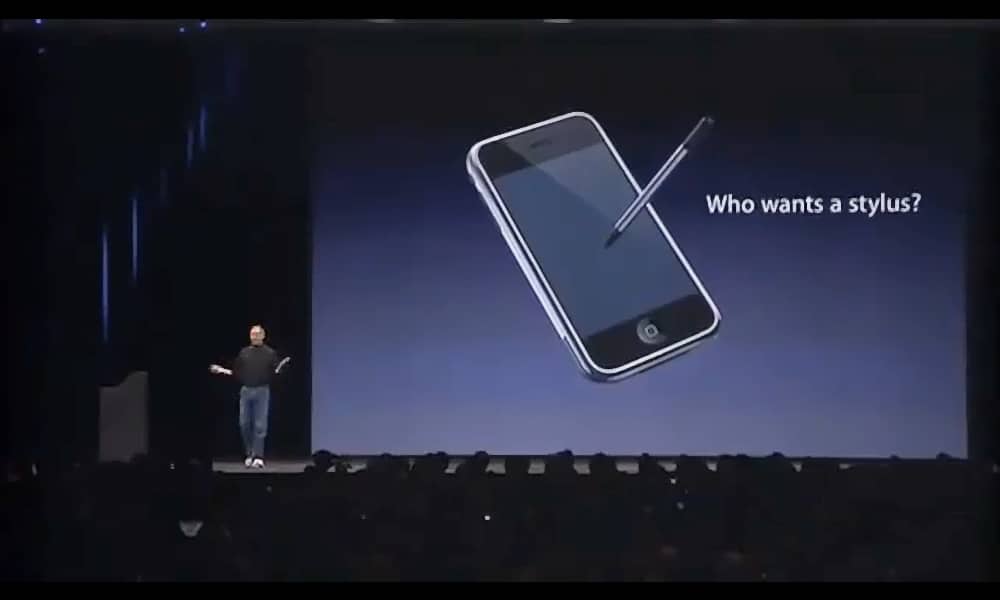
Oh, a stylus, right? We’re going to use a stylus. No. Who wants a stylus? You have to get them and put them away and you lose them. Yuck. Nobody wants a stylus. So let’s not use a stylus.
Steve Jobs
One can argue that Apple hasn’t completely stood its ground on this philosophy, as the iPad Pro got the Apple Pencil in 2015. However, that was a stylus for a 12.9-inch canvas, and it was originally designed as a tool for digital artists, not a simple text input method. Apple eventually added handwriting recognition, but that’s always been treated as secondary to the Apple Pencil’s true purpose.
Still, the Apple Pencil eventually came to all iPad models, including the 2019 fifth-generation iPad mini with its 7.9-inch display. However, despite several rumors of compatibility, stylus support never came to the iPhone. Although plenty of third-party companies made styluses, those were little more than glorified fingers.
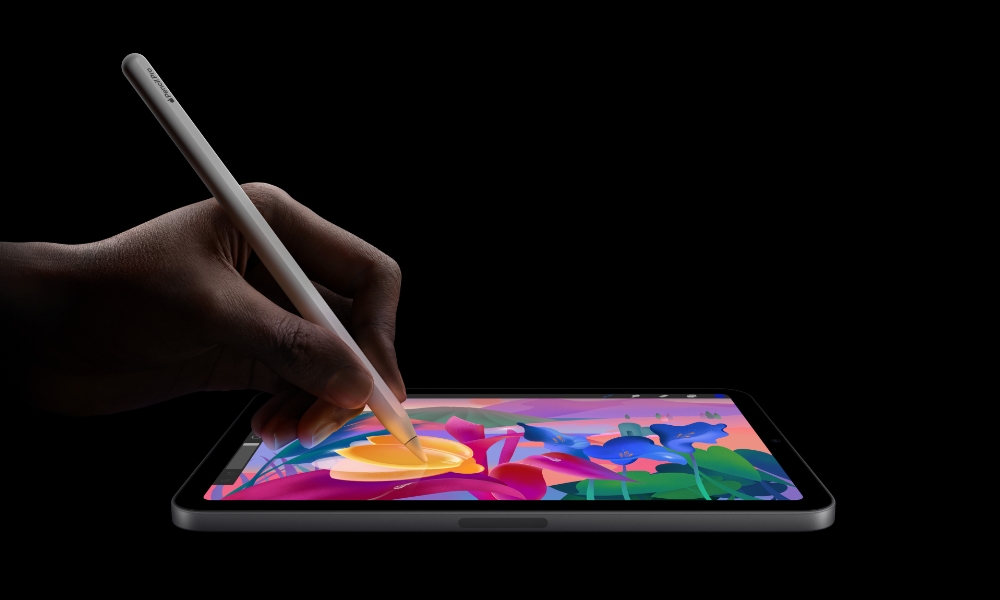
Because the foldable iPhone is likely to have a similarly sized display when open, it raised the question of whether Apple might consider a stylus for this hybrid device.
Well, apparently the company did. Gurman says that Apple “internally prototyped, tested and considered launching an Apple Pencil for the foldable iPhone.” However, it reportedly abandoned the idea for several reasons.
The prototype stylus was smaller than the Apple Pencil we’ve all come to know and love, which made sense considering it would need to fit comfortably alongside the iPhone. Gurman says it was “stubbier … to align with the unique height of the device,” and would attach magnetically to the side for storage and charging, much like the current Apple Pencil works with most iPad models.
The real problem is that the solution was clunky, and Apple abhors inelegant hardware designs. Storing the pencil was still awkward, especially if you didn’t plan to use it. Further, foldable displays, which are softer and more flexible by necessity, aren’t well-suited to being poked at with a stylus.
Certainly Jobs’ objections of two decades ago might not apply to a device where the stylus remains a secondary tool. However, it’s also fair to say that, unlike the iPad, the foldable iPhone isn’t expected to be a canvas for creatives. The Apple Pencil as we know it today is still very much focused on artistry, with features like squeeze and barrel roll gestures to select and control a palette of drawing tools.
On an iPhone, it really does become more of a note-taking and markup tool, and while those are undeniably useful applications, it’s an open question as to how much demand there is for them. After all, even Samsung has ditched support for its S Pen on recent Galaxy Z Fold models to focus on making improvements in other areas.
So, don’t expect a stylus for this year’s foldable iPhone, and we also wouldn’t put odds on this happening anytime soon, but we’ve also learned to never say never when it comes to Apple. After all, both Steve Jobs and Tim Cook also once dismissed the idea of a touchscreen MacBook, and by all reports one of those is just around the corner.
[The information provided in this article has NOT been confirmed by Apple and may be speculation. Provided details may not be factual. Take all rumors, tech or otherwise, with a grain of salt.]






