Apple’s New HomeView Is a Glue-Stuffed Nightmare to Repair
 iFixit
Toggle Dark Mode
If you’re thinking about picking up Apple’s new HomeView — or already have one sitting in your living room — we’d strongly recommend opting for AppleCare+, as trying to get it repaired any other way will be an exercise in frustration for either your wallet or your fingers.
First off, while Apple sells the HomeView for $299, the out-of-warranty repair cost is $279 — only $20 less than buying a whole new smart hub. On the other hand, you can purchase AppleCare+ for only $2.49 monthly or $24.99 per year, which lowers that to a flat $39.
That shouldn’t come as too much of a surprise, since it’s a similar story with all of Apple’s HomePod speakers, and the HomeView is clearly in the same category, despite its screen.
Unlike an iPhone, iPad, or Mac, there are no distinct categories for service costs. Whether you break the screen or the internal speaker dies, it’s all classified as “Other damage” with a fixed cost.
Following a recent teardown by the folks at iFixit, it’s easy to guess why that is. Apple doesn’t likely try to fix a broken HomeView — it simply swaps it out for a replacement and tosses the broken one in the recycling bin. It’s pretty clear the new smart display was never designed to be fixed.
While we’ve seen the same with AirPods over the years, it at least feels like there’s some small justification for Apple making those so impossible to repair. With AirPods, Apple is cramming a lot of technology into a pretty tiny space, so there’s not a lot of room for seams and screws. It’s all sealed shut with glue.
However, it turns out that the HomeView is just as bad, despite being about a thousand times larger than a set of AirPods.
The HomeView is an absolute bear to take apart, and what made it so rough was watching the gleeful optimism we had when we started get crushed over and over. Designing for repair is an intentional act, and here, Apple didn’t bother.
iFixit
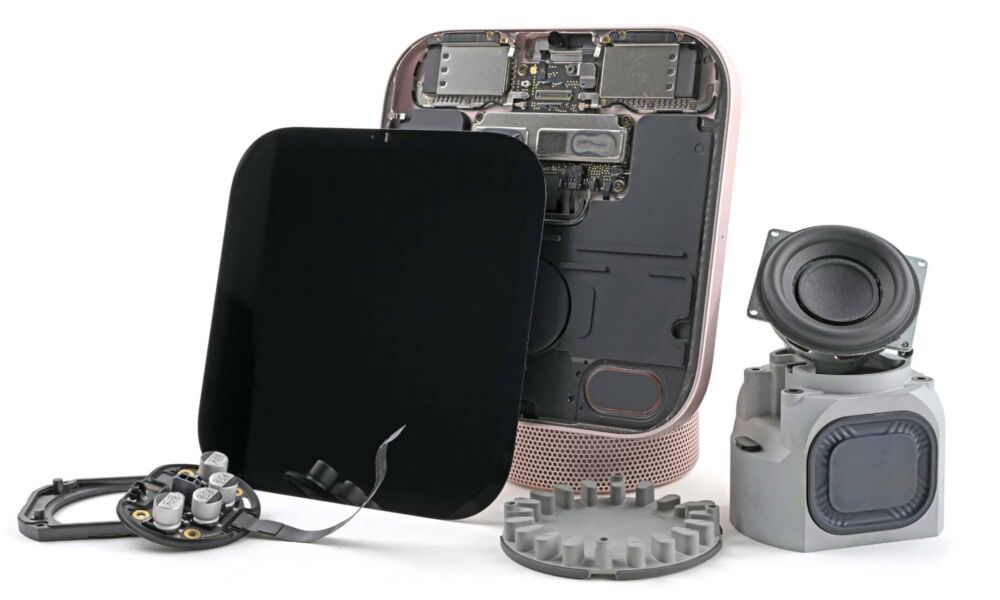
iFixit’s description of the HomeView as an “iPad-stuck-to-a-HomePod” seems eerily accurate after the team took a look inside. As the teardown crew notes, the original HomePod “took a hacksaw to open,” and while things have improved, Apple still clearly doesn’t feel like making its home devices easy to repair.
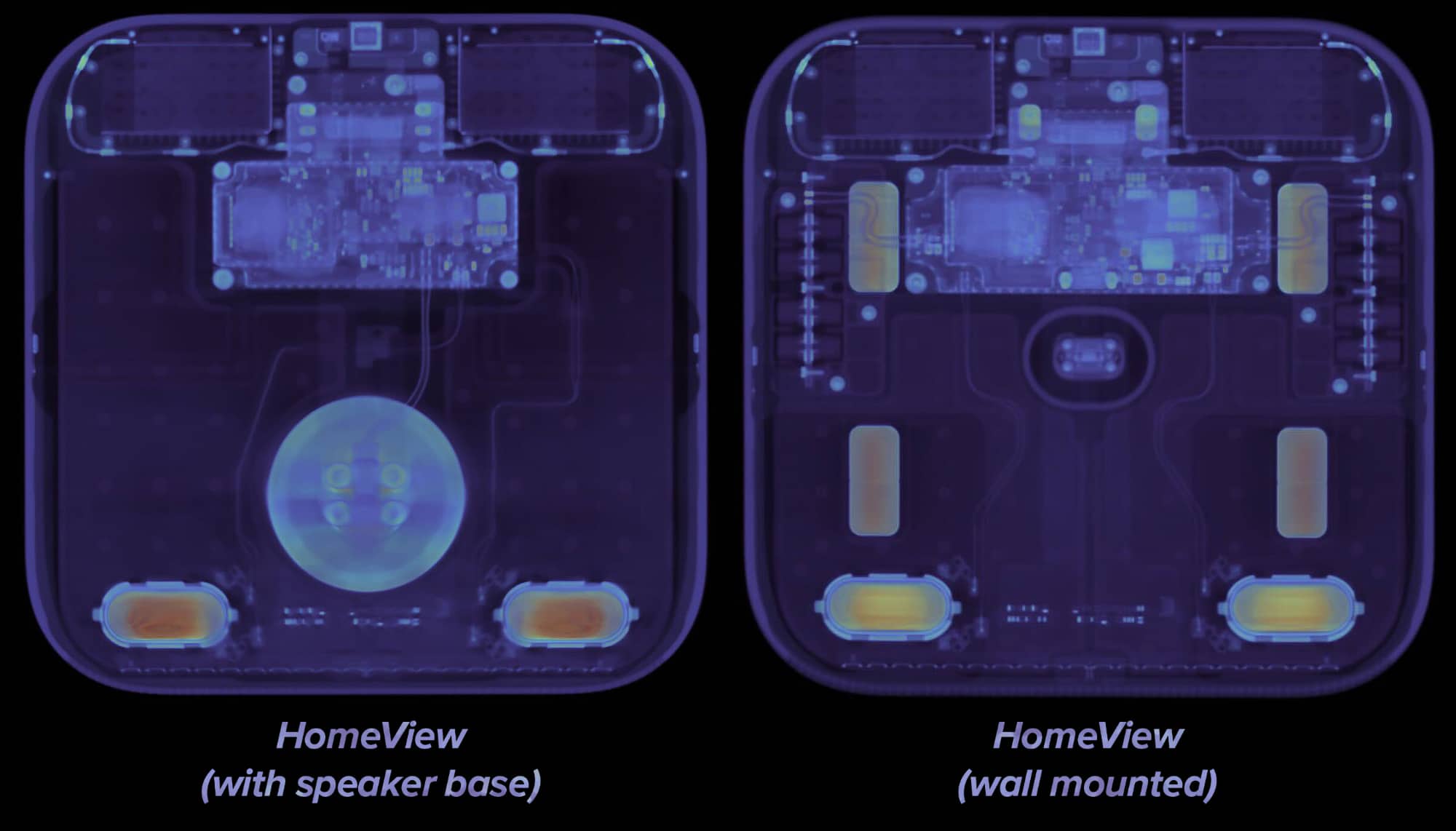
The process looked deceptively encouraging when viewed through a Lumafield Neptune CT scanner, but once they took out the tools, they discovered “just how determined Apple was to keep everything else from coming apart.”
iFixit covered both the tabletop HomeView and the wall-mounted model, and found they were surprisingly different on the inside, as the wall-mounted version had to incorporate a bank of capacitors that are otherwise housed in the tabletop model’s base — leaving less room for the internal speakers — while also packing in extra magnets and a centered USB-C port.
But it was the display that was the hardest part of the repair. The tabletop model’s base actually shares some similarities with the HomePod mini, coming apart easily enough, but also being packed with extremely short cables and oddly off-angle screws.
The way the cables are run through the pivot also makes it virtually impossible to separate the screen from the base without either using very specialized tools or disassembling the screen side — which is where the real challenge comes in.
The screen was found to be more glued down than even an iPad, which was perplexing, considering it’s likely to endure far less stress sitting mostly stationary on a table or kitchen counter. Once they got past the adhesive, they were confronted by an oddball combination of Phillips and Torx screws all over the place — even on the same brackets.
The speaker connectors on the logic board were also brittle enough to make it clear that the cables are not intended to ever be removed. After failing to remove those without basically ripping them off, the team discovered the logic board was glued in with a thermal bond — and the speakers were held in with so much glue that they bent iFixit’s tool before ultimately snapping right off — even after being absolutely soaked in isopropyl alcohol.
There’s probably a reason that Apple doesn’t include its home products in its Self Service Repair Program. While the screen-equipped HomeView feels like it should be at least as easy to repair as an iPad (and that’s not saying much), it’s decidedly much harder. If something goes wrong with your HomeView, it’s a safe bet you’re better off replacing it than trying to repair it — and with the Apple repair cost coming in at only $20 less than a brand-new unit, you might be tempted to just chuck it in the recycling yourself and buy a new one at retail, since that’s likely all that Apple will do with your broken one. We’re guessing that $20 difference is just the recycling fee.