
Apple’s ‘iPhone Fold’ May Be a Longer-Term Commitment Than You Think
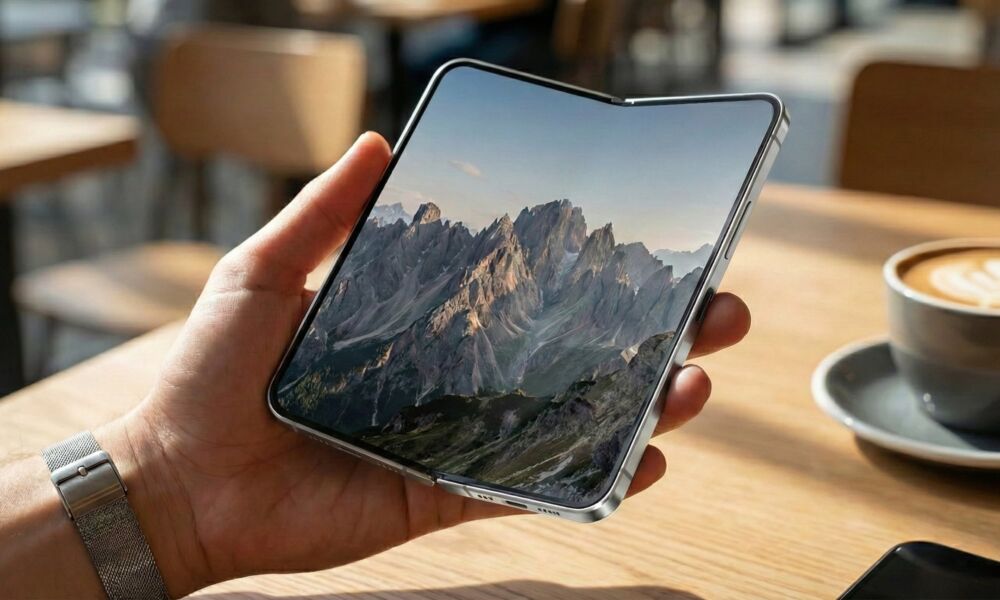 AI-generated concept image of a foldable iPhone [iDrop News / AI]
Toggle Dark Mode
Many of us are eagerly awaiting what could be Apple’s biggest new product launch in a decade: the first foldable iPhone. However, while the so-called “iPhone Fold” or “iPhone Ultra” could easily eclipse the Vision Pro, it’s sadly expected to have a similarly eye-watering price tag.
When Apple unveiled the Vision Pro three years ago, it showed us a future of spatial computing. It’s an idea that seemed fascinating on the surface, but not too many folks have even bought into the concept — much less the $3,500 device. By contrast, a foldable iPhone is eminently more practical, and therefore likely to draw in actual buyers rather than merely curious onlookers.
Still, with most reports suggesting it will start at $2,000 — and Apple already promising other iPhone price increases — it’s likely to have a somewhat limited market. That price tag is hard for most folks to stomach in today’s economy, but that’s not even the whole story; a new report from SellCell has just highlighted another reason why consumers might want to think twice before springing for Apple’s first foldable.
SellCell specializes in doing independent price comparisons to help consumers get the best deals on used tech. As a result, it also has solid data on how much smartphones typically depreciate over time, and it turns out foldables lead the pack for being the worst performers.
While SellCell can’t analyze a product that doesn’t exist yet, it can extrapolate from all the other foldables that have been on the market for years, from Samsung’s original Galaxy Z Fold in 2019 to more recent products like the Google Pixel Fold and OnePlus Open and their successors.
Compared to traditional smartphones, which lose an average of 55.3% of their value within 12 months, foldable smartphones lose an average of 64.6% over the same period. However, that translates into even more raw dollars, since foldable prices are also typically much higher than other smartphones.
SellCell estimates that foldable owners lose $392.37 more on average over 12 months than traditional smartphone owners.
For example, the Samsung Galaxy Z Fold 6, released in August 2024, had lost an average of $1,479.99 in value by August 2025. If a hypothetical $2,000 iPhone Fold followed the same curve, that would mean a loss of $1,292 in its first year, resulting in a used resale value of only $708.
Of course, there’s no guarantee that Apple’s foldable iPhone will get lumped into the same category. In fact, it seems much more statistically likely to follow a depreciation curve roughly similar to mainstream smartphones by the same manufacturers. For example, an iPhone 16 Pro model loses between 43.6% and 51% over its first year, depending on size and capacity, while the comparable Galaxy S25 Ultra models fall much further, dropping between 59.2% and 63.6% over 12 months. Google’s Pixel 9 Pro models sit in a slightly wider but similarly poorer range, landing between 55.5% and 64.6%. Only the OnePlus 13 nudges closer to the iPhone 16 Pro lineup, hovering around 51% over 12 months.
If you compare devices from the same manufacturers, the gap between traditional smartphones and foldables isn’t quite as stark as the overall averages would suggest. For example, the Galaxy Z Fold 6 ranges between 62.4% and 65.5% — only 1.9–3.6% more than the company’s standard flagships. The margins for Google and OnePlus are a bit higher, at up to 6.7%, but there’s also a point at which there’s some overlap; the Pixel 9 Pro 512 GB model actually loses more value than any Pixel 9 Pro Fold.
The iPhone continues to hold its value better than any other smartphone, with the iPhone 16 losing an average of 48.5% over 12 months. The OnePlus 13 comes in at a somewhat distant second at 53.2%, but everyone else dances around the 60% mark.
In other words, while Apple’s foldable will likely depreciate faster than the iPhone 18 Pro models expected to accompany its launch, there’s little reason to believe it will lose value at the same rate as other foldables. Still, even a 5% margin isn’t anything to shrug off when paying $2,000 or more for a smartphone, so it’s something for early adopters to think about, as it could make it harder to trade up to the second-generation foldable when it lands in 2027.
[The information provided in this article has NOT been confirmed by Apple and may be speculation. Provided details may not be factual. Take all rumors, tech or otherwise, with a grain of salt.]






