Apple Reveals How iCloud+ Unlocks Higher AI Limits in iOS 27.3
Toggle Dark Mode
Alongside the release of the second iOS 27.3 developer beta today, Apple is finally providing more details on the AI usage limits it’s been obliquely hinting at since it first announced Siri AI in June.
While it always seemed inevitable that Apple would eventually charge for Apple Intelligence in some way — server-side AI doesn’t come cheap — the company didn’t initially seem sold on the idea.
It wasn’t long after Apple first unveiled Apple Intelligence two years ago that Bloomberg’s Mark Gurman suggested Apple’s long game was to pivot it into its Services portfolio in the form of something like an “Apple Intelligence+” service. Other analysts soon agreed, believing that Apple would follow the same model adopted by rivals like OpenAI and Google, with a “premium” Apple AI service priced at around $20 per month on its own, and likely bundled into Apple One in some way.
The idea that Apple would eventually charge for AI wasn’t purely born out of the belief the company wanted another revenue stream. Apple silicon may be more powerful than ever, but it still can’t compare to what cloud servers can do, and building those costs money. Apple has invested a ton of money into building out Private Cloud Compute infrastructure to support its new AI features, and investors were going to expect it to recoup some of those costs.
Even so, by the end of 2024, former Apple CEO Tim Cook said he hadn’t really considered charging for AI features, telling Wired in late 2024 that “we never talked about charging for it.”
But that was then, and this is now. The resources required to power Apple Intelligence cost real money, especially after Apple was forced to partner with Google to develop the models needed to power the new Siri AI in iOS 27. So, it wasn’t a big surprise when software chief Craig Federighi announced during this year’s Worldwide Developers Conference (WWDC) that users would be able to pay for “increased access … with most iCloud+ subscription plans.”
Some features, including image generation, have daily usage limits because they rely on powerful server models. Increased access is available with most iCloud+ subscription plans, which also include Apple Intelligence support for compatible Home cameras.
Craig Federighi
Until now, the only limits that were explicitly clear were AI camera summaries in the Home app, where users need to subscribe to at least the $9.99 monthly 2 TB iCloud+ plan to get support for even a single camera.
Then, last week, Apple began rolling out “intelligence usage packs” for Logic Pro and other Apple Creator Studio apps, offering additional AI usage as one-time $49.99 purchases, valid for up to 12 months.
How iCloud+ Adds More AI Usage
Now, iOS 27.3 is showing us how this will work with standard Apple Intelligence features. While everyday Siri commands should be excluded from this entirely, more complex multi-step queries that rely on server-side processing will count against the AI usage limits, as will generative tools like Image Playground and AI editing in Photos.
Siri AI includes a generous daily usage limit. If you reach it, you will be notified, and you can still make everyday Siri requests like “Set a timer for 3 minutes” or “Text Mark that Annika’s party is at 123 Main Street.” Advanced requests are more complex, like “Text Mark the address for Annika’s party, and tell him what time we need to leave from home to make it on time” or “Add a summary of my San Francisco trip note to this email draft.”
Apple
Basically, anything that requires off-device processing and uses Apple’s Private Cloud Compute will have some limits, although Apple hasn’t said precisely what these limits are.
There don’t appear to be any obvious user-facing settings for this in iOS 27.3 yet, and it’s unclear how this will work at a software level. However, Apple has published a support document that lays it all out. Here are the key points:
- Usage limits reset each day, typically around midnight in your current time zone.
- Standard limits are per-device, not per-account. That means if you hit a limit on your iPhone, you can still continue on your Mac or iPad.
- If you hit your limit, advanced requests will be “paused” until your limit resets at midnight or you pay for more through an eligible iCloud+ plan.
- The additional usage multipliers that come as part of an iCloud+ plan are shared not only by all devices on your Apple Account, but across any family members sharing your plan — and this is consumed on a first-come, first-served basis.
Unlike AI camera summaries, the increased usage limits start at $2.99 per month with the 200 GB iCloud+ plan, which gets you double the “Standard Device Limit,” and access to the AFM Cloud Pro Model for Shortcuts.
- iCloud+ with 50 GB ($0.99): Standard Device Limit for all devices (no bonus)
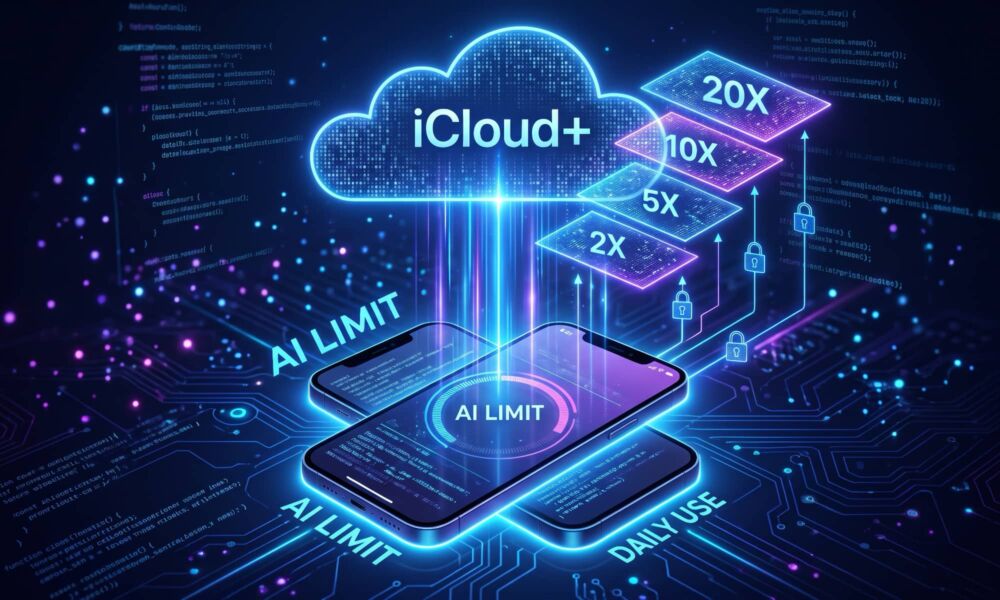
- iCloud+ with 200 GB ($2.99): Up to 2X Standard Device Limit
- iCloud+ with 2 TB ($9.99): Up to 5X Standard Device Limit
- iCloud+ with 6 TB ($29.99): Up to 10X Standard Device Limit
- iCloud+ with 12 TB ($59.99): Up to 20X Standard Device Limit
It’s not entirely clear how the math works, since these are multipliers and represent a shared pool, but the key phrase here seems to be that the multipliers are based on the “Standard Device Limit.” This suggests that the 2X increase isn’t across all your devices, but rather a shared pool that represents double whatever the limit is for a single device. In other words, a 200 GB iCloud+ plan would give you one additional device’s worth of usage every day.
Again, it’s not entirely clear what the base limits are — and we probably won’t know until we hit them. While Apple says these changes will be “starting with the 27.3 release,” the wording in its support document suggests that iOS 27.3 will be unlocking the increased access on the higher iCloud+ tiers, rather than enforcing limits that didn’t previously exist.
That makes sense, as Apple isn’t likely going to let folks get away with skirting these restrictions by staying behind on iOS 27.2. Instead, it’s likely the Standard Device Limit will be enforced on all iCloud+ plans on older software releases, with iOS 27.3 required for those who have a 200 GB or better plan to enjoy the increased usage.