Soaring iPhone and Mac Sales Propel Apple to a Massive $114.5B Q4
 Ascannio / Adobe Stock
Toggle Dark Mode
Today, Apple announced its fourth-quarter results for 2026, covering the period from July to September — and marking new CEO John Ternus’ first time at the helm during the regular earnings call that followed.
“Today, Apple is proud to report a September quarter revenue record of $114.5 billion, up 12 percent from a year ago, with iPhone reaching a September quarter record and Services reaching an all-time high, capping off our best fiscal year ever,” said John Ternus, Apple’s CEO. “We’re closing the year with our most ambitious lineup yet. That includes the iPhone Duo, the most transformational iPhone since the original, alongside iPhone 18 Pro and iPhone 18 Pro Max, our most powerful iPhones yet. We also just introduced a whole new generation of hardware for the home and brought Touch to Mac for the first time. Together with the all-new Siri AI, it’s an incredible lineup to carry us into the holiday season.”
In an interesting twist, John Ternus introduced Apple’s chief operating officer, Sabih Khan, noting that he will be participating in future earnings calls. That’s not too surprising in retrospect; Ternus’ predecessor, long-time CEO Tim Cook, was an operations guy through and through — he spent nearly a decade with that portfolio before moving into the big chair. By contrast, John Ternus has a much stronger hardware background, so it’s understandable how he’d prefer having the COO on board to answer the usual supply chain questions that always come up.
The Numbers

Apple is once again shattering records, not only reporting $114.48 billion in revenue, but also crossing significant new Q4 thresholds for iPhone, Mac, and Services. In total, the company posted $30.7 billion in net quarterly profit and capped off an all-time full-year fiscal revenue record of $478.8 billion.
Last year, Apple crossed the $100 billion mark for the first time in a September quarter. However, this year’s revenue reached double-digit overall growth for the first time in years — 11.7% gains over Q4 2025. Shrinkage in both the iPad and the Wearables, Home, and Accessories categories was more than made up for by staggering growth in the iPhone and Mac.
| Segment | Q4 2026 Revenue | Growth (YoY) |
|---|---|---|
| iPhone | $57.58B | +17.5% |
| Mac | $10.79B | +23.7% |
| iPad | $6.23B | -10.4% |
| Wearables | $8.30B | -7.9% |
| Services | $31.57B | +9.8% |
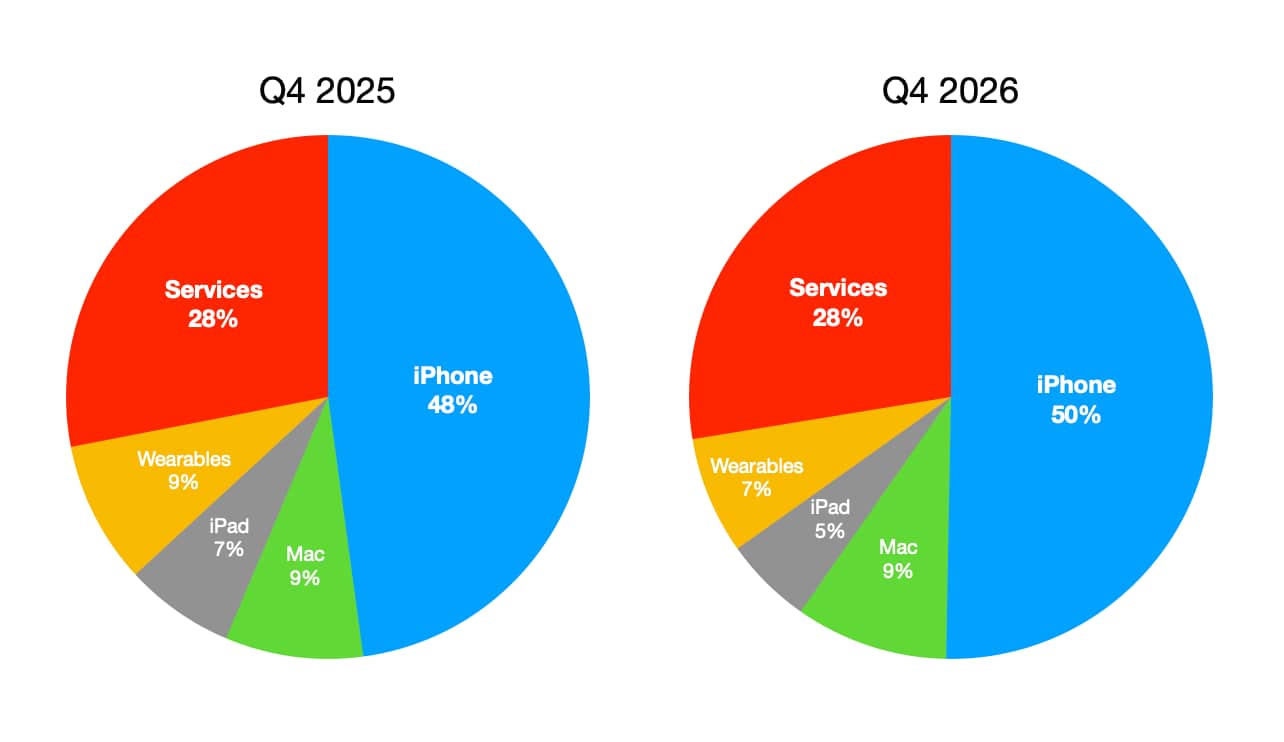
What’s notable about the iPhone category is that Apple’s fourth quarter ends in September, which means the staggering growth that saw it cross the $50 billion mark for the first time in Q4 was driven entirely by the iPhone 17 lineup during the summer, followed by the two weeks or so that the iPhone 18 Pro and iPhone 18 Pro Max were on sale — and not the standard iPhone 18, which isn’t out yet, nor the iPhone Duo, as that launched in October.
Although new iPhones are always popular, the iPhone 18 Pro lineup was certainly no more special than last year’s iPhone 17 Pro models, which only drove 6.1% growth in Q4 2025 over the iPhone 16 launch. However, this time around there’s a good chance more sales were driven by the strong rumors of impending price hikes and the fact that the standard iPhone 18 isn’t arriving until the spring.
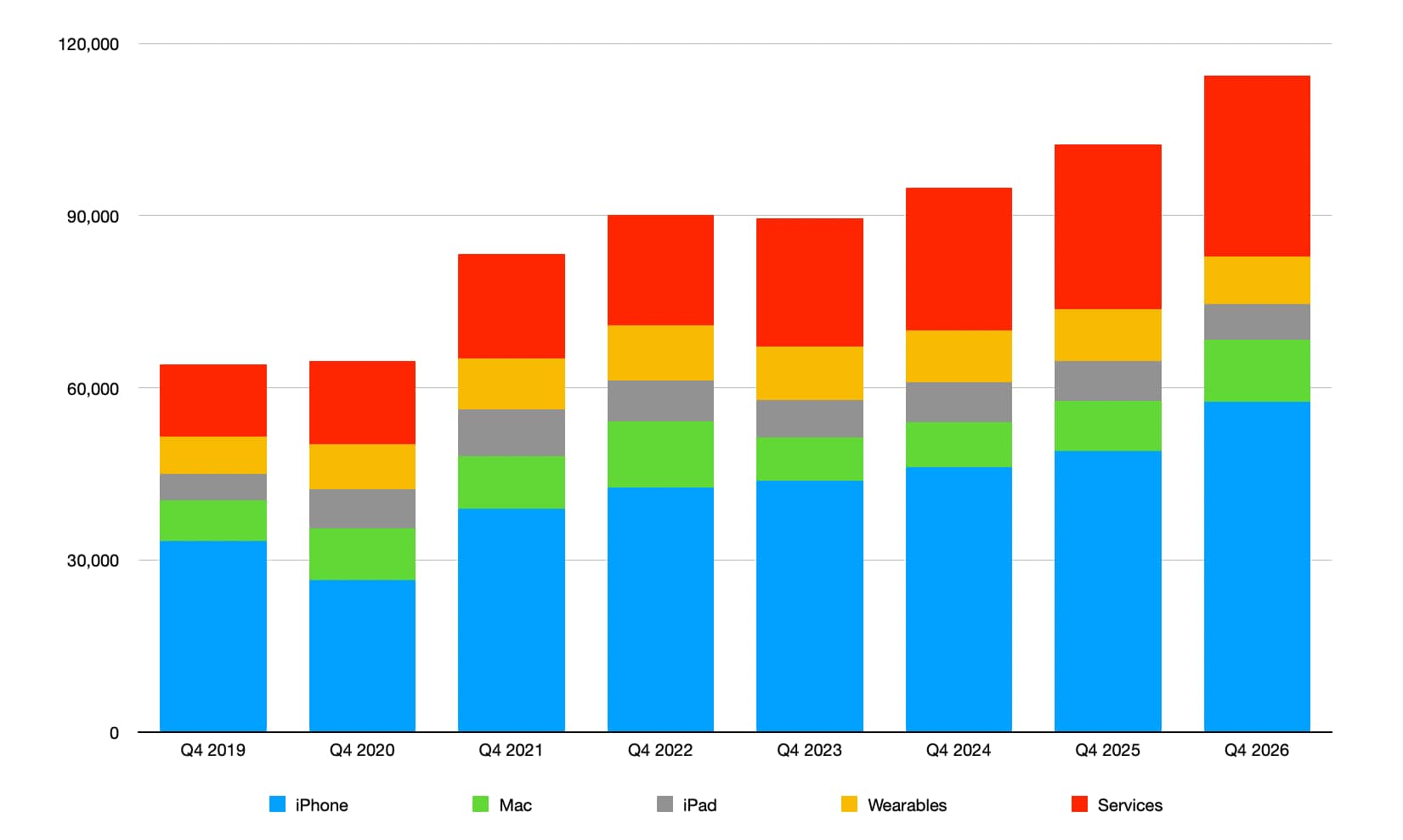
While Macs got price hikes in June, it didn’t seem to slow things down there either, where Macs saw double the 12.7% growth in the same category between Q4 2024 and Q4 2025, while also breaking $10 billion for the first time. Some of this was undoubtedly driven by the MacBook Neo, but it also probably doesn’t hurt that the Mac mini and Mac Studio debuted in late August, both of which are typically in high demand by AI companies. Those didn’t land in stores until September 22, but Apple had opened preorders right away, which gave it nearly five weeks to record revenue in that category.
Meanwhile, the drop in the iPad category wasn’t surprising considering that it’s been a quiet year for Apple’s tablets so far. The M4 iPad Air arrived in March, but that was largely a spec bump over its 2025 predecessor. Meanwhile, we’re still waiting for the entry-level iPad, and the OLED iPad mini launched only last week, and therefore won’t be factored in until Apple reports its Q1 2027 “holiday quarter” results early next year.

Wearables is a bit more interesting, as Apple launched the Apple Watch Series 12 and Ultra 4 in September, alongside the iPhone 18 Pro and iPhone 18 Pro Max, and put those up for preorder right away. Those clearly weren’t enough to drive much growth, but this category also hasn’t seen Q4 growth since Q4 2022, when the original Apple Watch Ultra and AirPods Pro 2 likely drove a fair bit of growth.
Finally, there’s Services, which continues its ascent, breaking the $30 billion quarterly mark, although its 9.8% growth may suggest it’s finally leveling off a bit, compared to the double-digit growth over the last three years — 15.1% in Q4 2025, 11.9% in Q4 2024, and 16.3% in Q4 2023.

During the earnings call, particularly in the Q&A session afterward, John Ternus pointed to iCloud+ and Apple’s September decision to bundle it with Apple TV and Apple Arcade in 100 countries and regions, likely driving new subscribers in areas where it’s traditionally been a harder sell.
He also touched on the new AppleCare One Family plan, which allows households with multiple Apple devices to cover them all for a flat $50 monthly fee. That’s a great deal, but it’s not entirely clear how much of that would be net new revenue as opposed to customers swapping out individual AppleCare+ or AppleCare One plans for the family bundle.
Ternus also had some interesting comments on iCloud+, including higher usage tiers for Siri AI and Apple Intelligence, where he suggested most of those advantages are yet to come — that at some point Apple will likely market iCloud+ with more specific benefits. So far, this has been kind of vague in every area except for video summaries for home cameras, where they’re currently a little bit absurd, requiring customers to pay for the 6 TB or 12 TB plans to get more than a single camera — pricing that makes it hard to believe it’s driving too many subscriptions right now.