Apple Crime Log: Toronto Cops Make Canada’s First ‘SMS Blaster’ Arrests
 Tony Stoddard / Unsplash
Toggle Dark Mode
In this week’s iDrop News Apple Crime Log, we have a particularly big story as Canadian cops make an arrest in the country’s first “SMS Blaster” investigation.
Toronto Police have arrested three men as a result of “Project Lighthouse,” a first-of-its-kind investigation into mobile “SMS blasters,” according to a report from iPhone in Canada.
SMS Blasters are high tech devices that allow scammers to impersonate cell towers and send scammy texts in large numbers. This is believed to be the first time police have detected the scheme on Canadian soil.
Police first kicked off the investigation back in November 2025, when a cybersecurity partner initially detected an SMS Blaster operating in the downtown Toronto area. In the months following, cops detected the device as it made its way through the Greater Toronto region. The scammers are believed to have tricked tens of thousands of smartphones into connecting to its “network.”
How Does an SMS Blaster Work?
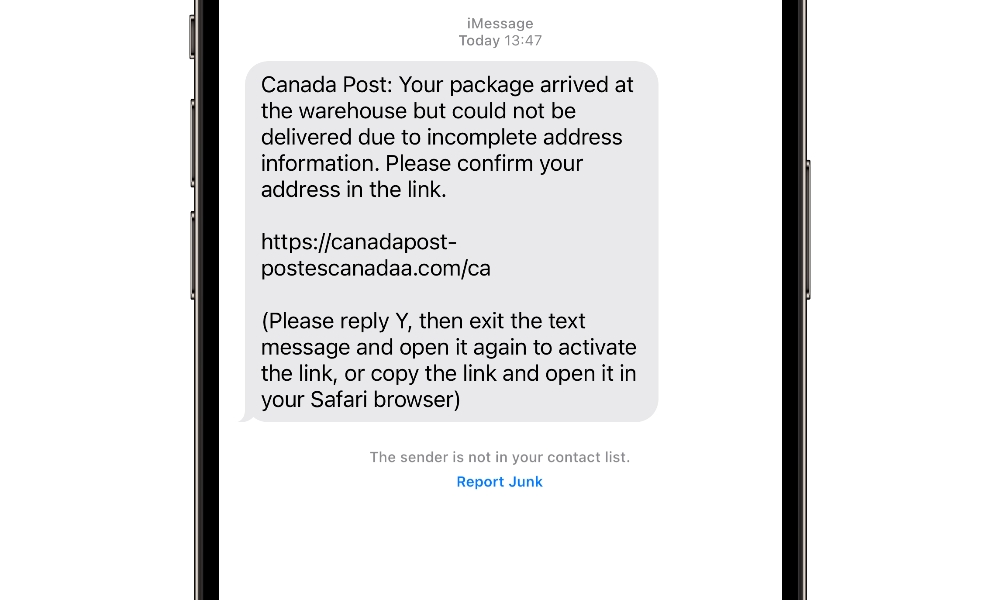
An SMS blaster is a device that’s configured to pose as a legitimate cellular tower. When a phone is nearby, the Blaster forces the device off of the real cellular network and onto the rogue device’s fake “network.” Once the device is connected, the criminals then begin sending “smishing” texts that appear to originate from trusted sources like banks or the Canadian Postal service, containing links to malicious websites designed to steal the victim’s login credentials and financial/personal data.
While the devices are designed to steal information, they also have other worrying side effects, as they also cause damage to local infrastructure. Police have recorded more than 13 million instances of network interference, which could have created life-threatening situations.
“These disruptions could temporarily prevent affected devices from connecting to legitimate cellular networks, including limiting access to emergency services such as 911,” say Toronto police.
“This is a new and emerging threat in Canada — one that uses advanced technology to reach thousands of people at once and exploit their trust,” said Toronto Deputy Chief Robert Johnson. Johnson also said the sheer scale of the scheme allowed criminals to automate it.
Police Arrest Suspects

Police were able to obtain search warrants in Markham and Hamilton on March 31, 2026, allowing them to seize several SMS Blasters and a “significant quantity” of electronic evidence. Three men were then arrested on a combined total of 44 charges, including fraud, mischief, and endangering of life.
The arrested individuals were identified as 27-year-old Dafeng Lin of Hamilton, 25-year-old Junmin Shi of Markham, and 21-year-old Weitong Hu of Markham, who turned himself in on April 21.
How to Protect Yourself Against SMS Blasters
SMS Blasters are becoming increasingly popular among the bad actors of the world, with some shady websites advertising the devices for sale for as much as $50,000. The ads claim the devices can send an SMS message to any cell phone in a 500-meter to 2-kilometer area. While the devices are promoted as a way to send advertising texts, scammers are obviously using them for more malicious intents. Either way, there’s no valid legal use for these devices, as it’s against the law in most countries to disrupt telecommunications networks at all, much less impersonate legitimate services.
Toronto Police urge the public to always be suspicious of any unexpected text messages, specifically messages that appear to be from organizations like 407 ETR or Canada Post requesting payment. Users are advised to never click on any links in unsolicited text messages and to only access their accounts through official apps or by manually typing a known-good website address into a browser. While that advice is specific to the Greater Toronto Area, scammers are leveraging SMS Blasters in other areas as well, so you should exercise caution about similar texts no matter where you happen to be. Scammers rely on you freaking out over the text message, spurring you to click the links, allowing the bad guys to steal your login information, providing them with access to your accounts.
Pro Tip: Apple’s Lockdown Mode offers protection against SMS Blasters since it disables the 2G cellular connectivity they use to trick your phone into hopping onto their “fake” networks. However, it also disables a few other features on your iPhone, so it may not be worth it unless you’re traveling through a busy urban area that’s at a higher risk of being targeted by SMS Blasters.