Chromebooks, Dismissed: Kansas City Schools Go All-In on the MacBook Neo

Toggle Dark Mode
Apple’s affordable new MacBook Neo has been one of the most sought-after laptops in the company’s history, with shipping times quickly rising to several weeks following its launch in March. However, while a $599 MacBook was always sure to be a hit with budget-conscious consumers, it seems it’s educational institutions that are driving most of the demand — and limiting the supply.
Last month, Tim Cook highlighted this during Apple’s Q2 2026 earnings call, mentioning how entire school systems are “switching from Chromebooks and Windows PCs to the MacBook Neo,” and even calling out Kansas City Public Schools by name as one example. This week, the school district confirmed that, while giving us an idea of just how massive of a switch it’s making.
On its website, Kansas City Public Schools (KCPS) proudly announced its transition to an “all-Apple district,” adding that the decision was made in light of rising enrollment and the need to invest in the right student technologies for the future.
Over time, we will replace more than 30,000 Windows PC and Chromebooks with the more secure, durable, and reliable Apple devices. Already, 4,500+ MacBook Neos have been procured for students in 8th grade and up, while lower grades have access to the district’s existing iPads and MacBook Airs.
Kansas City Public Schools
While the announcement suggests the district plans to go beyond the MacBook Neo, the staggering numbers suggest the lower-cost laptop will be the primary tool used by students. That’s not surprising considering its $499 educational price — and it’s a safe bet that KCPS isn’t even paying that much considering the 4,500-unit order volume — and the promise of more to come.
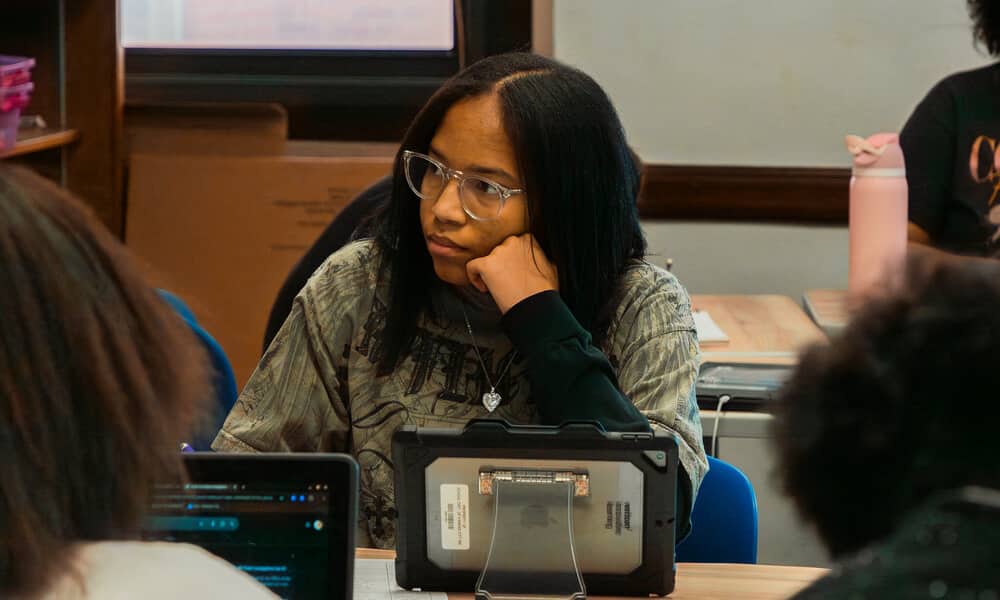
“Students are now proud of their schools because they have the best products,” said KCPS Chief Technology Officer Scott Jones.
It’s hard to say how many other educational institutions are following this lead, but Apple’s decision to break into a new price point for educators has attracted a lot of interest, placing a greater strain on Apple’s supply chain than the company anticipated.
What’s notable is that Apple was already quite optimistic about how well its $599 MacBook Neo would sell; Cook shared during last month’s earnings call how it was “very bullish” on the new Mac, suggesting demand exceeded even its wildest expectations.
Some analysts believe that the MacBook Neo’s popularity has been a double-edged sword for Apple due to its decision to use leftover iPhone chips as a cost-cutting measure. Since the MacBook Neo runs on an A18 Pro with one less GPU core than the ones used in the 2024 iPhone 16 Pro models, it’s obviously a “binned” version from those earlier production runs. However, as those bins run dry, Apple has been forced to restart the A18 Pro fabrication lines to meet demand, potentially adding to its costs.

This led to some speculation that Apple might ditch the 256 GB MacBook Neo, especially after it did that with the Mac mini last month. However, that seemed highly improbable; Tim Cook has long been regarded as a zen master of supply chain logistics, so it’s inconceivable that Apple’s CEO wouldn’t have factored the need to produce more A18 Pro chips into the company’s forecasts and pricing models.
The Mac mini also wasn’t exactly a good example, as raising its bar of entry was as much of a strategic play as creating a 256 GB MacBook Neo priced at $499 for education — and omitting a Touch ID sensor in the process. That entry-level MacBook Neo is firmly targeted at educational institutions like KCPS and extremely price-conscious students, and as this week’s announcement shows, it’s clearly living up to that potential. By contrast, the $599 Mac mini represented actual lost revenue for Apple, since those were being gobbled up for use in agentic AI server farms, and unlike publicly-funded educators, the lucrative AI industry isn’t going to balk at a $200 price increase to step up to the 512 GB model.