The HomeView’s Robotic Sequel is Already in the Works
Toggle Dark Mode
Now that Apple has officially unveiled its much-anticipated HomeView smart hub, it’s clearly ramping up for a sequel. While reliable reports of Apple’s work on the current model go back to at least 2024, those were also frequently accompanied by insider info on Apple’s longer-term goals, one of which is a unit with “a motorized robotic arm.”
It’s not an exaggeration to say that we’ve been hearing about this product for just as long as the HomeView itself. By all accounts, Apple has likely been developing both ideas in parallel. In August 2024, Bloomberg’s Mark Gurman shared info on a product codenamed J595, describing it as “a smart home command center, videoconferencing machine and remote-controlled home security tool.”

According to Gurman, Apple’s executives greenlit this idea in 2022, which explains why we were hearing vaguer rumors about Apple’s home hub plans back in 2021, when the company’s engineering and design teams were likely spitballing multiple ideas.
While some early 2026 reports seemingly conflated the two products, with The Information suggesting that a “robotic swiveling base” was coming “as soon as this spring,” Gurman had made it clear from the get-go that Apple was working on two separate products.
Looking at the HomeView, it’s not hard to imagine how Apple could have added a swivelling base, akin to what Belkin already did for the iPhone with its Stand Pro. Watching the “family” in Apple’s promo video pull the HomeView around to face them makes it apparent how useful this could be. However, Apple chose to omit that for whatever reason — likely to reduce the cost and complexity of the first-generation model.
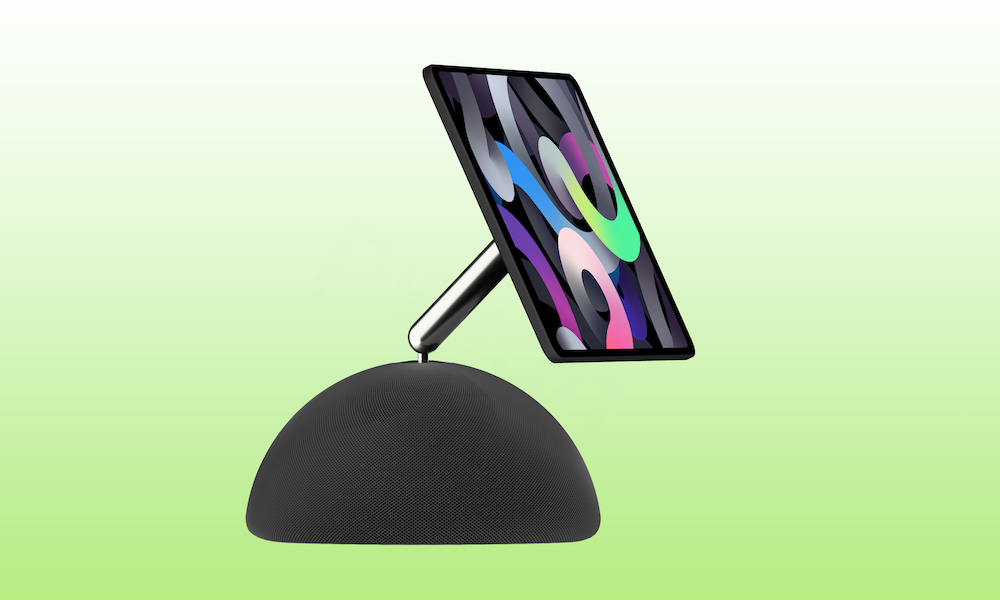
However, just because it’s not there right now doesn’t mean it isn’t coming — and Apple apparently has something better in mind than merely a swivelling base. In this week’s Power On newsletter, Gurman confirms that the J595 version is still very much on the books, and could be released as soon as 2027 — likely in the fall — although it could also slip into 2028.
Code-named J595, this version looks like the current HomeView but has a roughly 9-inch screen (up from 7 inches) and a motorized robotic arm that lets the display swivel a full 360 degrees. Using voice recognition, the machine is designed to identify who’s speaking and automatically turn toward that person.
Mark Gurman
The idea here would be to not only let it turn toward the person who is speaking (an audio engineering challenge that might have also made Apple reluctant to try to ship this in the first model), but also emulate some of what the Belkin Stand Pro can already do with an iPhone, letting it follow people around the room while they’re on a FaceTime call.
Apple already has some of this technology in place. Belkin’s stand relies on the DockKit framework that Apple introduced three years ago in iOS 17, so it’s your iPhone that’s actually signaling to the stand which way to turn or tilt. The stand just receives those signals and engages the motors accordingly.

So that part shouldn’t be hard to accomplish at all, but the notion of a “motorized robotic arm” rather than just a swivel stand suggests that Apple plans to have it do a bit more. Plus, there’s still the matter of it reliably moving the screen to face whoever is speaking based solely on directional audio cues in a variety of acoustic environments.
While the J595 will be a sequel of sorts, Apple isn’t planning to release it as a successor to the HomeView, but rather a higher-end version that will be sold, likely with a suffix like “Max” or “360.” In some ways, that makes the current HomeView another one of Apple’s typical first-generation “proof of concept” devices that it will ultimately build into a more comprehensive device family and ecosystem.
[The information provided in this article has NOT been confirmed by Apple and may be speculation. Provided details may not be factual. Take all rumors, tech or otherwise, with a grain of salt.]