Ford’s New Electric Truck Will Take Apple Maps Off-Road
 Ford
Ford
Toggle Dark Mode
While most automakers have been eagerly embracing Android Automotive (aka Google built-in), Ford has surprised everyone by going in the other direction. As we reported in July, Apple announced that the carmaker would be going with Apple Maps for its new Universal Electric Vehicle (UEV) platform.
This isn’t quite the same as Android Automotive — and it’s nothing close to Apple’s CarPlay Ultra — as Ford will still be building its own software stack. So it’s not “iOS for the car,” so much as leveraging Apple Maps for the navigation side of its integrated systems. The platform will still be entirely Ford’s.

The secret sauce to all this is Apple’s new MapKit for Automotive SDK, but Ford plans to take it beyond navigation by also integrating intelligent EV routing functionality and its BlueCruise ADAS system. This will see Ford’s own in-car systems tying directly into Apple Maps to handle things like battery preconditioning, EV ranges, and semi-autonomous on-ramp-to-off-ramp driving on major highways.
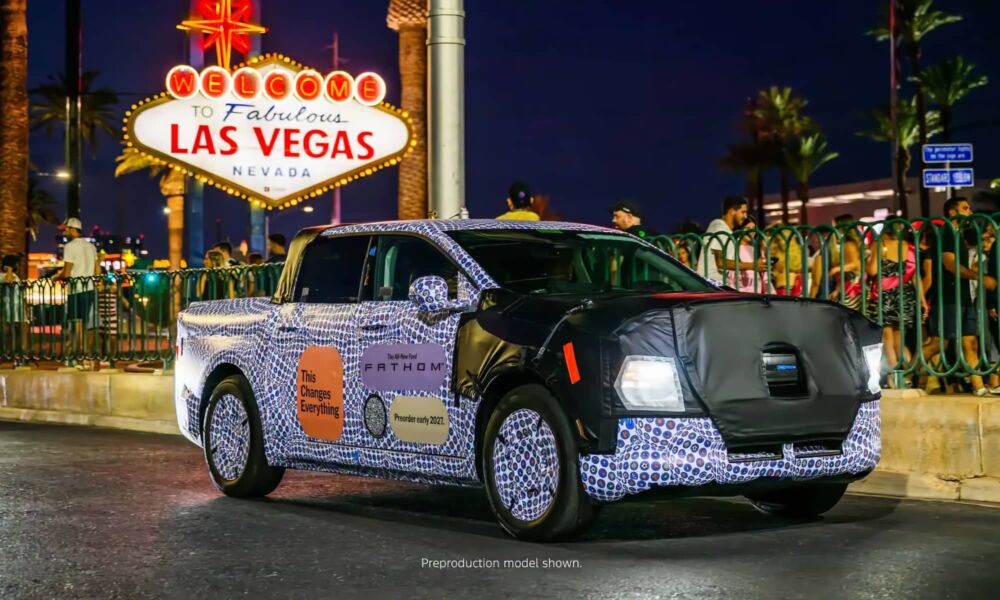
We haven’t heard much from Ford about this beyond the joint announcement that Apple issued in July. However, this week Alan Clarke, Ford’s vice president of advanced EV development projects, sat down with GreenCars to discuss how this will work in the upcoming Fathom electric truck — the first vehicle expected to host the new UEV platform (via 9to5Mac).
Clarke explains that Ford didn’t just go with Apple by default. The automaker evaluated Apple, Google, and even others when deciding which mapping platform to choose for the Fathom, but when the dust settled, Apple came out on top.
“We had to optimize for performance, capabilities cost, quality, you name it,” Clarke said. “We spent time determining which was the best solution.”
The Ford executive said that Apple Maps “has gotten so much better over the last few years,” dispelling a common myth that still pervades some tech circles. (I can certainly relate: I bought a car with Google built-in this summer, but Apple Maps still beats it hands down simply by actually knowing when roads are closed or open in Toronto).
Still, the real win for Ford was Apple’s willingness to work very closely with the automaker. He described Apple’s team as “very flexible” and willing to work very closely with Ford’s engineers and developers to build a system that would fit seamlessly into Ford’s UEV experience:
We wanted to make sure that we had really tight integration with that team when we’re talking about the things that have to happen on a vehicle: range estimation and determining how much range you have and how you want to precondition the batteries and how you charge.
You need a great maps provider that has the capability to get elevation, weather, and the maps data to have accurate updated information about chargers.
Alan Clarke, Vice President of Advanced Development Projects, Ford
Clarke added that it didn’t hurt that “Apple Maps looks beautiful,” and he believes it will be “a really big wow factor for our customers” on the Fathom’s large display.
Despite the embedded Apple Maps, the Fathom will still support Apple CarPlay, so drivers can use Apple Maps through that interface, or even Google Maps via CarPlay. Android Auto is also supported, so there are plenty of options. “But the Apple Maps themselves are directly embedded in the UI,” Clarke says, “so you can do the routing directly through that” — presumably with no need to connect an iPhone at all.
The Ford Fathom is expected to open for preorders in early 2027 and start at $29,945, according to Car and Driver, which reported this week that Ford has recently taken it to Las Vegas for hot-weather testing. The Wall Street Journal reports that the company has set a goal of selling 100,000 vehicles in the first year it goes on the market.