Apple’s $2B Bet on Q.ai: Is ‘Silent Speech’ the Next Face ID?
Toggle Dark Mode
Apple has just made its second-largest acquisition ever, reportedly paying close to $2 billion to acquire an Israeli AI company that specializes in “silent speech.”
The company in question, Q.ai, has been working on artificial intelligence technology across several categories, but its most prominent patents are focused on incorporating optical sensors into headphones or glasses to recognize “facial skin micro movements.” These could allow a wearer to communicate without talking, essentially turning thought-like muscle movements into digital text, according to the Financial Times, which was the first to report on the specifics of the deal from insider sources.
Apple confirmed the acquisition to Reuters yesterday, only hours before its Q1 2026 earnings report, with its hardware technologies chief Johny Srouji making a rare statement, although those comments remained vague, as such PR statements often are.

[Q.ai] is a remarkable company that is pioneering new and creative ways to use imaging and machine learning. We’re thrilled to acquire the company, with Aviad at the helm, and are even more excited for what’s to come.
Johny Srouji, Apple SVP of hardware technologies, in a statement to Reuters
That leaves us to read between the lines on where Q.ai might actually fit into Apple’s AI puzzle, but there’s also enough room for some educated speculation — and there’s some interesting history between Apple and Q.ai’s CEO, Aviad Maizels.
Some of the work done by the four-year-old startup centers on using machine learning to help understand and decipher hard-to-discern audio, such as speech that’s whispered or spoken in noisy environments. That alone could go a long way to enhancing Siri’s voice recognition capabilities, and possibly play into conversational features on the AirPods Pro, but these might also just be the tip of the iceberg.
What’s much more intriguing is the “facial skin micro movements” patent application filed by Q.ai last year, which could not only detect words mouthed or spoken, but also identify a person and “assess their emotions, heart rate, respiration rate and other indicators,” Reuters says. It’s not hard to see ways in which this could open the door to new health monitoring capabilities and accessibility features tied into Apple’s AirPods and future products like its much-rumored smart glasses.
Such a system could allow Apple customers wearing headphones and smart glasses to have private, non-verbal discussions with an AI assistant.
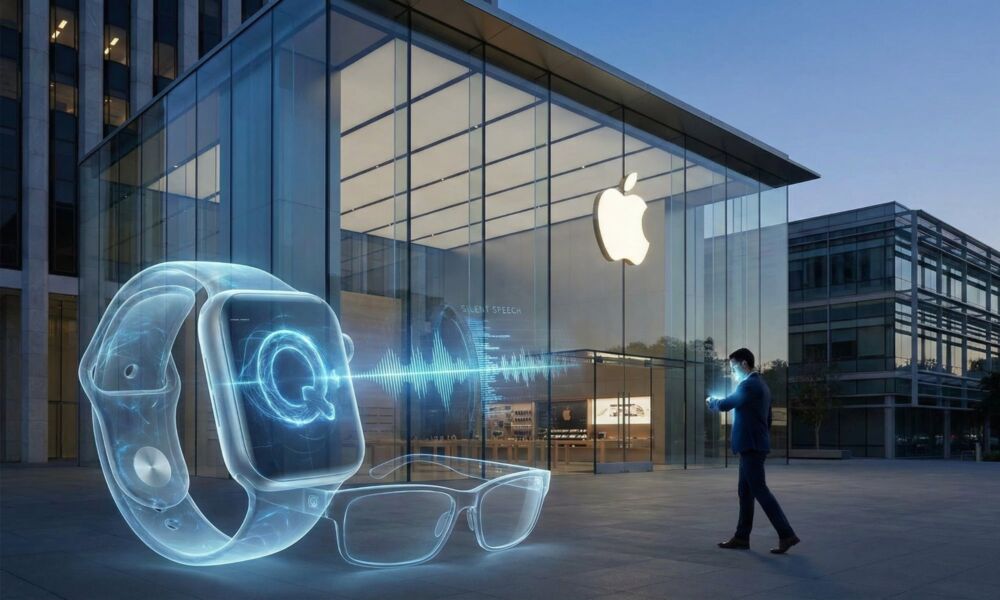
Holographic Apple Watch and smart glasses displaying the Q.ai logo and silent speech waveforms in front of a modern glass Apple Store.
Further, the fact that Apple’s statement came from Apple’s senior VP of Hardware Technologies confirms that the Q.ai acquisition isn’t merely a software project, but it’s also likely not directly product-focused. We don’t often hear public statements from Srouji, but his division is focused on underlying technologies like Apple silicon, so whatever purpose Apple has in mind for Q.ai, it seems it will be at the level of Apple’s core silicon and sensor architecture.
However, the deal is also very much an “acquihire,” as Reuters notes that all 100 employees, including CEO Aviad Maizels and co-founders Yonatan Wexler and Avi Barliya, are joining Apple.
This isn’t the first deal Q.ai’s Maizels has done with Apple, as he also founded a three-dimensional sensing firm, PrimeSense, which Apple acquired for $350 million in 2013. PrimeSense was best known for making the sensors embedded in Microsoft’s Xbox 360 Kinect system, which Apple used as one of the foundations for Face ID in the iPhone X, combined with several other acquisitions.
“Joining Apple opens extraordinary possibilities for pushing boundaries and realizing the full potential of what we’ve created,” Maizels said in a statement to Reuters, “and we’re thrilled to bring these experiences to people everywhere.”
While the $2 billion price tag has yet to be formally confirmed, it would make the Q.ai acquisition the second-largest in Apple’s history, next to its $3 billion acquisition of Beats in 2014. That deal helped Apple launch Apple Music in 2015, so if the money Apple is shelling out on Q.ai is anything to go by, we can expect similarly big things from this deal.