Apple’s ‘Big Week’ Gets Even Bigger with the M5 Pro MacBook Pro

Toggle Dark Mode
Apple eased into its promised “big week” of product announcements yesterday with the iPhone 17e and the M4 iPad Air — two very welcome but not entirely surprising entries. Now, for day two, it’s putting the finishing touches on its MacBook Pro lineup with the new M5 Pro and M5 Max models that were conspicuously missing from its October MacBook Pro release.
In a pair of separate newsroom announcements today, Apple first highlighted the new M5 Pro/Max chips on their own, and then announced its higher-end MacBook Pro laptops that will be the first home for these powerful chips.

The M5 Pro and M5 Max
As predicted by analysts and supply chain reports, Apple has rearchitected its flagship M5 silicon, which may explain why the new chips didn’t launch alongside the base M5 last fall. The chips were reportedly being designed and fabricating using TSMC’s SoIC-mH packaging process, which allows the CPU and GPU to be separated. This “server-grade” packaging allows for better production yields and thermal performance while offering more flexibility in CPU and GPU combinations.
Apple has dubbed this its new “Fusion Architecture” and it describes it thusly:
This innovative design combines two dies into a single system on a chip (SoC), which includes a powerful CPU, scalable GPU, Media Engine, unified memory controller, Neural Engine, and Thunderbolt 5 capabilities. M5 Pro and M5 Max feature a new 18-core CPU architecture. It includes six of the highest-performing core design, now called super cores, that are the world’s fastest CPU core.1 Alongside these cores are 12 all-new performance cores, optimized for power-efficient, multithreaded workloads.
Interestingly, this design change is likely the reason why code found in Apple’s OS 26.3 software contained no references matching the M5 Pro; only the M5 Max and M5 Ultra were accounted for by the conventional naming standards. Apple’s Fusion Architecture has turned the M5 Pro/Max into what is essentially a single chip under the hood with the GPU configurations mixed and matched.
Apple doesn’t come right out and say this, but it notes that both chips share the same 18-core CPU architecture, with six high-performance cores — which it now calls “super cores” — joined by 12 “performance” cores. Apple seems to have dropped the word “efficiency” in describing its CPU cores with this generation, but it notes that these that are “optimized for power-efficient, multithreaded workloads.”
In other words, Apple has effectively just moved the goalposts from “performance” and “efficiency” to “high-performance” and “performance.” That said, there’s likely more than just marketing semantics at play; Apple’s claim that these six “super cores” are the world’s fastest is a bold stance, even by its usual standards.
M5 Pro and M5 Max are a monumental leap forward for Apple silicon, leveraging our new Fusion Architecture to scale the capabilities of Apple silicon while preserving its core tenets of performance, power efficiency, and unified memory architecture. Both chips underscore our relentless pace of innovation, integrating the world’s fastest CPU cores, a next-generation GPU with Neural Accelerators, a faster Neural Engine, and high-bandwidth, high-capacity memory — resulting in an unparalleled combination of performance, efficiency, and incredible on-device AI capabilities for MacBook Pro.
Johny Srouji, Apple’s senior vice president of Hardware Technologies
Those 18 CPU cores are joined by either 20 or 40 GPU cores, depending on whether you opt for the M5 Pro or M5 Max; although Apple is still offering lower-core configurations for its MacBooks (more on this in a moment), these are likely just binned versions of each chip. The M5 Pro supports up to 64 GB of unified memory with a memory bandwidth of up to 307 GB/s, while the M5 Max also doubles both of those numbers: up to 128 GB of unified memory at 614 GB/s. Both chips feature a 16-core Neural Engine, plus a Neural Accelerator in each GPU core, Apple’s latest Media Engine with support for hardware-accelerated H.264 and HEVC, AV1 decode, and ProRes encode and decode, Memory Integrity Enforcement, and Thunderbolt 5.
The New MacBook Pro Models
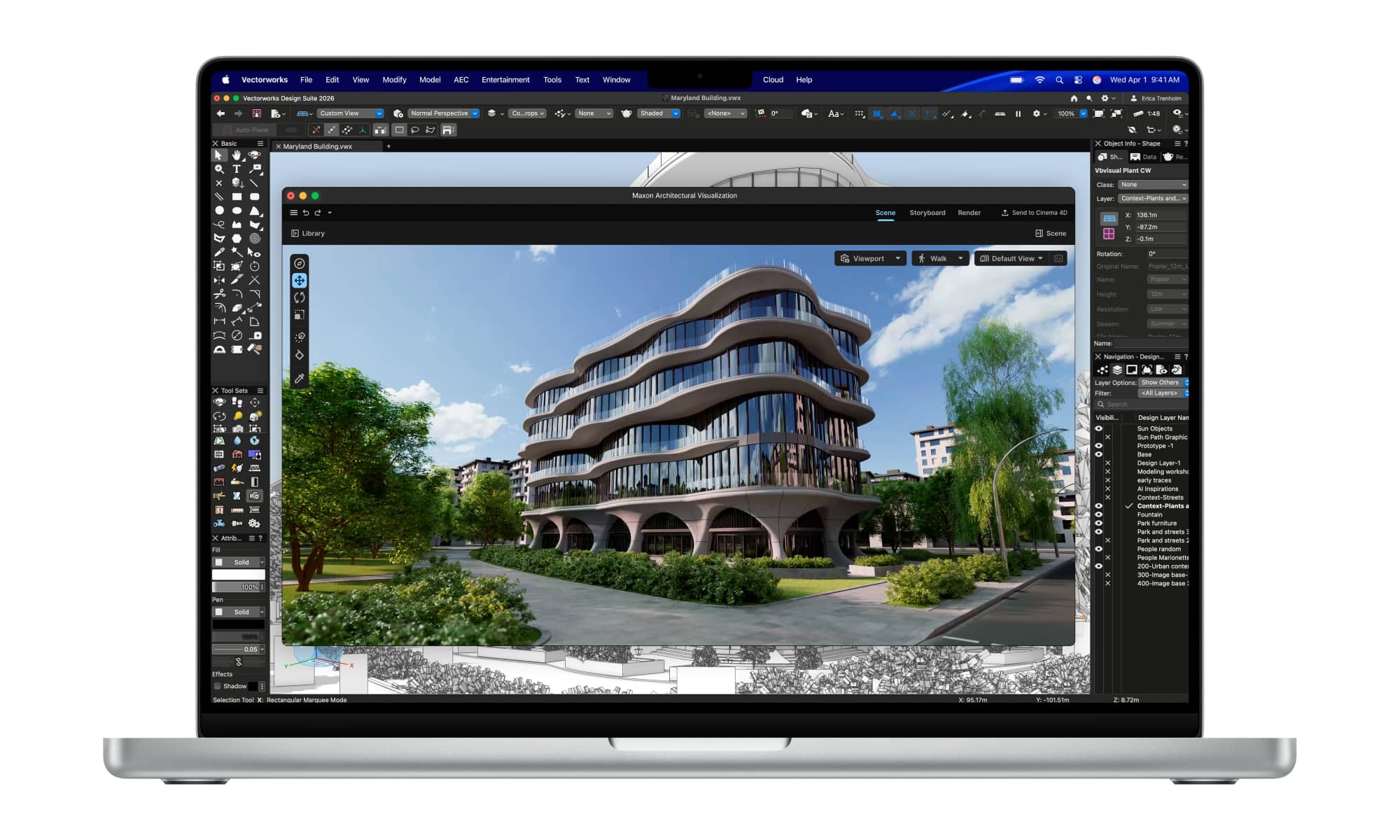
As usual, Apple is leading the way into its high-end silicon with new 14-inch and 16-inch MacBook Pro models, but it’s also still keeping with the trend over the past four years of making the chips the only real upgrade.
While Apple has much bigger plans in store for the MacBook Pro later this year, the new M5 Pro/Max models are effectively identical to their M4 Pro/Max predecessors and the M5 14-inch MacBook Pro that came out in October in every way except for the chip inside.
The design, dimensions, weight, and colors are the same, as they mostly have been since the M1 Pro/Max models arrived in late 2021, with only the 2023 addition of Space Black marking a slight change from earlier designs.
Of course, the new M5 Pro and M5 Max chips pack in all the healthy performance boosts we mentioned earlier, and it’s telling that this year Apple is not only making its usual comparisons against the original M1 Pro/Max models to show the massive performance leaps, but also factoring in how much things have improved year-over-year, especially on the AI side.
For instance, while the M5 Pro is up to 7.8x faster than the M1 Pro at AI image generation, it’s still 3.7x faster than last year’s M4 Pro. Similar gains have also been seen with LLM processing, although the improvements drop off when we leave the realm of Neural Engines and Accelerators.
MacBook Pro with M5 Pro and M5 Max redefines what’s possible on a pro laptop, now up to 4x faster than the previous generation. With Neural Accelerators in the GPU, the new MacBook Pro enables professionals to run advanced LLMs on device and unlock capabilities that no other laptop can do — all while maintaining exceptional battery life. Combined with even faster unified memory and storage, it empowers users to take their work even further, unleashing new possibilities and pushing the boundaries of what they can do.
John Ternus, Apple’s senior vice president of Hardware Engineering
Perhaps more significantly, the M5 Pro also raises the bar for RAM. While the M4 Pro capped out at 48 GB of RAM, the M5 Pro can now be configured with up to 64 GB.
That could save some folks from being forced up to the pricier M5 Max just to get that extra memory, although you’ll still need to go with the top-end model if you want an 8 TB SSD, as the M5 Pro tops out at 4 TB. Interestingly, Apple has dropped the 1 TB configuration from the M5 Max MacBook Pro, leaving all models now starting at 2 TB.
Both the M5 Pro and M5 Max models are also offered with two chip configurations, with a “binned” 15-core CPU and 16-core GPU option for the M5 Pro and an 18-core CPU and 32-core GPU option for the M5 Max. These chips also offer different memory configurations. Here’s a quick rundown of the memory and storage configurations.
| Model / Chip | RAM | Storage |
|---|---|---|
| M5 (10 CPU / 10 GPU) | 16 / 24 / 32 GB | 1 / 2 / 4 TB |
| M5 Pro (15 CPU / 16 GPU) | 24 / 48 GB | 1 / 2 / 4 TB |
| M5 Pro (18 CPU / 20 GPU) | 24 / 48 / 64 GB | 1 / 2 / 4 TB |
| M5 Max (18 CPU / 32 GPU) | 36 GB | 2 / 4 / 8 TB |
| M5 Max (18 CPU / 40 GPU) | 48 / 64 / 128 GB | 2 / 4 / 8 TB |
As you can see from the table above, Apple is largely repeating last year’s M4 Pro/Max RAM and storage tiers, including the oddball binned M5 Max, which remains available in a single 36 GB RAM configuration.
Last year, the M4 Pro was the sweet spot in the lineup, and we suspect that will prove even more true for the M5 Pro, which now features an identical set of CPU cores to the M5 Max, making the highest-end chip relevant only for those who need insane amounts of GPU power or RAM.