UNiDAYS or Bust: The End of Apple’s Education ‘Wild West’
Toggle Dark Mode
Over the years, Apple has traditionally taken a “trust but verify” approach to purchases made through its educational discount program in most countries, including the United States and Canada. However, that’s about to change as Apple implements a more formal verification program to confirm that those making educational purchases actually meet the eligibility requirements.
While Apple already requires educational customers in places like the UK to submit proof of their status, it’s traditionally taken customers at their word when making educational hardware and software purchases; only services like Apple Music required additional verification to qualify for a student discount. Instead, Apple relied on a “spot check” style auditing process where it reserved the right to ask buyers to submit documentation; however, this was rarely done.
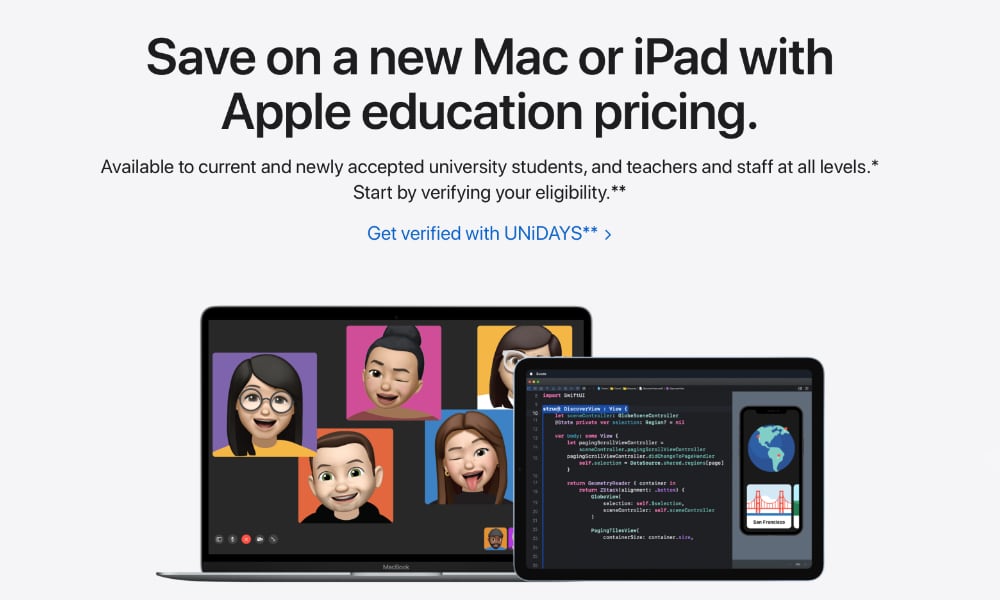
However, Apple is now expanding the UK verification program, which relies on UNiDAYS, to the US and several other countries, including Canada, Australia, Hong Kong, Turkey, and Chile. This means that customers will need to go through an automated pre-verification process before being allowed to even proceed with an order from Apple’s education store. This mirrors the process that’s already officially followed in Apple Stores, where buyers need to present physical ID and proof of status to receive the educational discount.
As with the system in the UK, the new online process will require the student or educator to go directly to UNiDAYS — either the website or the iPhone app — to verify their academic status. For most students enrolled in an institution of higher learning, this will often be as simple as logging into their school’s academic portal or verifying their status through an official email address associated with the college or university.
However, in some cases students may need to upload identity documents such as photo ID, student ID, transcript, or enrolment letter. Since families who homeschool are also eligible for Apple’s educational discounts, UNiDAYS will also accept an identity document and an appropriate proof of homeschooling, such as a formal Letter of Intent or Letter of Acknowledgement.
The automated verification process should typically occur in moments, but if a manual review is required, UNiDAYS will typically provide a decision within 24 hours.
This move should also help to clear up any confusion around eligibility for Apple’s educational discounts. For instance, many parents and high school students mistakenly believe they qualify, but in fact only faculty and staff of K-12 institutions are eligible to make purchases from Apple’s Education store. For students, eligibility is limited to those attending or accepted into a post-secondary institutions — either the students themselves or their parents. Those who homeschool their children are eligible for educationally discounted purchases in the “K-12 faculty” category as they’re effectively the teachers in this case.
Apple also places limits on how many devices can be purchased by an individual under the education discount, although these are primarily intended to prevent the program from being abused, as they’re quite generous, allowing for one new iMac, Mac mini, and MacBook to be purchased each year, along with two iPads, one Apple Watch, and two Accessories.
Apple Watch Joins the Education Store
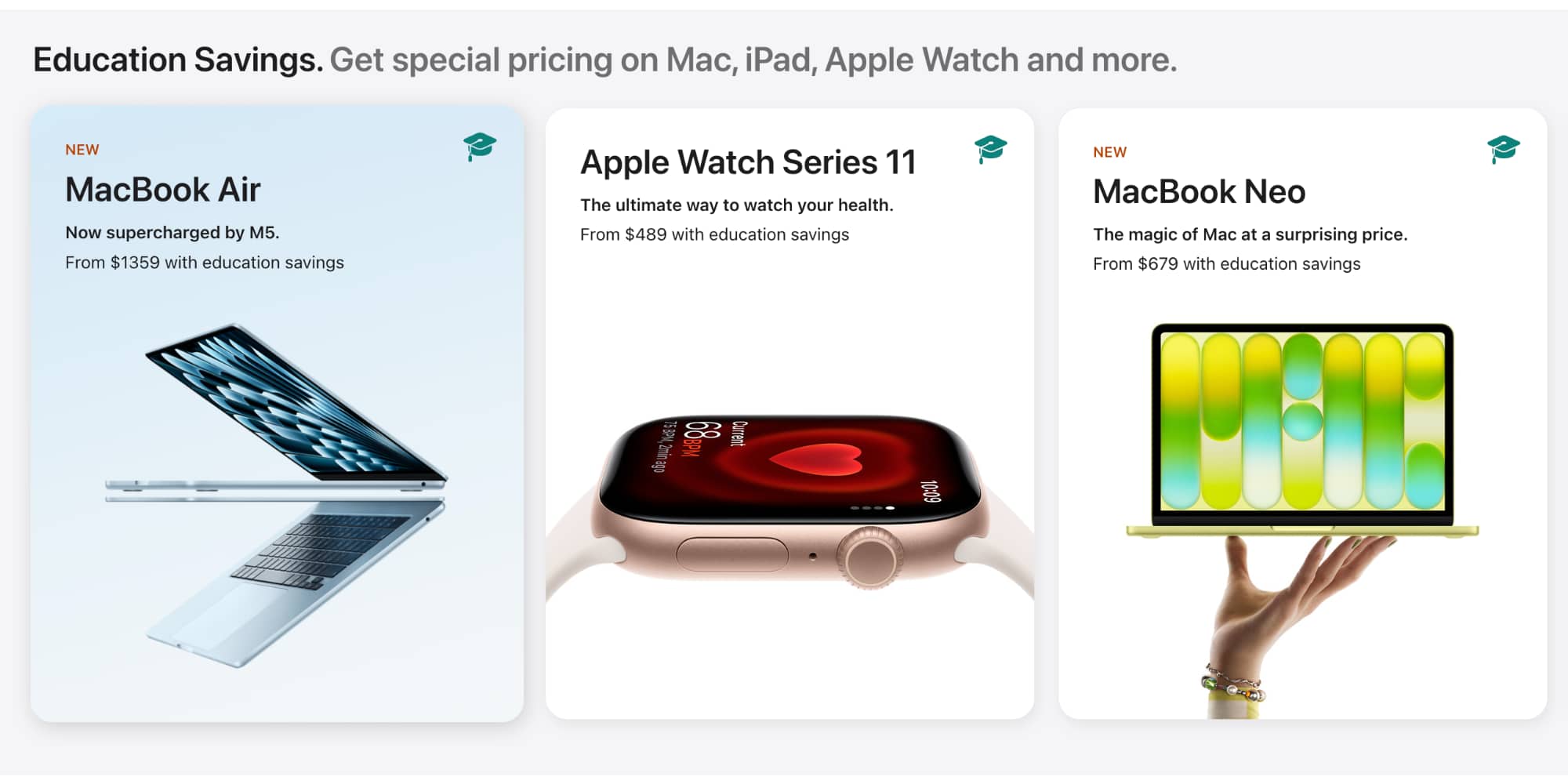
If you were paying attention, you may have noticed an addition to that list. While the Apple Watch was previously excluded from education discounts, Apple has also added it to the list of eligible products this week in several countries, including the six that are adding UNiDAYS verification and about a dozen others.
While it’s possible this new addition partly inspired Apple to tighten the rules around education discounts, it seems more likely this was triggered by Apple’s most insanely popular new entry: the MacBook Neo.
At $599, the MacBook Neo is already selling like hotcakes, and it’s not hard to imagine quite a few folks taking advantage of the $499 price tag — whether they’re technically eligible or not. To be fair, it’s not even that people are deliberately abusing the system; some parents are genuinely confused about Apple’s eligibility requirements, and with the MacBook Neo being an ideal laptop for high-school students, it’s not surprising that many parents genuinely believe they can pick one up at the educational price for their kids and simply don’t bother to read the fine print.
With graduation season upon us, that’s a good loophole for Apple to close. While students who are leaving high school and moving on to higher education certainly qualify — and can still register with UNiDAYS with nothing more than a letter of acceptance — parents will still need to pay the full $599 price for kids moving into high school unless they’re being homeschooled.
Apple is already struggling to make new MacBook Neo laptops fast enough to keep up with demand — and it’s also facing pricing pressure that makes giving away educational discounts much more challenging. While Apple isn’t about to abandon its “Chromebook killer’s” $599 sweet spot , forcing more customers to pay the proper sticker price will certainly help keep it more affordable for the institutions and students who actually do qualify for education.