One Last Record for the Road? Tim Cook’s Penultimate Earnings Call Is a $111 Billion Beast
 Chengdu Release
Toggle Dark Mode
Apple is wrapping up April with the announcement of its Q2 2026 earnings, marking the first three months of 2026, and as usual it’s shattering all previous records with overall revenue of $111 billion — a nearly 17% increase from the year-ago quarter and the first time Q2 earnings have crossed the $100 billion threshold.
It’s also notable that this is the first earnings call following this month’s bombshell news that Apple CEO Tim Cook will be leaving the CEO’s office in September, ending his 15-year tenure and handing the reins over to hardware engineering chief John Ternus.

Cook kicked off the earnings call that followed the quarterly results by reflecting briefly on his 28 years with Apple and 15 years as CEO and thanking investors for their support over the years. He also noted that this will be his 89th earnings call, although he’ll have one more to go in July, making an even 90. He expressed extreme confidence in Ternus, who also joined the call for a brief “cameo” to introduce himself as the CEO-to-be and expressed his enthusiasm for what lies ahead, including an incredible product roadmap — which he naturally declined to talk about.
We have an incredible roadmap ahead. And while you’re not going to get me to talk about the details of that roadmap, suffice it to say this is the most exciting time in my 25-year career at Apple to be building products and services. I couldn’t be more optimistic about what’s to come.
John Ternus
Cook then returned to highlight the lineup of exciting new products Apple launched during the quarter, while adding how the growth has been incredible despite supply constraints, particularly for the iPhone 17 lineup, which continues to see stellar double-digit growth even in the second quarter after its launch.
Today Apple is proud to report our best March quarter ever, with revenue of $111.2 billion and double-digit growth across every geographic segment. iPhone achieved a March quarter revenue record, fueled by such extraordinary demand for the iPhone 17 lineup. During the quarter, Services achieved yet another all-time record, and we were excited to introduce remarkable new products to our strongest lineup ever. That included the addition of the iPhone 17e and the M4-powered iPad Air, along with the launch of MacBook Neo, which is captivating customers all around the world.
Tim Cook
The Numbers
Apple’s second quarter covers the time frame from January to March, since its fiscal year runs from October to September, and it’s typically the company’s slowest quarter, as it comes on the heels of a busy holiday season and it’s typically punctuated by fewer new product launches.
That wasn’t so much the case this year, thanks to an exciting week at the start of March that saw the iPhone 17e, M4 iPad Air, M5 Pro and Max MacBook Pro, M5 MacBook Air, two new Studio Displays, and the unprecedented $599 MacBook Neo. However, it’s notable that most of these products didn’t go on sale until nearly half way through the month, yet they still seemingly contributed to a record-breaking second quarter.
Apple posted revenue of $111.18 billion, a 16.6% jump from the $95.3 billion in Q2 2025. As usual, that blew past Wall Street’s expectations, which had predicted only 9.5% growth, with revenue reaching $102.93 billion.
This is almost double the $58.3 billion that Apple earned in Q2 2020, which was the quarter before the COVID pandemic began locking things down. It made a nice climb to $89.5 billion in Q2 2021, but its high watermark before this year was actually Q2 2022, when it posted $97.28 billion. The numbers hovered around the $90-95 billion mark after that, so this year’s revenue is a significant jump from what was looking to become a trend.
Unlike Q1 2026, Apple posted growth in all five of its categories, with the iPhone growing by almost as much as it did last quarter, and Services showing even greater growth, hitting an all-time revenue record of $30.98 billion thanks to a surge in iCloud+ and Apple TV subscriptions. Meanwhile, the iPad, Mac, and Wearables categories (which also includes Home and Accessories) saw respectable single-digit growth, with iPad revenue buoyed by the continued success of the M5 iPad Pro and the budget-friendly A16 iPad.
| Segment | Q2 2026 Revenue | Growth (YoY) | Key Driver |
|---|---|---|---|
| iPhone | $56.99B | +21.7% | iPhone 17 Lineup & 17e |
| Services | $30.98B | +16.3% | iCloud+ & Apple TV Records |
| iPad | $6.91B | +8.0% | A16 iPad & M5 iPad Pro |
| Wearables | $7.90B | +5.0% | Apple Watch Ultra 3 & Series 11 |
| Mac | $8.40B | +5.7% | MacBook Neo & M5 MacBook Air |
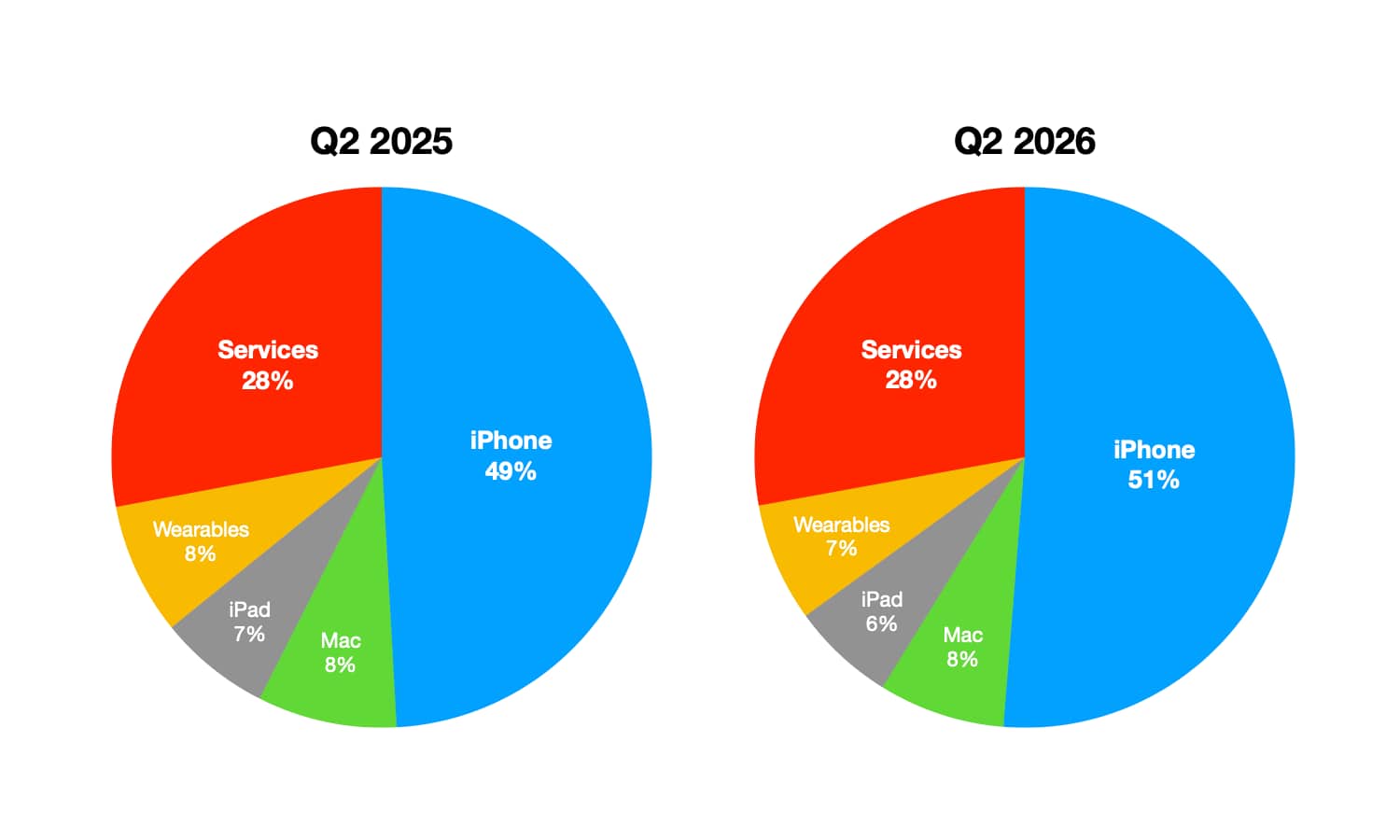
The distribution between the categories remained roughly the same, although the iPhone once again took the majority share at 51% of overall revenue, returning to the dominance it enjoyed in Q2 2024.
Surprised by Mac

Apple CEO Tim Cook once again touched on how March saw more people switching to the Mac than ever and the MacBook Neo is selling much better than expected, but he didn’t give all the credit for that to Apple’s most affordable laptop, since Apple launched three other MacBooks around the same time.
During the Q&A session that follows the earnings report, Cook expressed a few times how the MacBook Neo shattered even Apple’s wildest expectations. At one point, he described the customer response as “off the charts,” and said that even though Apple was “very bullish” before announcing it, the MacBook Neo still managed to sell faster than Apple has been able to keep up.
We’re seeing school systems like the Kansas City public schools switching from Chromebooks and Windows PCs to the MacBook Neo. Hearing anecdotally more and more of those stories at the school system level and the individual consumer level. We could not be happier with how things are going at the moment.
Tim Cook
However, the Neo wasn’t the only surprise. The Mac Studio and Mac mini have also apparently become hot commodities. While pundits have attributed the dwindling supply of these desktop Macs to “RAMageddon,” Cook said the real reason is that customers have figured out how powerful these boxes are for doing AI work and they’ve been gobbling them up. That makes the shortage still related to the “AI gold rush” — just at a higher level.
Mac mini and Mac Studio are amazing platforms for AI and agentic tools and the customer recognition of that is happening faster than we predicted, so we saw higher than expected demand.
Tim Cook
Cook added that it “may take several months” for these two Macs to “reach supply-demand balance,” so availability will likely continue into the next quarter and possibly even beyond.
The RAMpocalypse is Coming

By now it’s no secret that the entire industry is struggling with memory costs, and while Apple is more buffered against this than most companies thanks to its supply chain power and Cook’s legendary logistical prowess, it’s still a sword of Damocles hanging over the company.
Responding to a question on how Apple plans to handle this, Cook said that Apple has been pretty good at forecasting the impact of this, noting that he promised during the Q1 earnings call that there would be some impact on profitability in the March quarter — and there was — but it was offset by benefits from “carry-in inventory” — a term for the chips Apple already had on hand in this case. However, that’s about to change for Q3:
For the June quarter, we expect significantly higher memory costs, which will be partly offset by the benefit of carry-in inventory.
Tim Cook
Cook said he couldn’t really provide much “color beyond June,” except to say that Apple believes memory costs will “drive an increasing impact on our business.”
Nevertheless, Cook said the real issue in the short term isn’t memory but rather the availability of the advanced nodes that Apple’s SoCs — its A-series and M-series chips — are produced on. That’s the problem Apple is facing with the Mac Studio, Mac mini, and MacBook Neo, which makes sense, as Apple uses Unified Memory, which means this isn’t purchased separately but rather fabricated right into the chips.
It’s not because of a problem per se, other than we just under-called the demand. There are lead times to this and it takes a while to correct that. The primary constraint from a product point of view for the June quarter will be on the Mac and it’s the mini, Studio and Neo. It’s all of those.
Tim Cook
The iPhone 17 Family
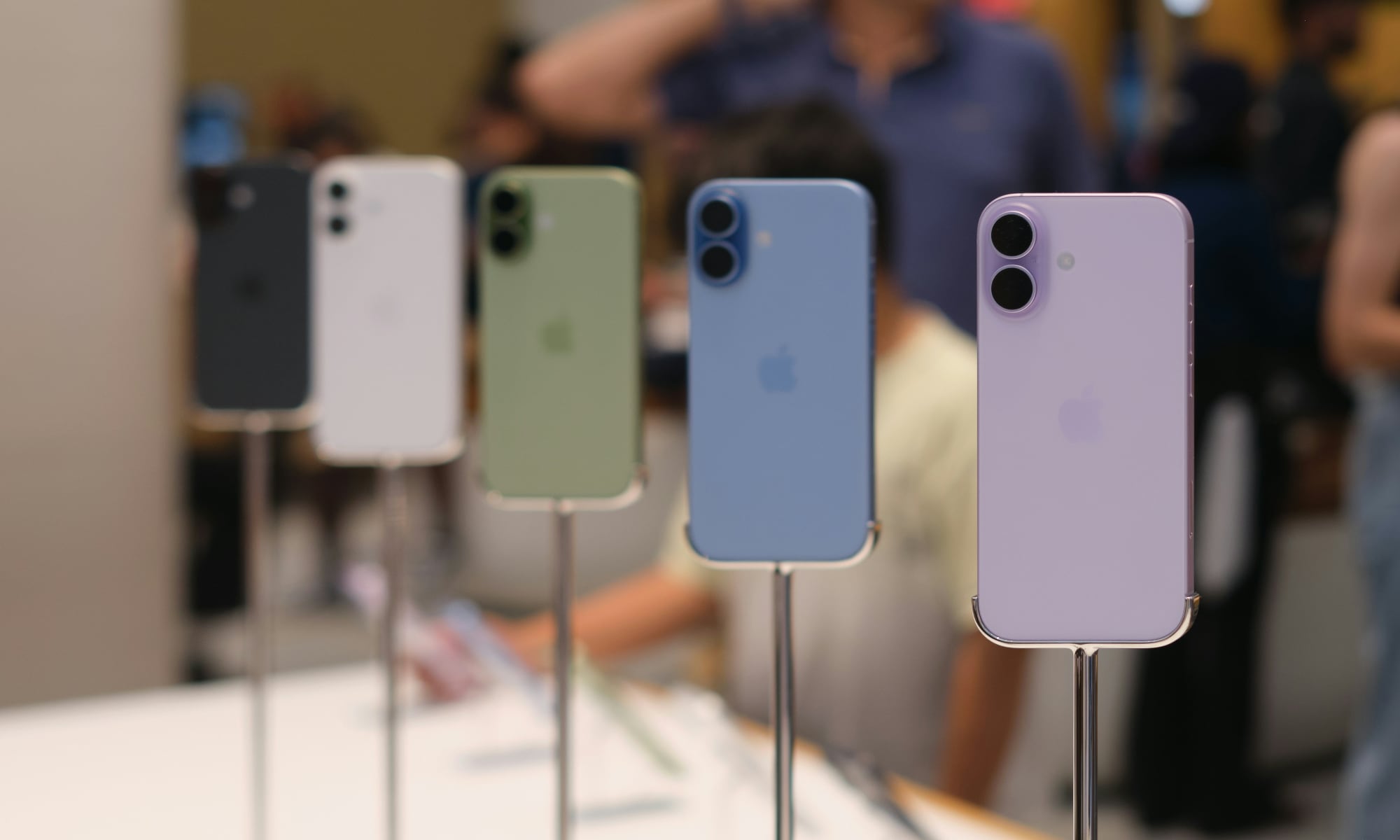
The one product Apple doesn’t expect to be supply-constrained is the iPhone. Cook didn’t comment on that when asked but instead pivoted to the Mac, making the comments we shared above.
Nevertheless, the iPhone 17 has driven unprecedented Q2 growth for Apple, and Cook surprisingly didn’t give too much credit to the iPhone 17e, instead focusing on the entire lineup.
When asked what he believes is driving the incredible growth even in the midst of Q2 supply constraints, Cook said basically “everything” about it, expressing how much customers love it across the globe, with double-digit growth in the majority of markets from US to Latin America to Greater China to India to Europe to Southeast Asia.
The iPhone 17 family is driving it. People love the design, love the performance, love the durability, love the camera, love Center Stage, and love that Apple Intelligence is integrated across the platform.
Cook added that Apple set another new record for upgraders, and he believes it’s ultimately the customer satisfaction for the iPhone 17 family, which sits at 99% in the United States. “These numbers are just unheard of,” he added.
‘Really Happy in China’ and ‘Over the Moon’ in India
Apple continues to do exceptionally well in China, across all product categories. Traffic in stores has grown by double digits, with the iPhone now the top-selling model in urban China, the Mac mini the top-selling desktop, and the MacBook Air the top-selling laptop.
However, it’s India that Apple now sees as its biggest growth opportunity. Cook shared how Apple has been “focused on this for a while,” since it’s the second-largest smartphone market and third-largest PC market in the world — and he says there’s plenty of room for growth, as Apple still has only a modest share of the market, and as more people are moving into the middle class, they’re discovering Apple products for the first time.
The majority of customers in all of our categories — from iPhone to Mac to iPad to Apple Watch — are new to that product there in India, which speaks very well to growing the install base there. I’m over the moon excited about India.
Tim Cook
‘Never Forget the North Star’
In response to a question on what advice he’s giving John Ternus for the next chapter of Apple, Cook talked about how the advice he received from Steve Jobs when he entered the CEO’s office — “I never want you to ask what I would have done. Just do what’s right.” — “lifted a huge burden” and served him well over the 15 years he’s been at the helm.
For John, I think my advice is, what I told him is that one of the most important decisions he will make is where to spend his time. I would spend it where the greatest benefit to the company and the users are, and never forget the North Star for the company.
We’re about making the best products in the world that really enrich others’ lives and if you keep focusing on that and make your decisions around that it will produce a great business and we’ll be able to build more products and do it all over again.
Tim Cook