Is OpenAI Building a Phone After All? Jony Ive’s AI Project Takes a Sharp Turn
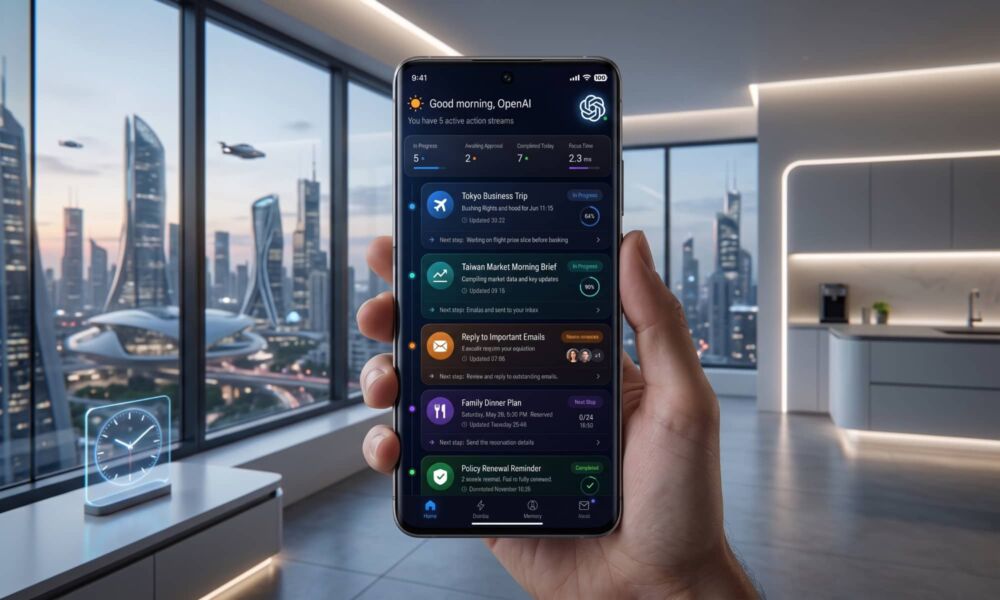 Concept image of an OpenAI smartphone [Ming-Chi Kuo / iDrop News / AI]
Toggle Dark Mode
Although OpenAI teamed up with Jony Ive last year to create the next big thing in AI hardware, a new report suggests it could be expanding its hardware ambitions beyond its mysterious accessories into the much more competitive smartphone market.
There’s been a lot of speculation on exactly what OpenAI’s Sam Altman is up to with Jony Ive, as the duo have been deliberately cryptic whenever they’re asked about their plans. They apparently collaborated quietly for at least a couple of years before formally announcing their partnership — a $6.5 billion all-stock deal in which OpenAI picked up Ive’s AI device startup — but all they’ve ever really said is what their hardware product won’t be.

Altman has said it’s not a pair of smart glasses, that it’s intended to “help wean users from screens,” and that Ive is shying away from traditional wearables. Instead, the pair described it as a “third core device” that would go on a desk alongside a MacBook Pro and an iPhone.
Unsurprisingly, the blogosphere was rife with speculation after all that. Analyst Ming-Chi Kuo suggested a pin-like device “with a form factor as compact and elegant as an iPod Shuffle,” while 9to5Mac’s Ben Lovejoy opined that we might see a smart pen in light of Ive’s fondness for such things and the uniqueness of such a device.
However, more recent reports have suggested a camera-equipped behind-the-ear wearable with the codename “Dime” or “Sweepea,” which could be preceded by a camera-equipped smart speaker, smart glasses, and a smart lamp.
While that contradicts some of what Altman initially said, it’s also fair to say that he was referring to a single device, and never promised OpenAI wouldn’t pursue other angles, and now it looks like it could even be going all the way to trying to create an ‘iPhone Killer’ — a direct challenge to the house Jony Ive helped build.
Can OpenAI ‘Redefine’ Smartphones?
At least, that’s what we’re hearing from Ming-Chi Kuo, who posted a lengthy tweet over the weekend claiming that OpenAI is working with both MediaTek and Qualcomm to develop custom smartphone chips optimized for AI, in the hopes of delivering the first smartphone built entirely on AI from the ground up.
Kuo believes this will “redefine” the smartphone by fundamentally changing how users interact with the device:
Users are not trying to use a pile of apps. They are trying to get tasks done and fulfill needs through the phone. This fundamentally changes how people think about smartphones. I made a smartphone interface concept design, shown at the end of this post, for comparison with today’s model, using the iPhone as an example.
Ming-Chi Kuo
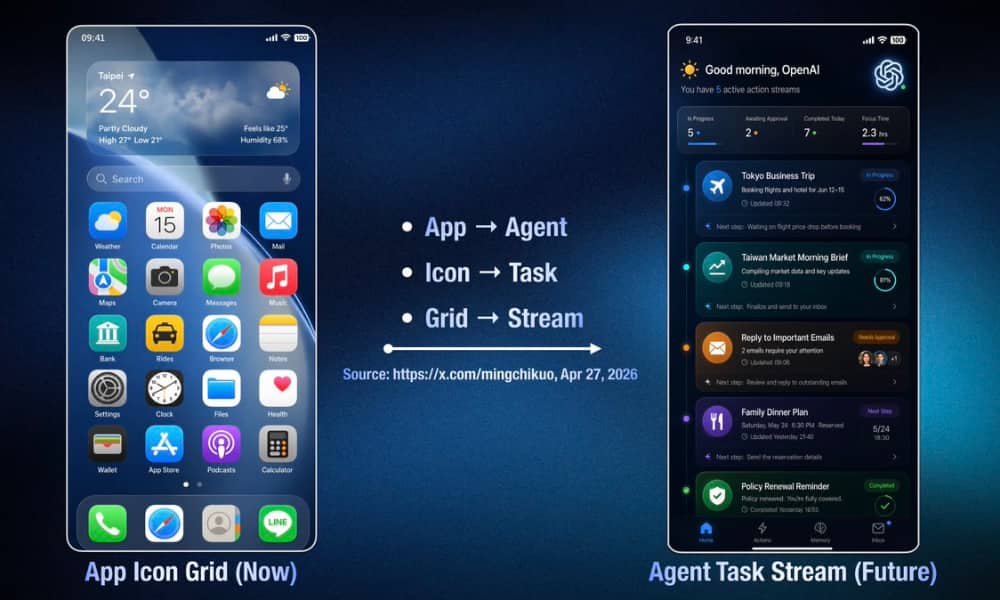
Kuo believes it makes sense for OpenAI to create its own smartphone for the same reason that Apple tightly controls its own hardware and software ecosystem. By owning all the pieces, OpenAI can guarantee that it delivers “a comprehensive AI agent service” while also ensuring it’s not hampered in its ability to “capture the user’s full real-time state” so that the AI agent can proactively respond to or even anticipate the user’s needs in real-time.
Plenty of theories have been swirling among the pundits on how smart glasses and other wearables will displace smartphones, and while that might be true someday, it’s not happening anytime soon. Kuo suggests that if OpenAI wants to run a profitable hardware business, it needs to create a mainstream device — and smart glasses and pins remain far from that.
Of course, it remains to be seen how many people really want a smartphone that’s fully powered by an AI agent. After all, iPhone sales have continued to surge despite Apple’s failure to deliver on all of its Apple Intelligence promises. For many, a lack of AI features is a stronger selling point than all the latest bells and whistles. AI can be equal parts helpful and creepy, depending on how you look at it, and if Kuo’s analysis is accurate, OpenAI is going to give a lot of folks cause for pause as it tries to use “years of accumulated user data” with continuous monitoring of the user’s interactions and context, potentially feeding even more data into the hungry AI beast.
Assuming these reports are even accurate — and that Altman and Ive can pull it off — OpenAI’s “iPhone Killer” is going to face an uphill battle. After all, proactive AI agents may sound great in sci-fi movies, but most of us are far less enthusiastic about the idea of having one watching our every move.
[The information provided in this article has NOT been confirmed by Apple and may be speculation. Provided details may not be factual. Take all rumors, tech or otherwise, with a grain of salt.]