Apple Maps Was Tim Cook’s Trial by Fire
Toggle Dark Mode
Apple’s 15-year chief executive spent some time waxing nostalgic this week after the formal announcement that he’ll be leaving the CEO’s office in September. In addition to penning a heartfelt letter to the Apple community, Cook held a morning-after all-hands meeting at Apple Park alongside CEO-designate John Ternus, during which he reiterated his love for Apple and reassured everyone that he’s healthy and looking forward to his new role as executive chairman.
While the meeting was strictly for Apple employees, these town hall meetings rarely stay in-house. The initial details leaked out almost right away, and we’ve gradually been hearing more as the week goes on. Last night, Bloomberg’s Mark Gurman shared some interesting details on what Tim Cook called his “first really big mistake” after taking the helm as CEO in 2011.

Anyone who was an active Apple user in 2012 could probably guess what that would be before he even said it: the launch of Apple Maps.
Apple Maps debuted in iOS 6, less than a year after Cook took office. The project was undoubtedly started under Steve Jobs, who had famously talked about “going thermonuclear” on Google’s Android operating system in 2010, and was certainly looking for ways to loosen Apple’s dependency on its rival, however it would have been entirely Cook’s call to go live with it — and we all know it was far from ready for prime time back then.
It turns out Cook knew this too — at least in retrospect. Part of Apple’s problem was that it took a rather myopic approach to the accuracy of the mapping data.
“The product wasn’t ready, and we thought it was because we were testing more of local kind of stuff,” Cook candidly admitted to staff during Tuesday’s town hall meeting.
Of course, it’s easier to say that in hindsight, and Apple has done a great job with Apple Maps in the years since, to the point where it can not only hold its own against Google Maps, but even surpasses it in some ways. The choice between the two apps today really comes down to a combination of personal preference and local accuracy; each one is still clearly better in some geographic areas, but there’s no longer a clear winner.
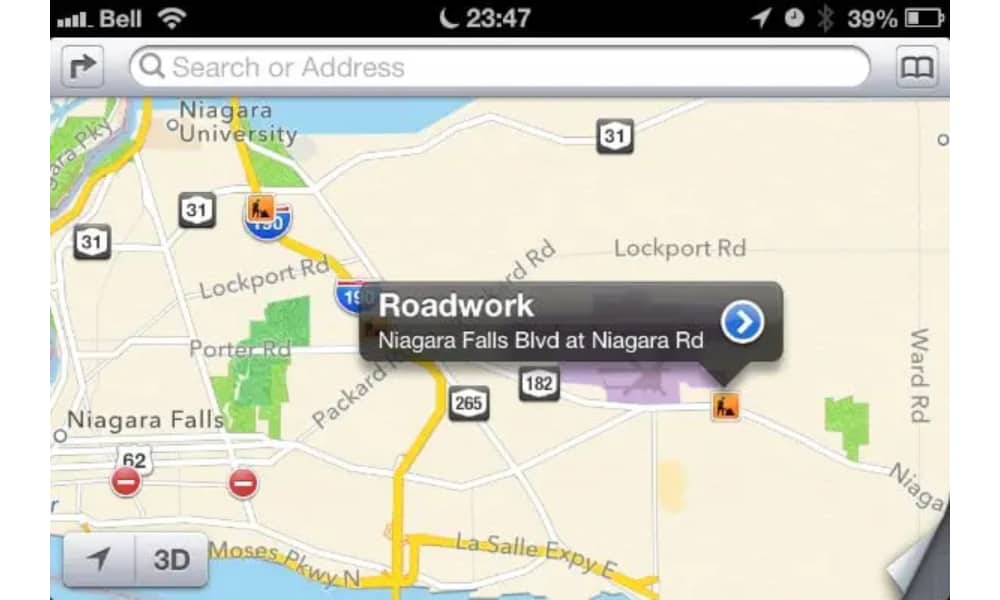
However, Apple Maps launched as a far cry from the app it is today. Landmarks were mislabelled, directions would take users into all sorts of bizarre places, including closed and in the wrong direction down one-way streets, and even sometimes led users into dangerous situations.
It’s not even clear if Apple’s executives truly believed it was ready in 2012, but there were external pressures involved. The iPhone Maps app was fully developed by Apple from the start, but Google provided the underlying data, and reliable insiders revealed that Google was demanding expanded access to iPhone user data — including location tracking — in exchange for delivering better, vector-based maps to Apple devices.
Giving up private data on its users was anathema to Apple, for both competitive reasons and maintaining user trust. As a result, Cook broke the maps deal with Google and turned the key on Apple’s own fledgling Maps project.
It wasn’t long after this that we saw the rare departure of a senior vice president — the first under Cook’s tenure — when software chief Scott Forstall was shown the door. While there were likely several reasons for this, Gurman suggests the Apple Maps debacle was a significant factor, especially after he refused to sign a letter apologizing for the debacle, which went out with Tim Cook’s name on it. However, that was also simply described as the final straw in a series of clashes between Forstall and other executives following Cook’s appointment as CEO.

Forstall worked closely with Steve Jobs on several projects, including Siri, and it’s never been clear if he pushed for Apple Maps to be deployed early, but there were other internal disagreements after the fact, with Forstall denying the Maps issues were serious enough to warrant a public apology, and that the widespread criticism was overblown and would blow over.
The executive who headed up Apple Maps, Richard Williamson, was also reportedly fired by services chief Eddy Cue, whose department was ultimately responsible for the Apple Maps service. Nevertheless, it was Cook who rightly took public responsibility, both then and now.
In an unusual move for Apple, Cook not only apologized for the frustration Apple Maps caused its customers, but specifically recommended alternative map apps from the App Store like Bing, MapQuest, and Waze, or even suggesting folks use Google Maps in Safari (since Google had yet to release its own standalone app at the time). Cook also promised to “keep working non-stop until Maps lives up to the same incredibly high standard.”
Cook echoed that in this week’s comments, saying “We apologized for it, and we said, ‘Go use these other apps. They’re better than ours.’ And that was some humble pie.” However, the seasoned CEO also called it a valuable expeirence, and “the right thing for our users,” adding that “Now we’ve got the best map app on the planet. We learned about persistence, and we did exactly the right thing having made the mistake.”