Early Benchmarks Show iPhone 17e Punching Well Above Its Weight Class
Toggle Dark Mode
While the plethora of products that Apple announced last week won’t be arriving in stores until this Wednesday, we’ve already been seeing some early performance benchmarks, presumably coming from reviewers and others with pre-release access.
On Friday, we shared how the MacBook Neo scored. The new budget Mac offered few surprises thanks to its A18 Pro chip, which is already a known quantity, although ranking it against M-series silicon provided some fascinating insights. Now, we’re seeing some early benchmarks for the iPhone 17e, and they’re also roughly in line with what we’d expect from the A19 chip packed inside.
After all, that chip isn’t a new quantity. Apple debuted the A19 in the iPhone 17 last fall, while the iPhone 17 Pro, iPhone 17 Pro Max, and iPhone Air all got the more powerful A19 Pro. Still, the iPhone 17e version not only features one less GPU core — four compared to five on the iPhone 17 — but there has also been speculation that Apple could be using an under-clocked A18 chip in its budget model.

However, many people put the same theory forward about last year’s iPhone 16e. It didn’t help that it does have slightly lower average Geekbench scores, but that was only a 2–4 percent gap, and individual scores consistently peaked at the same 3,500+ single-core performance as the iPhone 16.
There’s always a margin of error when it comes to benchmarks, especially since things like background tasks and thermal state can impact the results. With that in mind, the new Geekbench scores for the iPhone 17e should be taken with a healthy-sized dose of salt, especially since we have a relatively small sample size right now.
As of this writing, there have been 44 CPU benchmarks submitted to Geekbench — a number that’s almost certain to increase exponentially once the iPhone 17e starts getting into customers’ hands. To put this in perspective, well over 200,000 benchmarks have been submitted for the iPhone 17 since it was released last September.
| Device (Chip) | Single Core | Multi-Core | Metal |
|---|---|---|---|
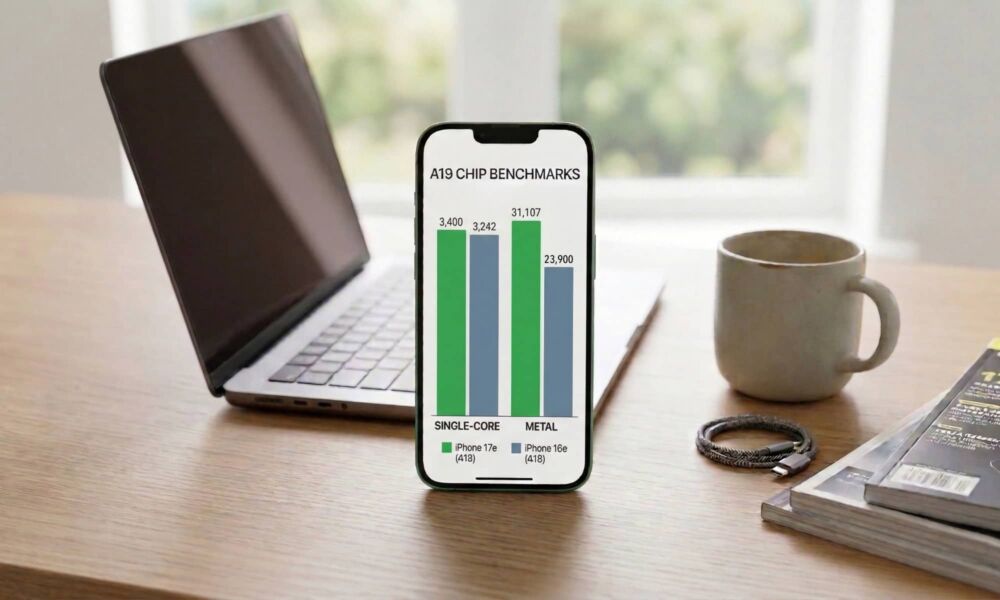
| iPhone 17e (A19) | 3,400 | 8,559 | 31,107 |
| iPhone 16e (A18) | 3,242 | 7,979 | 23,900 |
| iPhone 16 (A18) | 3,319 | 8,281 | 27,670 |
| iPhone 17 (A19) | 3,626 | 9,249 | 37,159 |
| iPhone 17 Pro (A19 Pro) | 3,778 | 9,805 | 45,578 |
| iPhone Air (A19 Pro) | 3,677 | 9,413 | 37,905 |
There have also only been 25 Metal benchmarks, which measure the chip’s graphics performance. Here’s how the average scores compare to its predecessor and siblings.
The lower Metal scores against the rest of the iPhone 17 lineup are to be expected, as the iPhone 17e only has four GPU cores in its A19 chip. Similarly, the A19 Pro chip in the iPhone Air is similarly hampered, with only five GPU cores against the six in the more powerful version found in the iPhone 17 Pro.
Still, what’s really surprising here is the significantly higher Metal score over the iPhone 16e, which points to a potential 30 percent increase in graphics performance compared to its predecessor.
The other numbers remain a bit of a mixed bag, with less impressive single-core and multi-core gains over last year’s model, and a surprising falloff compared to the iPhone 17, which should be using the same chip.
This could bolster speculation that Apple is indeed using an under-clocked chip here, but it’s too early to draw that conclusion just yet, and there could be other reasons for the lower results, including thermal issues that prevent the A19 from reaching its peak. It’s also notable that the Geekbench numbers are already running a wide gamut, with single core scores ranging from 2,989 to 3,685, and multi-core from 6,657 to 9,332, so the averages are far from settled until the sample size grows enough to filter out outliers like Low Power Mode runs or thermal-throttled tests.
Still, the bottom line for anyone considering the iPhone 17e is that it can safely be expected to perform as well as the current iPhone 17 at everyday task. Even if it’s slightly under-clocked, the gap in the above scores is insignificant in practical terms, and it should be a very healthy upgrade over both the iPhone 16e and the standard iPhone 16 when it comes to GPU performance.