From ‘Toaster-Fridge’ to Reality: The Touchscreen Mac is Coming
Toggle Dark Mode
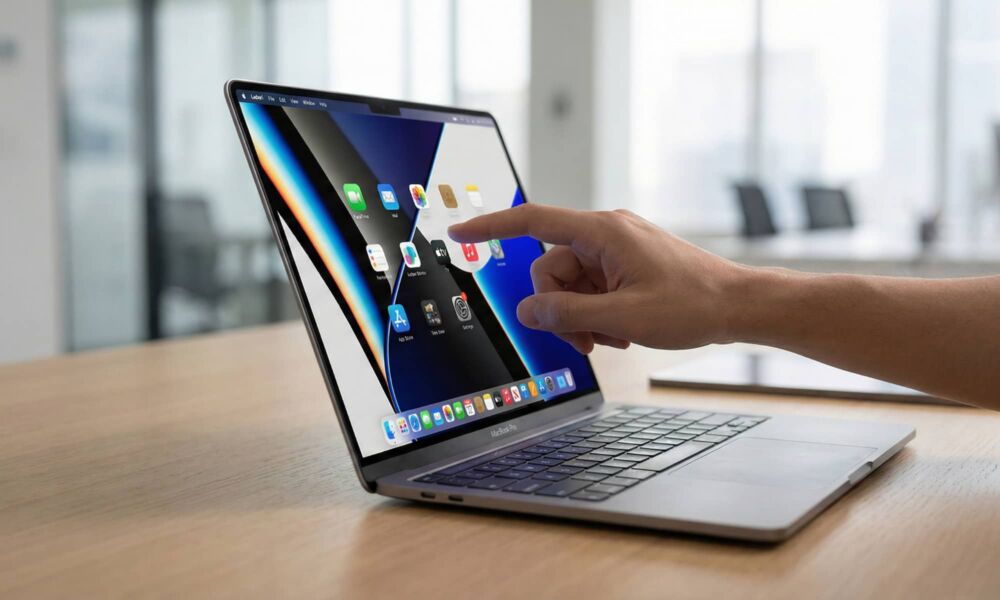
In September, Apple supply chain analyst Ming-Chi Kuo revealed that this year’s big MacBook Pro upgrade wouldn’t be so much the OLED display that’s been reported by multiple sources, but a long-anticipated touchscreen. While Kuo was initially a lone voice in the wilderness on that prediction, Bloomberg’s Mark Gurman chimed in to confirm it a few weeks later , and this week he’s followed that up with some additional details on what we can expect.
While multiple reports have pointed to a big redesign coming for the next-gen M6 MacBook Pro later this year — the ones that will ship after the M5 Pro and M5 Max spec bumps finally make it out of the door next month — and everyone agrees that it will finally make the transition to OLED, there’s been a lot less of a consensus on what else is coming.

Even Kuo’s report that the new MacBook models would “feature a touch panel for the first time,” didn’t go into any detail, leaving many to speculate on whether this would be a full touchscreen user interface or something akin to the old Touch Bar, but simply built into the screen. Some of the reluctance to get our hopes up stemmed from Apple’s opposition to the very notion of touch screen Macs, suggesting folks looking for that experience should simply buy an iPad instead.
Steve Jobs was famously dismissive of the idea, insisting that “Touch surfaces want to be horizontal” and Tim Cook has echoed that sentiment on several occasions since, insisting that distinct products are far better. “You can converge a toaster and a refrigerator,” he said in 2012, “but those things are probably not going to be pleasing to the user.”
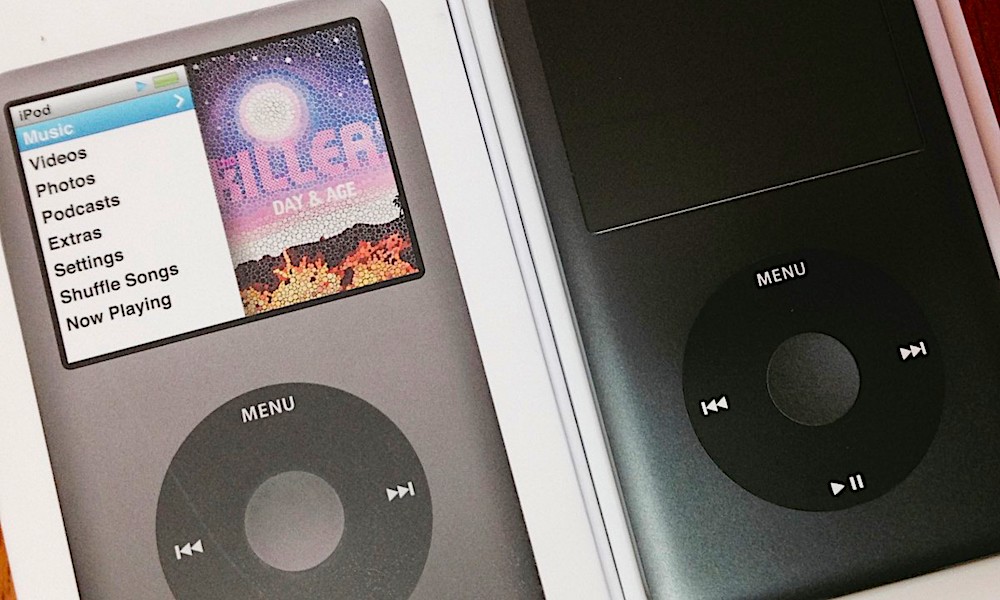
Of course, times change, and Apple is famous for dismissing an idea completely one year only to embrace it the next. Steve Jobs himself did that on several occasions, perhaps most famously with the fifth-generation iPod in 2005, which brought video to the 2.5-inch screen despite Jobs’ repeated insistence that nobody wanted such a device.
Now, more than 20 years later, it looks like Apple is about to make another about-face on one of its core beliefs. According to Gurman, this year’s MacBook Pro won’t just add a side of touchscreen — it will fully embrace it as a user interface.
To be fair, it’s not the first time we’ve heard Apple was exploring this idea. Gurman reported in early 2023 that Apple was working on it, but without any concrete information it was hard to tell exactly what the company had in mind or if it would even turn into a tangible product.
Now, with the switch to a whole new MacBook Pro design, Apple’s plans are beginning to come into focus. The M6 MacBook Pro will feature an OLED panel, likely using the same tandem display technology introduced in the extremely thin M4 iPad Pro to shave a few precious millimetres off the MacBook, but it also appears that Apple is planning to borrow another page out of the iPhone playbook.
When Apple last redesigned the MacBook Pro in 2021 for the Apple silicon era, it went with an edge-to-edge screen, moving the camera into a notch. Now, it looks like it will continue that transition with its next redesign, replacing that with the Dynamic Island, much like it did on the iPhone 14 Pro.
On the iPhone, however, the Dynamic Island serves as an expandable status bar, and it’s not clear exactly how Apple will implement that on a MacBook Pro screen where menu bar space is abundant. The Dynamic Island is also expected to be smaller, which makes sense as Apple still isn’t expected to use it to bring Face ID to the Mac, so there are fewer sensors to worry about covering up. However, Gurman still emphasizes that it will be a full Dynamic Island and not simply a circular camera cutout.
The Dynamic Island on the Mac will be built around a hole-punch-sized cutout for the computer’s camera. It’s smaller than the pill-shaped notch in current iPhones.
Mark Gurman
On the other hand, the Dynamic Island could become a more essential component of Apple’s touchscreen plans, as Gurman notes that “the Mac will gain a refreshed, dynamic user interface that can shift between being optimized for touch or point-and-click input.”
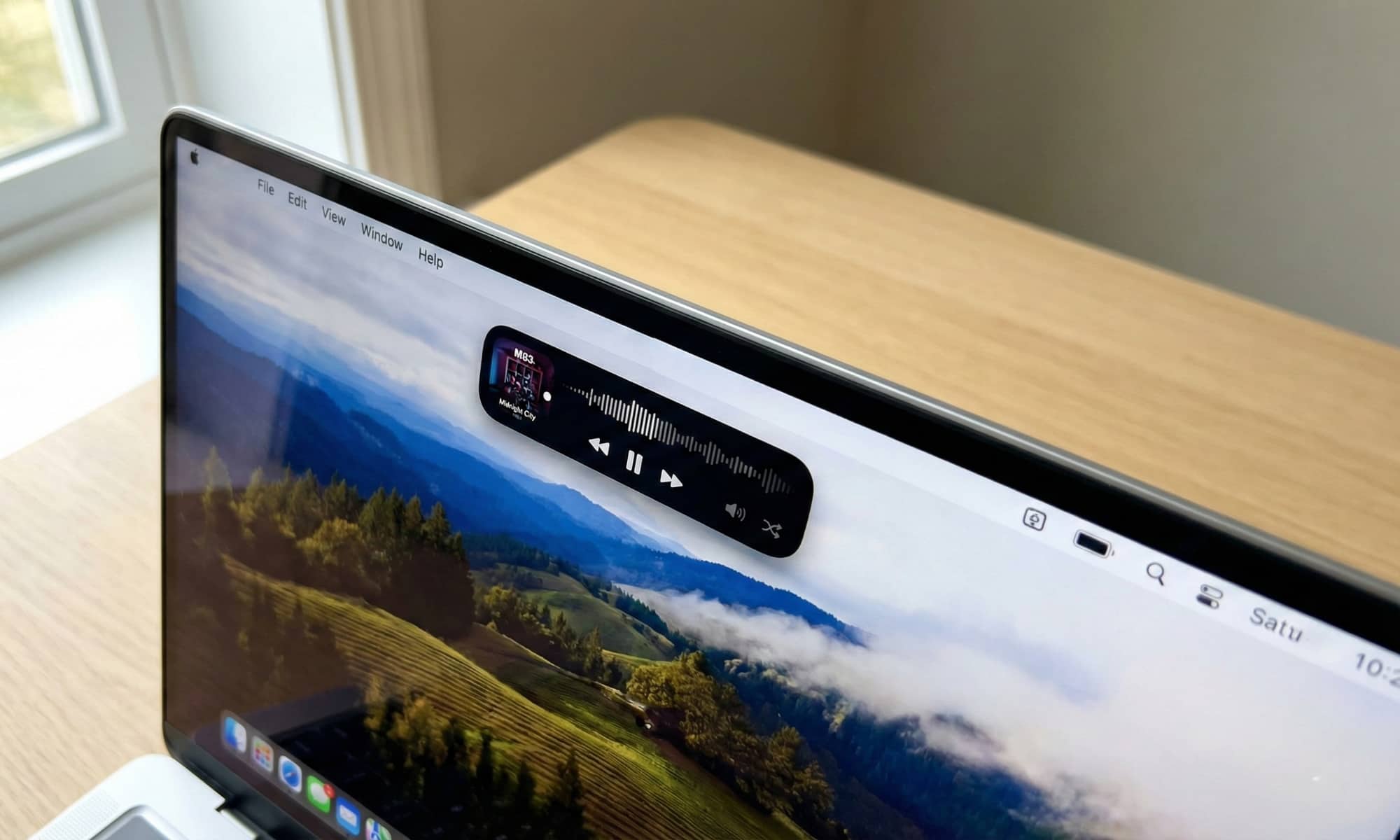
It’s not hard to imagine how a touch-optimized interface in macOS 27 might hide the standard menu bar, leveraging the Dynamic Island to provide a more intuitive way of accessing critical controls and notifications rather than forcing users to aim for small tappable targets on the status bar, and that seems to fit with what Gurman’s sources have told him about the UI.
For instance, if users touch a button or control, the interface will bring up a new type of menu surrounding their finger that provides more relevant options for touch commands. The goal is to give users the controls that make the most sense based on whether they’re touching or clicking.
Mark Gurman
The touch-optimized interface is expected to focus on selecting and interacting with on-screen items, and it sounds like it may feel like a hybrid of both macOS and iPadOS in that mode. However, one conspicuous but completely understandable omission will be touch-based typing. Apple isn’t building the MacBook Pro to be a Windows-style 2-in-1 device, and the iPad isn’t going anywhere for folks who actually want a tablet-first experience.
The M6 MacBook Pro is expected to retain a standard laptop form factor, so the physical MacBook Pro keyboard isn’t going anywhere, and some reports suggest Apple is looking at ways to reinforce the hinge to make the screen sturdier while users are tapping away, emphasizing that this will indeed be a laptop-style touch screen, not a hybrid tablet device.
[The information provided in this article has NOT been confirmed by Apple and may be speculation. Provided details may not be factual. Take all rumors, tech or otherwise, with a grain of salt.]