Jony Ive’s First OpenAI Project Isn’t a Wearable — It’s a ‘HomePod 2.0’
Toggle Dark Mode
It’s been nearly a year since former Apple design chief Jony Ive joined forces with OpenAI’s Sam Altman on a project to release a mysterious AI hardware device that they hinted would be like something we’ve never seen before.
The cryptic announcement was enough to get a lot of folks excited, considering that not only was Ive the design genius behind Apple’s most iconic products, but that he’d also brought some of the Apple dream team with him, including Scott Cannon, Evans Hankey, and Tang Tan. OpenAI also paid a cool $6.5 billion to buy out Ive’s startup, so they weren’t just dabbling in this.

So it’s no surprise that this kicked off a wave of speculation on exactly what Ive’s team and Altman were up to.
The only direct hint we got was that it would be “a totally new kind of thing” and “a third core device a person would put on a desk after a MacBook Pro and an iPhone,” according to The Wall Street Journal’s Berber Jin, who spoke to Ive and Altman shortly after the partnership was announced.
Other pundits also weighed in with their own predictions. Ming-Chi Kuo suggested a pin-like device “with a form factor as compact and elegant as an iPod Shuffle” that could be worn as a pendant around the neck, while 9to5Mac’s Ben Lovejoy shared the interesting idea that it might be a smart pen — a notion that didn’t seem all that fanciful considering both Ive’s fondness for such things and the uniqueness of the approach.
Still, the project remained extremely secretive until early this year, when leaks pointed to a ChatGPT-powered device code-named “Dime” or “Sweetpea” that had been delayed until early 2027. Those reports pointed to a potential behind-the-ear wearable that would feature a custom 2 nanometer chip and incorporate cameras, microphone arrays, and speakers to sense the wearer’s environment, although that was also said to be only one of several devices the team was working on.
However, while there are probably still a few more ambitious devices in the works, a new report from The Information suggests that the first Ive-Altman product may be considerably more underwhelming than the hype suggested.
HomePod Redux?

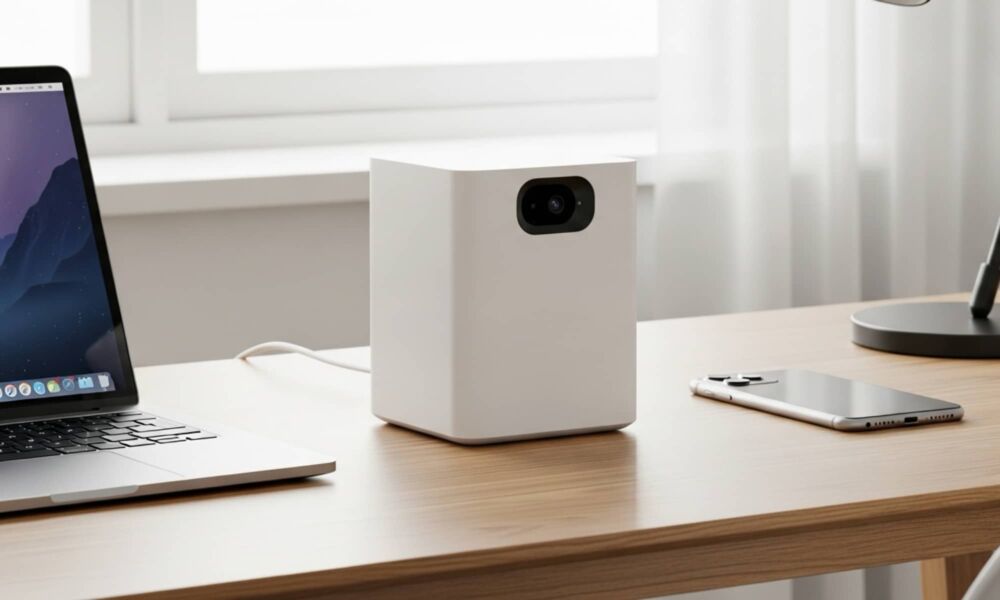
In the report, Stephanie Palazzolo and Qianier Liu reveal that OpenAI’s first device will be not a pin, earpiece, or smart pen, but something considerably more mundane: a smart speaker — and it sounds like Ive’s own attempt at a “HomePod 2.0.”
The smart speaker — the first device OpenAI will release — is likely to be priced between $200 and $300, according to two people with knowledge of it. The speaker will have a camera, enabling it to take in information about its users and their surroundings, such as items on a nearby table or conversations people are having in the vicinity, according to one of the people. It will also allow people to buy things by identifying them with a facial recognition feature similar to Apple’s Face ID, the people said.
Stephanie Palazzolo and Qianier Liu
If the report is accurate, the other two devices in the pipeline aren’t as revolutionary as we’d been led to believe either. The speaker will purportedly be followed by smart glasses and a smart lamp, but those aren’t coming until at least 2028.
To be fair, it may not be the form factor that counts here. If Ive and Altman can pull off their most ambitious goals, this smart speaker could take things up a big notch from anything we’ve seen yet. The integrated cameras and other sensors would not only power facial recognition, but also learn about its surroundings to give the AI assistant more context, such as how many people are in the room, what the lighting conditions are like, the ambient temperature and noise levels, and more.
It remains to be seen what it will be able to do with all that information, but OpenAI has told employees that it could be proactive at doing things like suggesting early bedtimes or exercise routines based on observed behavior and other data like calendar schedules. This is all something that OpenAI calls “Goal-Oriented AI.”
OpenAI may beat Apple to the punch here, but possibly only by a bit. We’ve been hearing reports that Apple is hard at work on its own “HomePad” hub device that would incorporate cameras and a screen, as well as new HomePod and HomePod mini smart speakers that will pack in more powerful AI-capable chips and possibly even an LCD panel on the larger model. However, many of these reports go back several years and have yet to materialize into a real set of products. Some of that is reportedly due to delays in getting Siri ready for prime-time, as it’s supposed to power the “HomePad,” but nothing we’ve heard suggests that even this is quite as ambitious. Apple’s plans for more sophisticated AI home devices are reportedly still in the very early stages.
Meanwhile, Apple is reportedly developing a trio of AI wearables — smart glasses, camera-equipped AirPods, and a pendant — although not all of these are guaranteed to turn into real products. They’re also expected to function largely as iPhone accessories rather than standalone AI devices, becoming the “eyes and ears” of Siri on the iPhone to provide more natural voice access and feed data into features like visual intelligence.
[The information provided in this article has NOT been confirmed by Apple and may be speculation. Provided details may not be factual. Take all rumors, tech or otherwise, with a grain of salt.]