
iPhone 17e Teardown Shows How to Add MagSafe to Your iPhone 16e (Sort Of)
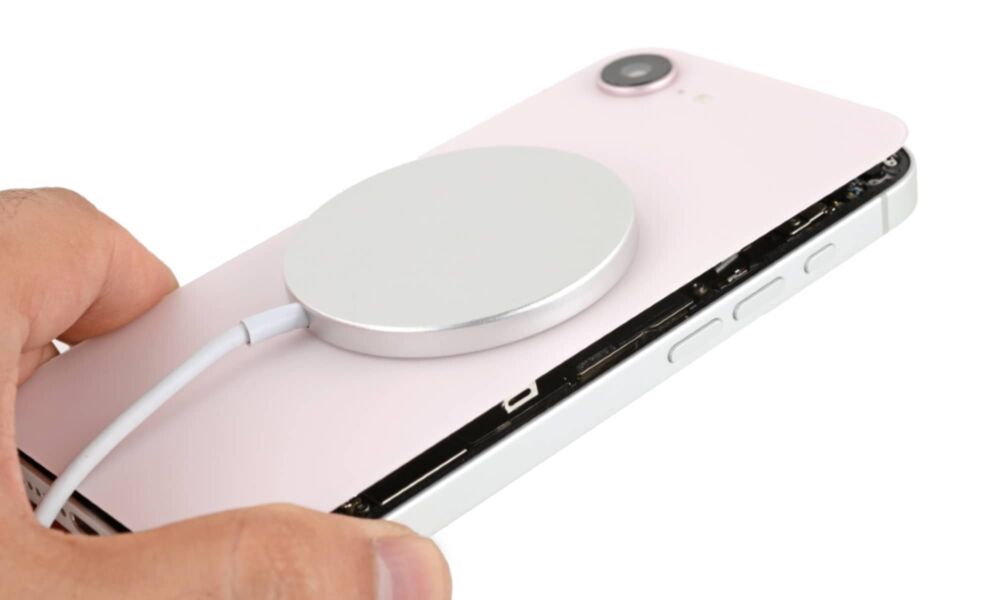 MagSafe Charger on an iPhone 16e [iFixit]
Toggle Dark Mode
Now that the tech world has finished tearing down Apple’s new MacBook Neo (literally), it’s time for the iPhone 17e to take a trip under the screwdrivers, and iFixit has been happy to oblige.
Earlier this week, the popular repair and teardown site took a deep dive into the iPhone 17e and discovered a few surprises — not in what was new inside the device, but in how little has actually changed from its early 2025 predecessor.

That’s fairly obvious from the outside: the iPhone 17e and iPhone 16e use the same 2022-era display first introduced in the iPhone 14, and the body design is identical save for a new soft pink color option in this year’s model. Really, the only things that have changed in the specs are some new chips — the iPhone 17e gets a bump to the A19 and C1X modem chips, compared to last year’s A18 and C1 — and the addition of MagSafe charging support. It’s that last part where things get interesting.
During its teardown of the iPhone 17e, iFixit found that the internals were every bit as identical to the iPhone 16e as you’d expect from the specs, and that nearly every part was swappable between the two models. Even an iPhone 16e logic board could be transplanted into an iPhone 17e (although you’d effectively be turning your new iPhone into an older one). The only real caveat here is the Face ID sensors, which won’t calibrate across devices due to Apple’s usual high-security pairing rules for biometric sensors.
However, the real surprise is that biggest upgrade in this year’s model — the MagSafe coil — is part of the back panel, and that panel is not only physically but also electronically compatible with the iPhone 16e.
In practical terms, that means that iPhone 16e owners could theoretically get a MagSafe upgrade simply by swapping out that one part. While it’s obviously not worth buying a whole iPhone 17e just to salvage it for parts to upgrade your older model, Apple has already published the iPhone 17e repair manual, complete with instructions for replacing the back glass, and it will undoubtedly begin selling those parts on its Self Service Repair Store in the near future.
That means an iPhone 16e owner could order the iPhone 17e back and use it to add MagSafe to their older model. However, when the folks at iFixit actually tried this, they found it didn’t deliver all the same capabilities of the iPhone 17e’s MagSafe implementation.
It’s not a 100% identical experience: Your 16e won’t inherit the “thonk” noise and MagSafe animation, and it won’t pop into StandBy mode when you’re MagSafe charging and your phone is on its side.
Elizabeth Chamberlain, iFixit
In fact, using an iPhone 17e back on an iPhone 16e doesn’t really appear to do anything more than add the magnets. The iPhone 16e lacked MagSafe, but it did support the same Qi 7.5W wireless charging that was standard on the iPhone SE and other pre-MagSafe models — the 2017–2019 iPhone 8 through iPhone 11 lineups.
Putting the MagSafe ring onto an iPhone 16e allows it to dock magnetically with MagSafe adapters, but iFixit confirmed you don’t actually get the 15W MagSafe/Qi2 charging speeds that the iPhone 17e is capable of. They measured an iPhone 16e drawing up to 10W when they added the glass back from the 17e, and also believe it’s “plausible that a 16e with the MagSafe alignment might even draw closer to 15W,” although that last part seems to be purely conjecture at this point. The actual charging speeds will depend largely on the charging circuits in the iPhone itself, as those determine how much power is drawn from a Qi charger — the coil just delivers it.
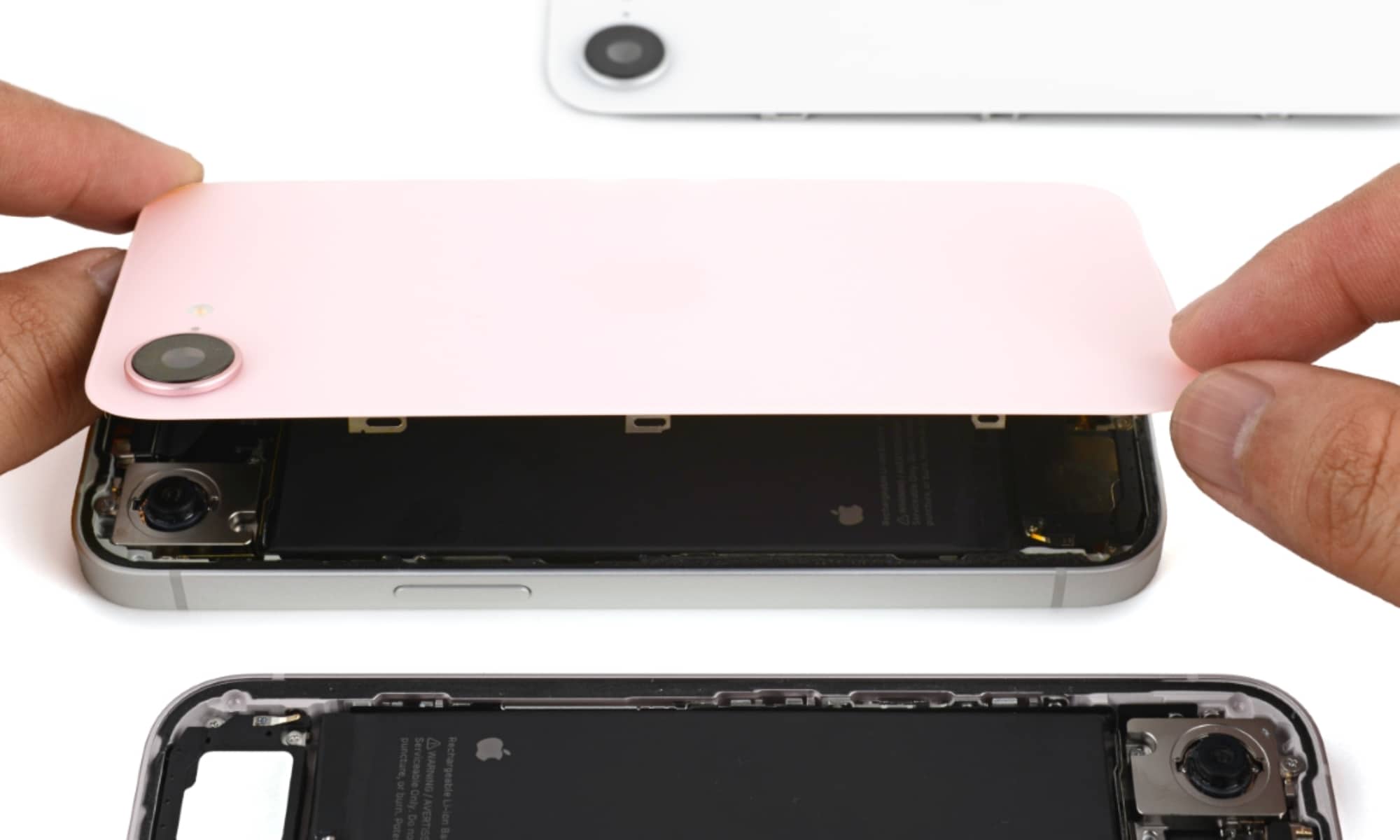
How much will this upgrade cost? Well, Apple charges $159 for the back glass for most recent iPhone models in the same class, including the iPhone 16e, iPhone 16, or iPhone 17, so we can safely assume the back glass for the iPhone 17e will come in at the same price. That goes down to around $120 after you return the original part, but iFixit notes that you can find equivalent parts from third-party suppliers for around $20. Is it worth the effort? For most folks the answer is probably no; after all, you can get a MagSafe case that will give you nearly the same effect and it doesn’t require you to open up your iPhone. Still, DIYers who like to tinker might find it a fun exercise, if nothing else.
This also isn’t the first time we’ve seen iPhones using interchangeable parts. The 2020 iPhone SE and 2017 iPhone 8 had a similar relationship, since their designs were nearly identical, and even the iPhone 12 and iPhone 12 Pro were found to have surprising similarities, including identical displays that could be swapped between models, revealing that Apple was artificially limiting the brightness of the panel in the iPhone 12.






