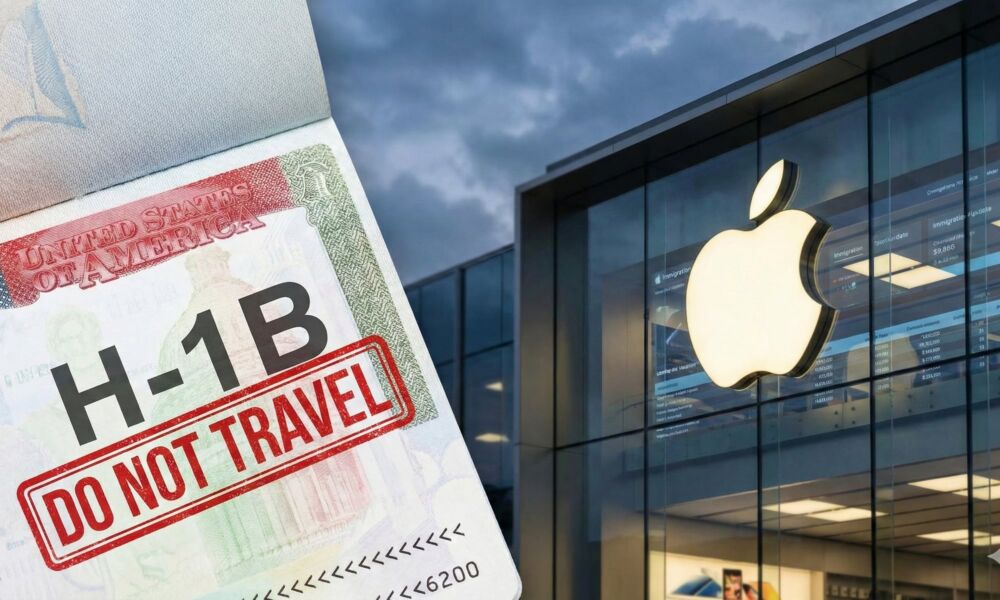
Apple Warns H-1B Staff: Stay in the US or Risk a Year-Long Re-Entry Delay
Toggle Dark Mode
Apple, Google, and Microsoft have told their staff to stay in the United States if they need a visa stamp to return to the country, according to Business Insider.
Tech firms have long taken advantage of foreign work visas, in particular the H-1B visas that allow them to employ foreign graduate workers in specialty occupations. In 2020, President Donald Trump signed an executive order suspending the issuing of new H-1B visas. While Apple initially objected to that policy, it was specific to obtaining new H-1B visas. However, Apple is now concerned about staff who already have the visa.
Employees currently in the US require a valid visa stamp in their passport to re-enter the US. Business Insider reports that lawyers for Apple, Google, and Microsoft are pointing to new delays in the process that could push things back by as long as a year.
These come due to a revision to the H-1B re-entry process that took effect on December 15, 2025. Overseas embassies and consulates must now conduct what the Trump administration calls “online presence reviews,” which involve an active audit of five years of social media history across all accounts and services.
Applicants are also now required to make their social media profiles fully public to facilitate this vetting, with private accounts leading to ‘negative inferences’ that can trigger year-long administrative delays. This rigorous vetting applies not only to H-1B visa holders but also to their spouses and children on H-4 visas, as well as to those on student visas, many of whom are interns with big tech companies.Feature Pre-December 2025 Post-December 15, 2025 Social Media Data List handles for past 5 years Mandatory audit of past 5 years Account Privacy Private accounts generally accepted Must be set to “Public” Primary Red Flags Terrorist ties / Criminal history “Anti-American” views / Censorship involvement Processing Impact Standard (Weeks/Months) Up to 12-month backlog
The New $100,000 Barrier to Global Talent
This new policy is the latest in the Trump administration’s longstanding efforts to limit immigration. Earlier this year, the White House announced a $100,000 filing fee for new H-1B visas that took effect on September 21. Many big tech firms, including Apple, have protested these policies since they began to take shape during Trump’s first term in 2017.
Nevertheless, these firms have little choice but to comply with the new rules and do their best to limit the potential consequences for their talent base. Apple’s law firm, Fragomen, has reportedly warned visa holders employed by the company not to travel.
“Given the recent updates and the possibility of unpredictable, extended delays when returning to the U.S., we strongly recommend that employees without a valid H-1B visa stamp avoid international travel for now,” the firm told visa holders. “If travel cannot be postponed, employees should connect with Apple Immigration and Fragomen in advance to discuss the risks.”
Microsoft’s visa-holding employees received a similar warning from the company’s associate general counsel for immigration, Jack Chen. “For employees currently stuck abroad, we know this is an anxious moment,” he wrote.
“We will provide clear and orderly guidance to you directly as soon as we can,” Chen continued. However, he also advised affected staff to “strongly consider changing” their travel plans if at all possible. “There are limitations to your ability to perform work for your US role during that period,” he wrote.
A spokesperson for the State Department told Business Insider “While in the past the emphasis may have been on processing cases quickly and reducing wait times, our embassies and consulates around the world, including in India, are now prioritizing thoroughly vetting each visa case above all else.”
Tim Cook’s High-Stakes Diplomacy
While Apple CEO Tim Cook has a history of mollifying Trump to gain favor with the administration over such issues as tariffs, he hasn’t hesitated to risk Trump’s ire on other matters like DEI and immigration, where he openly criticized the President’s policies and even considered legal action during Trump’s first term.
Google’s CEO, Sundar Pichai, also condemned the executive order, saying “Immigration has contributed immensely to America’s economic success, making it a global leader in tech, and also Google the company it is today. Disappointed by today’s proclamation – we’ll continue to stand with immigrants and work to expand opportunity for all.”
While the H-1B program has traditionally allowed up to 85,000 “specialty workers” to bolster the US tech sector annually, these tighter policies — the $100,000 fee and the exhaustive five-year digital audit — represent a fundamental shift in the talent pipeline. For companies like Apple, Google, and Microsoft, the “American Dream” they once touted as a recruitment tool is being replaced by a simpler, more urgent directive to their global talent: don’t leave the country if you want to keep your job.