Free Falling: How an iPhone 17 Pro Survived a 3,600-Foot Drop
 CBC News
Toggle Dark Mode
It’s a report that may sound unbelievable for anyone who’s held an iPhone 17 Pro in their hands, but one fortunate iPhone owner in Canada managed to beat the odds after she dropped her new iPhone from an airplane.
A video reel on the Canadian Broadcasting Corporation’s (CBC) Instagram shared the tale of how Heather Cline, a mixed-media artist, and her husband were flying in a Cessna Skyhawk over rural Saskatchewan, near Regina. While Cline’s husband, David Stanchuk, flew the plane, Heather leaned out with her new iPhone 17 Pro to capture some inspiration for a new project she was working on.

In the video, Heather says she’d ordered a grip “that would make it feel more like a traditional camera,” but since that hadn’t come, she was using a “cheesy-little lapel case.” Unfortunately, while Heather said “it was a great day for flying,” anyone who’s flown a small airplane will tell you it can also be a very windy experience.
Since Heather also hadn’t gotten used to where the camera lenses were on the new iPhone, she was trying different angles, and it wasn’t long before the airstream “sucked the iPhone right out of the case.”
So we orbited around a couple of times to make sure I had a good GPS location of where it was, because it was still appearing on the ‘Find My’ thing, so… then let’s go home and get in the truck and come back and look for it.
David Stanchuk
The couple eventually found the iPhone in a canola field (not exactly a hard target to hit in Saskatchewan), but the surprising part was that it was completely unscathed.
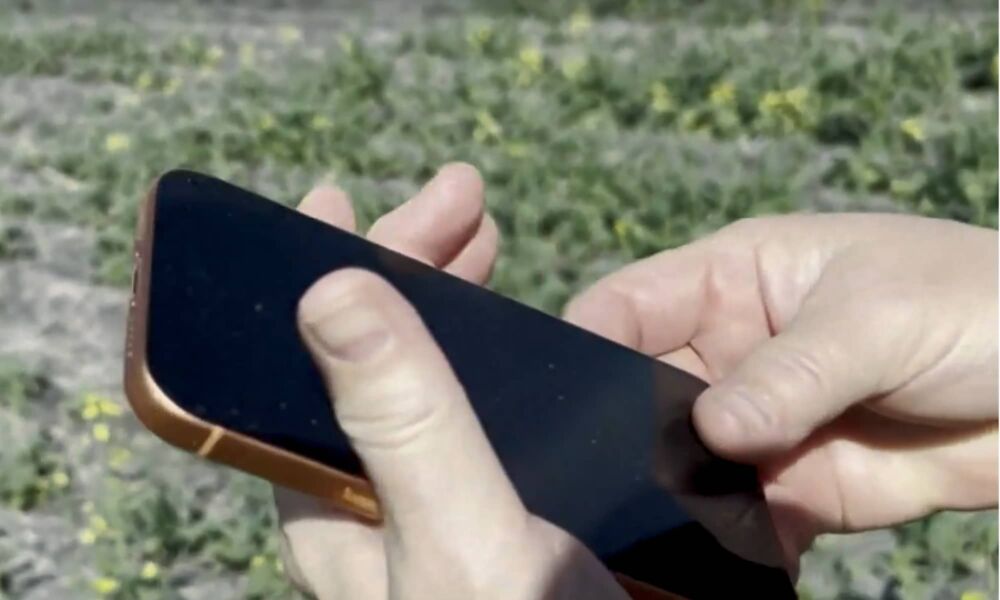
“I think it’s gonna be buried in the dirt, smashed, crazy,” Heather said. “I literally look down, the phone’s sitting there, face-up, just up against a few strands of canola. And it’s like, pristine.”
A Miracle? Or Just Physics?
Considering early reports of how scuffed up iPhone 17 Pro models were just from sitting in Apple Stores, it sounds like Cline’s iPhone was leading a charmed life. However, the reality is probably a bit more nuanced.
Firstly, “pristine” is a subjective term here. Heather Cline didn’t say whether it was completely free of scratches or nicks. The new unibody aluminum of the iPhone 17 Pro models is much softer than the stainless steel and titanium materials used in past models, but Heather also had a cosmic orange iPhone, which tends to show these far less than the deep blue version.
However, it also didn’t hurt that it landed on a relatively soft surface. My own cosmic orange iPhone 17 Pro Max got its first tiny nick after a fall from the edge of a bathtub onto a tile floor.
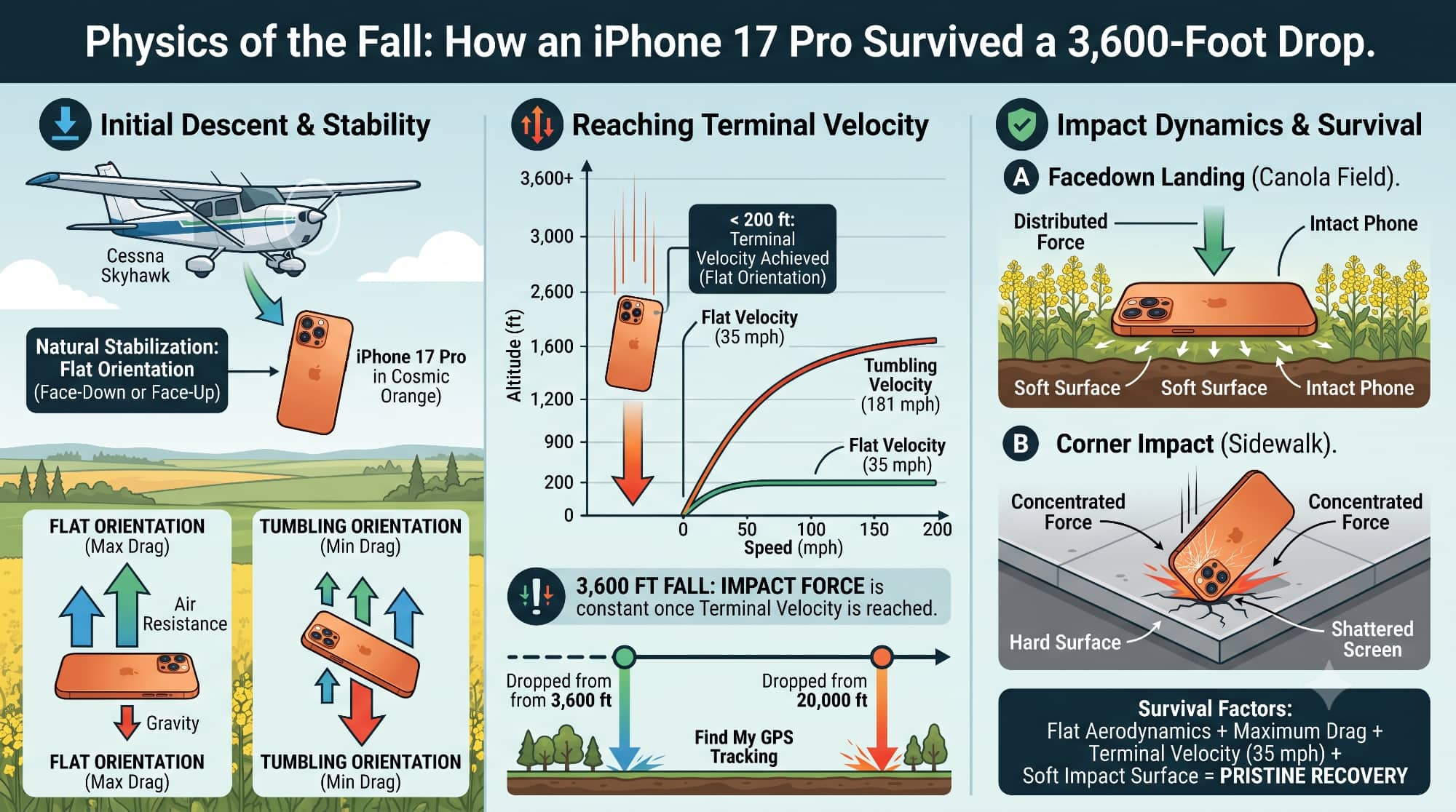
The real issue, though, is aerodynamics and impact surface. Plenty of real-world experiments have proven that flat objects — like an iPhone — have a tendency to stabilize and descend in a mostly face-down or face-up orientation. This makes them more subject to air resistance (drag), slowing their descent. It also means that once they do land, the force of impact is distributed evenly across the front or back — they “slap” the ground flat rather than hitting on a corner.
While Apple’s Ceramic Shield glass isn’t impregnable, a facedown landing in a grass field is a lot different than the concrete surfaces that come at the end of most professional drop tests, which usually present realistic worst-case scenarios. After all, both statistics and Murphy’s Law say you’re much more likely to drop your iPhone on a sidewalk or in a parking lot than on your front lawn.
There’s also the fact that while a 3,600-foot drop seems like it would cause more damage, objects eventually reach “terminal velocity” — their maximum descent speed — after a much shorter distance. Back-of-the-envelope math says an iPhone 17 Pro will fall at a speed of between 35 and 181 miles per hour, depending on the orientation it’s falling in, with the lower number being for a more common flat orientation, in which case it also reaches that velocity after less than 200 feet.
This means an iPhone is likely to hit the ground with the same level of force whether it’s dropped from the top floor of a tall apartment building or from an airplane cruising at 20,000 feet.
That’s not to say there isn’t some luck involved here. While objects like iPhones tend to flatten out during free fall, this isn’t always the case. Still, they have far more time to correct their orientation during a drop of several hundred feet than they do when falling out of your hand onto pavement, or sliding off a bathtub edge onto a tile floor.