A 9 GB iPhone 18 Could Be Apple’s Weirdest Silicon Compromise Yet

Toggle Dark Mode
Brace yourselves for a big change to Apple’s lineup this year, as we’re not expecting the iPhone 18 to arrive until next spring, when Apple will reportedly unveil it alongside its next budget model, the iPhone 18e. However, even though it’s still months away, we’re already seeing some hints as to what we can expect from both of Apple’s lower-end models.
Since the iPhone 18 Pro and iPhone 18 Pro Max will be joined by a new foldable iPhone — the so-called “iPhone Fold” or “iPhone Ultra” depending on which side of the rumor mill you’re on — Apple has reportedly decided it’s better to leave the base iPhone 18 model off the lineup. The two “pro” powerhouses are expected to build on the iPhone 17 Pro models with a new A20 Pro chip and variable aperture camera, while the iPhone 18 will undoubtedly still be a modest improvement.

In fact, it might turn out to be more modest than we thought. Despite a report earlier this month that Apple planned to upgrade it to 12 GB of RAM, since that’s a requirement for it to run Apple’s advanced AI Foundation Models that handle things like expressive voices for iOS 27’s new Siri AI, a reliable analyst is suggesting Apple has a stranger middle ground in mind.
According to Ming-Chi Kuo, who is often pretty good at reading Apple’s tea leaves, the A20 chip in the iPhone 18 is expected to get a RAM upgrade, but it won’t be going all the way to the 12 GB of RAM found in this year’s A19 Pro chip (and likely to grace the A20 Pro this fall). Instead, Apple is only moving the needle up a tiny notch — to 9 GB.
In any other era of the iPhone’s history, this would sound absolutely preposterous, but it’s sadly not too surprising considering the skyrocketing costs of securing DRAM.
Earlier this month, Tim Cook — Apple’s outgoing CEO and a battle-scarred veteran of the electronics supply chain — told The Wall Street Journal that he’s never seen a commodity price swing like this one in his 40 years of experience, calling it a “hundred-year flood.” A week later, Apple dramatically hiked prices on nearly everything it sells, leaving only the iPhone, Apple Watch, and AirPods out of the fray — for now.
The consensus is that iPhone price increases are coming, but that Apple will likely just wait until the fall when it unveils the iPhone 18 Pro models. At that point, the iPhone 17 and iPhone 17e may also see a hike — especially considering that the budget darling MacBook Neo wasn’t immune to the latest round.
This would set expectations for the iPhone 18 when it arrives next year, but Apple is also doing everything it can to keep its iPhone models as affordable as possible — and that’s especially true for the base models. In the economy of two years ago, 12 GB likely would have been a given; today, Apple needs to shave off every silicon edge it can.
Along similar lines, Weibo-based leaker Digital Chat Station posted a claim this week that the iPhone 18e won’t be getting a 120 Hz ProMotion display upgrade. To be fair, that’s mostly confirming what many already suspected; some hoped that Apple would match other budget flagships, but considering even the base iPhone didn’t get ProMotion until last year’s iPhone 17, it was probably too much to expect the e-series to jump on board right away.

However, one thing the iPhone 18e likely will get is the same RAM upgrade. Apple’s unified memory is baked into its silicon, so if the A20 chip in the iPhone 18 gets 9 GB, the iPhone 18e is all but certain to follow suit. The current iPhone 17e already sports an A19, so there’s nowhere for the iPhone 18e to go but to get that same chip.
That will make both of next year’s entry-level iPhones more capable AI devices, but it still begs the question as to how well they’ll support the more sophisticated on-device AI model Apple is using in iOS 27.
When Apple’s Craig Federighi said at WWDC that its “most powerful on-device model […] will be coming to our most capable iPhone, iPad, and Mac systems,” he showed a slide that implied that 12 GB was the minimum memory requirement.
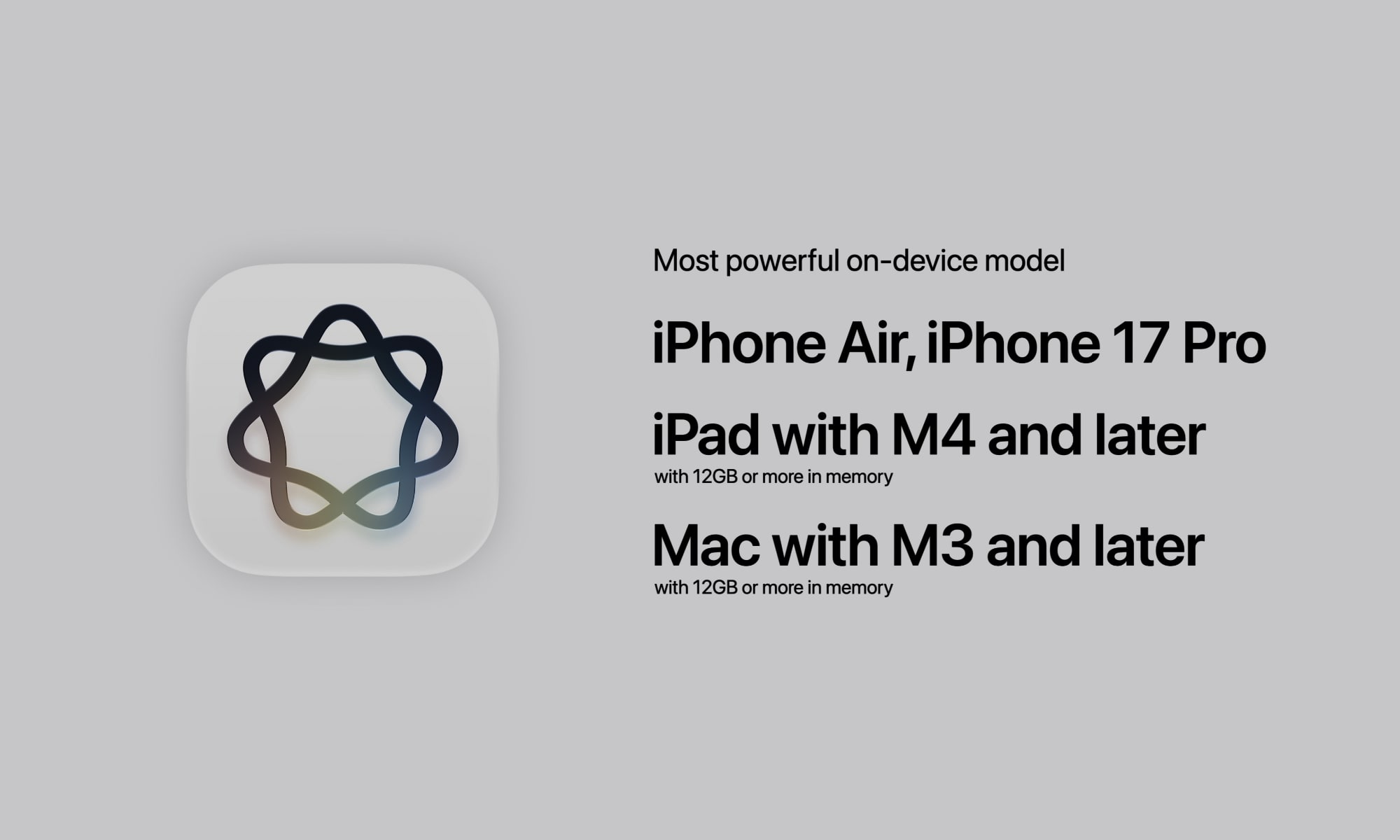
However, he never actually said that; the slide listed the minimum requirements based on existing hardware configurations, and there’s never been anything in the middle ground between 8 GB and 12 GB in any of Apple’s A-series or M-series chips.
In other words, when Apple says “with 12GB or more in memory” on that slide, it doesn’t necessarily mean those models require a full 12 GB of RAM — it just means that 8 GB is definitely not sufficient.
We’ll have to wait and see what happens, but 9 GB is a weird enough RAM configuration that Apple’s decision to go with that in the A20 — assuming it’s accurate — implies that an extra 1 GB of RAM could be just enough to give its “AFM 3 Core Advanced Model” — the one that can scale up to 20 billion parameters and handles expressive voices and higher-accuracy dictation — enough breathing room to do its thing.