Who Will Really Run ‘Siri 2.0’ Behind the Scenes?
Toggle Dark Mode
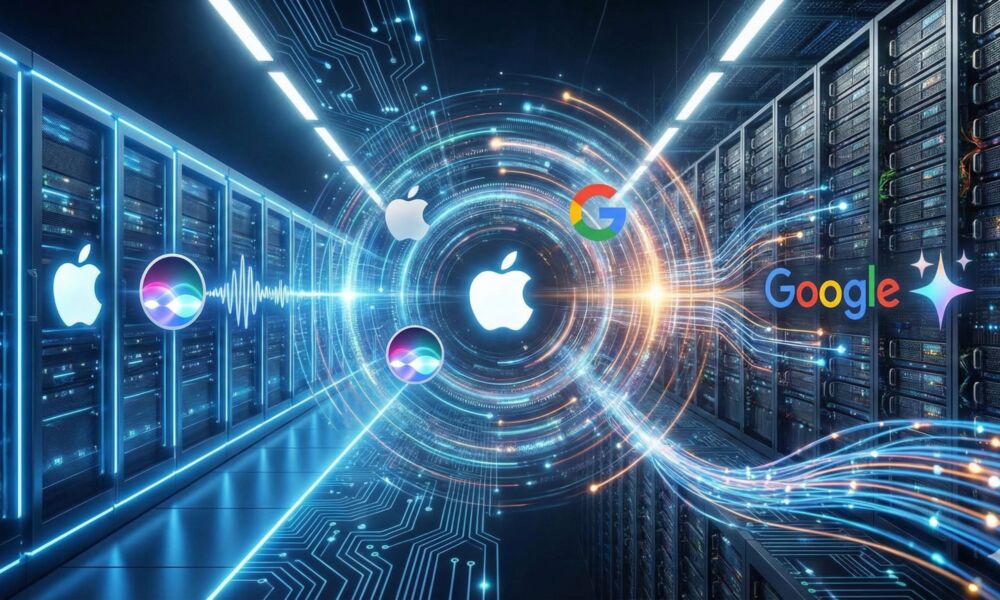
A recent statement from Google CEO Sundar Pichai has cast some doubt on whether Apple’s upcoming Gemini-powered Siri will truly remain within the Cupertino company’s infrastructure or be farmed out to Google’s servers. However, as always, the truth may be somewhere in the middle.
To say that Apple and Google have been somewhat coy since announcing their groundbreaking partnership last month to power the new “Siri 2.0” would be an understatement. Beyond a brief joint statement and a few evasive comments from both CEOs, we still don’t have a clear picture of the bigger plan.
The new deal was one of the hottest topics during last week’s quarterly earnings call, Apple CEO Tim Cook naturally dodged questions about the financial details of the partnership during the company’s quarterly earnings call last week, offering mostly vague boilerplate responses.
However, one thing Cook did reiterate was that Apple’s plans for the next-generation of Siri wouldn’t compromise on privacy. “We will continue to run on the device and run in private cloud compute,” Cook said, “And maintain our industry-leading standards in doing so.”
That gelled with what the initial joint announcement had said, specifically that “Apple Intelligence will continue to run on Apple devices and Private Cloud Compute, while maintaining Apple’s industry-leading privacy standards,” but the waters got muddied when Google CEO Sundar Pichai and appeared to be reading from a different song sheet yesterday.
During Google parent company Alphabet’s Q4 2025 earnings call, Pichai referred to his company as Apple’s “preferred cloud provider.”
I’m pleased that we are collaborating with Apple as their preferred Cloud provider and to develop the next generation of Apple Foundation Models, based on Gemini technology
Sundar Pichai
This phrasing was echoed verbatim by Chief Business Officer Philipp Schindler a few moments later, suggesting it was more carefully-crafted PR-speak. It’s also interesting that “preferred” was used here rather than “exclusive,” which not only leaves the door open to Apple arranging other partnerships, but also avoids potential problems from the US Justice Department.
While “cloud provider” can be read a few different ways, many took this to mean that Apple’s collaboration with Google would result in Siri being hosted on Google’s servers, potentially placing it outside of Apple’s direct control and raising privacy concerns.
Of course, a deal where Apple “leases” more powerful AI servers from Google doesn’t necessarily mean that Google will have any of its fingers directly in Siri. After all, Apple already securely stores exabytes of iCloud data on Google infrastructure, all fully encrypted in such a way that only Apple and its users can read it.
Still, Apple made a lot of noise in 2024 about how its Private Cloud Compute (PCC) architecture was designed with strong privacy protections at its core. These were hardened servers with no persistent storage, designed in such a way that even the most skilled Apple engineers couldn’t extract data from them if they tried. Even if Apple leases “bare metal” AI servers from Google to run its own Apple Foundation Models based on Gemini, it’s unlikely they’ll be built to the same high privacy standards as Apple’s PCC servers. If Siri moves to Google Cloud, Apple may have a lot of explaining to do on how Google’s servers will meet its same privacy standards.
So, Which Is It?
While neither Cook nor Pichai have offered enough concrete information to come to any firm conclusions, additional insider context provided by Bloomberg’s Mark Gurman gives us a few more lines to read between.
Gurman has been following the Apple-Google deal since last summer when it was still up in the air, but in a more recent report after the collaboration was announced, he noted that Apple may very well have plans to run Siri on Google’s more powerful AI servers — but not right away.
The first wave of Siri improvements are expected to arrive in the coming weeks when the first iOS 26.4 beta shows up. These are the ones that will fulfill the promises Apple made during its June 2024 Worldwide Developers Conference (WWDC) keynote.
These short-term Siri improvements are expected to be based on Apple Foundation Models (AFM) version 10, a 1.2 trillion parameter version of Google’s AI models that represents an 8x jump over the in-house models that Apple has been building over the past two years. These will reportedly be hosted on Apple’s Private Cloud Compute Infrastructure.

However, Gurman says there’s a bigger “Siri 3.0” on the horizon for iOS 27. Code-named “Campos,” this will turn the dial up to version 11 for a more conversational, chatbot-like Siri. Sources say that Apple has at least been considering hosting Campos directly on Google’s servers, but it’s still much more likely Apple is looking to host or lease Google-built servers with their tensor processing units (TPUs), rather than mixing Siri into Google’s own AI farms.
In other words, one possibility is that Cook is talking about the shorter-term plan for iOS 26.4, while Pichai is looking at where Apple may end up with iOS 27 and beyond. However, it’s also possible that Cook is playing semantic games here by considering “Apple Intelligence” and “Siri” to be two entirely different things, as Gurman suggested yesterday.
That would allow Cook to honestly say that Apple Foundation Models will “continue to run on the device and run in private cloud compute,” despite the fact that, as Gurman claims, “Apple is using Google Cloud for the chat Siri in the fall.” That latest tweet from Gurman sounds more definitive, although he only links to his January article where he said the two companies were “discussing hosting the chatbot directly on Google servers,” implying that a final decision has yet to be made.
It’s telling that Google is projecting a massive jump in capital expenditures for 2026 to the tune of $175 to $185 billion — twice as much as it spent in 2025. Some analysts have suggested this might be to build on the new capacity Apple will need to launch Siri 3.0 later this year, especially after Alphabet CFO Anat Ashkenazi confirmed that half of Google’s machine learning compute for the year is expected to go toward its cloud business — capacity that’s being explicitly built for use by other companies like Apple.
Either way, it may still be a while before we get any clearer answer to this. While Apple is expected to hold a Siri launch event later this month, there’s a good chance that will be all about the iOS 26.4 improvements, which everyone agrees will remain firmly on Apple’s own infrastructure.
If things go according to plan, Apple may show off Campos at this year’s WWDC in June, but even if that happens, it’s an open question how much they’ll be revealing about the plumbing underneath. Still, comments Pichai made during the earnings call about “planning for the long-term” strongly suggests the Apple-Google marriage isn’t a one-off for 2025, but a multi-year shift in how Siri will function.