Apple is Blocking Carrier Tracking in iOS 26.3 — But Only on These iPhones
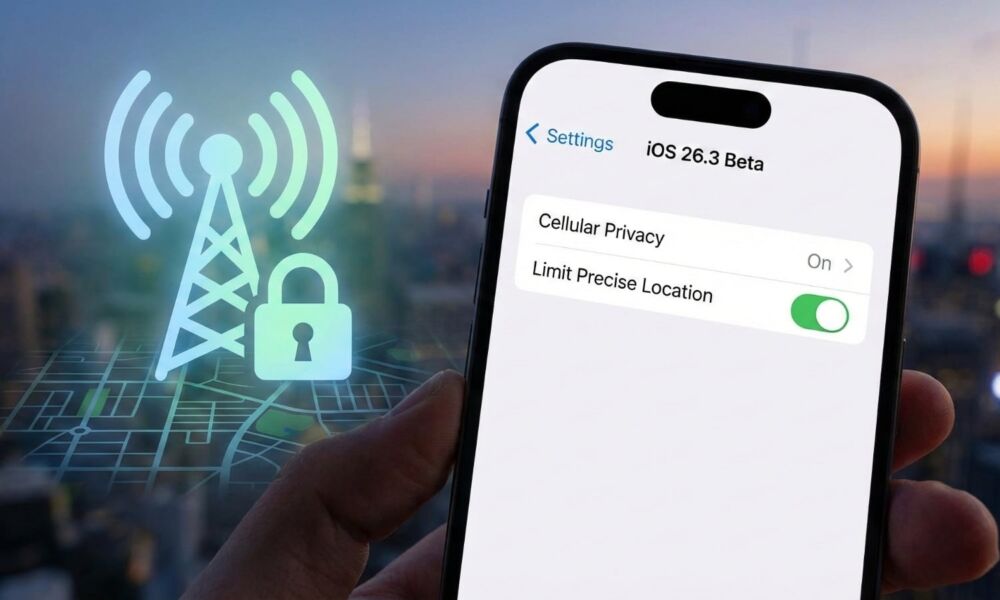 Concept Image [iDrop News / AI]
Toggle Dark Mode
Yesterday, Apple pushed out the third beta of iOS 26.3 to developers, and while not much has changed from when the first beta arrived in December (which wasn’t all that exciting to begin with), there is one interesting new privacy feature tucked into the upcoming point release.
It’s unclear if this was just introduced in the third beta, but Apple quietly published a support document yesterday that describes a new setting that will help protect your privacy from your cellular carrier.

The feature is labelled “Limit Precise Location.” It’s akin to the broader “Precise Location” setting that Apple added to iOS 14 five years ago to restrict apps to only determining your approximate neighbourhood rather than your specific coordinates. However, this one is even more useful as it prevents your carrier from tracking you based on their usual cellular triangulation methods.
Cellular networks can determine your location based on which cell towers your device connects to. The limit precise location setting enhances your location privacy by reducing the precision of location data available to cellular networks.
Apple
The new “Limit Precise Location” setting can be found in the Settings app under Cellular > Cellular Data Options, but don’t worry if you can’t see it even after you’ve updated to iOS 26.3, as it’s only available on a handful of devices — and a small number of carriers.
Specifically, it requires an iPhone Air, iPhone 16e, or cellular M5 iPad Pro. That’s because these are the only three devices (so far) that use Apple’s in-house modem chips, the C1 and C1X. Presumably, Apple can’t control what the Qualcomm chips used in other iPhone models send out to the cellular network, so even the iPhone 17 models aren’t on this list, but as Apple expands its C-series chips to more devices, they’ll almost certainly be included. It goes to show that Apple’s strategy to moving its chips in-house isn’t just about the supply chain; total control over the silicon is also the only way to achieve total control over the privacy.
Perhaps more interestingly, it’s also only enabled if you’re using one of six carriers: Boost Mobile in the United States, EE and BT in the UK, Telekom Germany, and AIS and True in Thailand. Presumably there’s something unique about these carriers, but it’s unclear whether they’ve made some type of pact with Apple or if they merely support whatever technology is needed to provide less accurate location information. We’re hoping this is just a preliminary list, and it will soon roll out to additional carriers, but we’ll have to wait and see.
For those iPhones where the setting is available, it’s paired with “Limit IP Address Tracking,” a feature of iCloud Private Relay that prevents your location and identify from being tracked by the websites you visit and online apps you use. However, “Limit Precise Location” is more about restricting what your carrier can see by limiting the information shared with the cellular network to the minimum required.
Apple affirms that this won’t affect signal quality or the user experience, nor does it impact the precision of location data shared with emergency responders during a call. It’s also solely for the cellular network, and has nothing to do with sharing your location with friends and family or locating your lost iPhone using Find My, or sharing data with third-party apps through Location Services.
The limited device and carrier support makes this an incredibly niche feature right now, but as the old adage goes, the journey of a thousand miles starts with a few steps, and the fact that Apple is kicking off this initiative seemingly points to a day when all iPhones will be harder for carriers to precisely track, improving everyone’s privacy.